In Exercises 47–52, write the vector v in terms of i and j whose magnitude ||v|| and direction angle θ are given. ||v|| = 6, θ = 30°
Table of contents
- 0. Review of College Algebra4h 43m
- 1. Measuring Angles40m
- 2. Trigonometric Functions on Right Triangles2h 5m
- 3. Unit Circle1h 19m
- 4. Graphing Trigonometric Functions1h 19m
- 5. Inverse Trigonometric Functions and Basic Trigonometric Equations1h 41m
- 6. Trigonometric Identities and More Equations2h 34m
- 7. Non-Right Triangles1h 38m
- 8. Vectors2h 25m
- 9. Polar Equations2h 5m
- 10. Parametric Equations1h 6m
- 11. Graphing Complex Numbers1h 7m
- OLD 1. Angles and the Trigonometric Functions Coming soon
- OLD 2. Trigonometric Functions graphs, Inverse Trigonometric Functions Coming soon
- OLD 3. Trigonometric Identities and Equations Coming soon
- OLD 4. Laws of Sines, Cosines and Vectors Coming soon
- OLD 5. Complex Numbers, Polar Coordinates and Parametric Equations Coming soon
- NEW (not used) 7. Laws of Sines, Cosines and Vectors Coming soon
- NEW (not used) 8. Vectors Coming soon
- NEW(not used) 9. Polar equations Coming soon
- NEW (not used) 11. Graphing Complex Numbers Coming soon
8. Vectors
Geometric Vectors
Problem 41
Textbook Question
In Exercises 39–46, find the unit vector that has the same direction as the vector v.
v = 3i - 4j
Verified step by step guidance1
Identify the given vector \( \mathbf{v} = 3\mathbf{i} - 4\mathbf{j} \). This means the vector components are \( v_x = 3 \) and \( v_y = -4 \).
Calculate the magnitude (length) of the vector \( \mathbf{v} \) using the formula:
\[ \text{magnitude} = ||\mathbf{v}|| = \sqrt{v_x^2 + v_y^2} \]
Substitute the components to get:
\[ ||\mathbf{v}|| = \sqrt{3^2 + (-4)^2} \]
Simplify the expression inside the square root to find the magnitude, but do not calculate the final numeric value yet.
To find the unit vector \( \mathbf{u} \) in the same direction as \( \mathbf{v} \), divide each component of \( \mathbf{v} \) by its magnitude:
\[ \mathbf{u} = \left( \frac{v_x}{||\mathbf{v}||}, \frac{v_y}{||\mathbf{v}||} \right) \]
Write the unit vector explicitly as:
\[ \mathbf{u} = \frac{1}{||\mathbf{v}||} (3\mathbf{i} - 4\mathbf{j}) \]
This expresses the unit vector in the same direction as \( \mathbf{v} \).
Verified video answer for a similar problem:This video solution was recommended by our tutors as helpful for the problem above
Video duration:
2mPlay a video:
0 Comments
Key Concepts
Here are the essential concepts you must grasp in order to answer the question correctly.
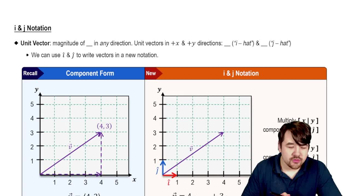
Vector Components and Notation
A vector in two dimensions is expressed in terms of its components along the x and y axes, often written as v = ai + bj, where i and j are unit vectors in the x and y directions. Understanding this notation helps in identifying the vector's direction and magnitude.
Recommended video:
i & j Notation
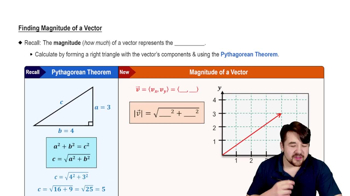
Magnitude of a Vector
The magnitude (or length) of a vector v = ai + bj is found using the Pythagorean theorem: |v| = √(a² + b²). This scalar value represents the distance from the origin to the point (a, b) and is essential for normalizing the vector.
Recommended video:
Finding Magnitude of a Vector
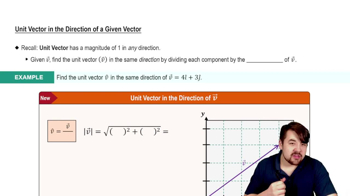
Unit Vector and Normalization
A unit vector has a magnitude of 1 and points in the same direction as the original vector. To find it, divide each component of the vector by its magnitude, resulting in a vector of length one that preserves the original direction.
Recommended video:
Unit Vector in the Direction of a Given Vector
Related Videos
Related Practice
Textbook Question