Use the given information to find the exact value of each of the following:
Verified step by step guidance
1
Identify the given information: \(\sin \theta = \frac{12}{13}\) and \(\theta\) lies in quadrant II. Recall that in quadrant II, sine is positive and cosine is negative.
Use the Pythagorean identity to find \(\cos \theta\). Since \(\sin^2 \theta + \cos^2 \theta = 1\), substitute \(\sin \theta = \frac{12}{13}\) to get \(\cos^2 \theta = 1 - \left(\frac{12}{13}\right)^2\).
Calculate \(\cos \theta\) by taking the square root of \(\cos^2 \theta\). Because \(\theta\) is in quadrant II, \(\cos \theta\) must be negative, so choose the negative root.
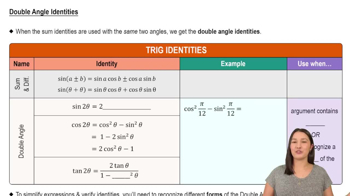
Recall the double-angle formula for tangent: \(\tan 2\theta = \frac{2 \tan \theta}{1 - \tan^2 \theta}\). To use this, first find \(\tan \theta = \frac{\sin \theta}{\cos \theta}\) using the values found.
Substitute \(\tan \theta\) into the double-angle formula to express \(\tan 2\theta\) in terms of known values, and simplify the expression to find the exact value.
Verified video answer for a similar problem:
This video solution was recommended by our tutors as helpful for the problem above
Video duration:
9m
Play a video:
0 Comments
Key Concepts
Here are the essential concepts you must grasp in order to answer the question correctly.
Trigonometric Ratios and Their Definitions
Trigonometric ratios relate the angles of a right triangle to the ratios of its sides. For an angle θ, sine (sin θ) is the ratio of the opposite side to the hypotenuse, cosine (cos θ) is adjacent over hypotenuse, and tangent (tan θ) is opposite over adjacent. Understanding these definitions is essential to find missing values when one ratio is given.
Sign of Trigonometric Functions in Different Quadrants
The sign of sine, cosine, and tangent depends on the quadrant where the angle lies. In quadrant II, sine is positive, cosine is negative, and tangent is negative. This knowledge helps determine the correct sign of the trigonometric values when calculating exact values for angles in specific quadrants.
The double-angle identity for tangent states that tan 2θ = (2 tan θ) / (1 - tan² θ). This formula allows calculation of the tangent of twice an angle using the tangent of the original angle. Applying this identity requires first finding tan θ from the given sin θ and then substituting into the formula.