Give the exact value of each expression. See Example 5. cos 30°
Verified step by step guidance
1
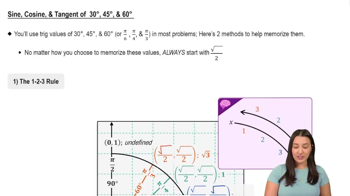
Recall that 30° is one of the special angles in trigonometry, and its cosine value is well-known from the unit circle or special right triangles.
Recognize that the cosine of 30° corresponds to the adjacent side over the hypotenuse in a 30°-60°-90° right triangle.
In a 30°-60°-90° triangle, the sides are in the ratio 1 (opposite 30°) : \(\sqrt{3}\) (adjacent 30°) : 2 (hypotenuse).
Therefore, the cosine of 30° is the length of the adjacent side over the hypotenuse, which can be written as \(\cos 30^\circ = \frac{\sqrt{3}}{2}\).
Write down the exact value using the simplified radical form without decimal approximation.
Verified video answer for a similar problem:
This video solution was recommended by our tutors as helpful for the problem above
Video duration:
1m
Play a video:
0 Comments
Key Concepts
Here are the essential concepts you must grasp in order to answer the question correctly.
Unit Circle and Special Angles
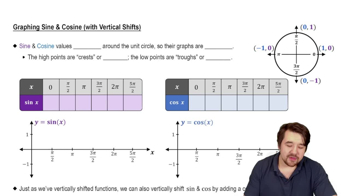
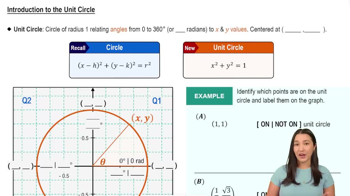
The unit circle is a circle with radius 1 centered at the origin, used to define trigonometric functions for all angles. Special angles like 30°, 45°, and 60° have well-known sine and cosine values derived from equilateral and right triangles, which help in finding exact trigonometric values.
Cosine of an angle in a right triangle is the ratio of the adjacent side to the hypotenuse. On the unit circle, cosine corresponds to the x-coordinate of the point where the terminal side of the angle intersects the circle, allowing exact values to be determined for standard angles.
The exact value of cos 30° is derived from the 30°-60°-90° triangle, where the sides are in the ratio 1:√3:2. Cos 30° equals √3/2, representing the adjacent side over the hypotenuse, providing a precise, simplified radical form rather than a decimal approximation.

 1:36 minutes
 Verified step by step guidance
 06:11
06:11