In Exercises 13–34, test for symmetry and then graph each polar equation.r = 2 + 2 cos θ
Verified step by step guidance
1
Identify the type of symmetry to test: polar equations can have symmetry with respect to the polar axis (x-axis), the line θ = π/2 (y-axis), or the pole (origin).
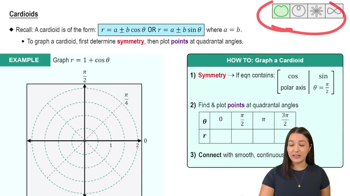
Test for symmetry with respect to the polar axis by replacing θ with -θ in the equation: r = 2 + 2 \(\cos\)(-θ). Since \(\cos\)(-θ) = \(\cos\)(θ), the equation remains unchanged, indicating symmetry with respect to the polar axis.
Test for symmetry with respect to the line θ = π/2 by replacing θ with π - θ: r = 2 + 2 \(\cos\)(π - θ). Since \(\cos\)(π - θ) = -\(\cos\)(θ), the equation changes, indicating no symmetry with respect to the line θ = π/2.
Test for symmetry with respect to the pole by replacing r with -r: -r = 2 + 2 \(\cos\)(θ). This does not simplify to the original equation, indicating no symmetry with respect to the pole.
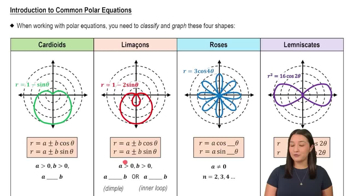
Graph the equation by plotting points for various values of θ, using the symmetry with respect to the polar axis to simplify the process. The graph will be a limaçon with an inner loop.
Verified video answer for a similar problem:
This video solution was recommended by our tutors as helpful for the problem above
Video duration:
4m
Play a video:
0 Comments
Key Concepts
Here are the essential concepts you must grasp in order to answer the question correctly.
Polar Coordinates
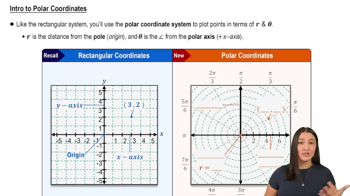
Polar coordinates represent points in a plane using a distance from a reference point (the pole) and an angle from a reference direction. In polar equations, 'r' denotes the radius (distance from the origin), and 'θ' represents the angle. Understanding how to convert between polar and Cartesian coordinates is essential for graphing polar equations.
Symmetry in polar graphs can be tested by substituting specific values for θ. A graph is symmetric about the polar axis if replacing θ with -θ yields the same equation, and it is symmetric about the line θ = π/2 if replacing θ with π - θ gives the same result. Recognizing these symmetries helps in sketching the graph accurately.
Graphing polar equations involves plotting points based on the values of 'r' for various angles 'θ'. The shape of the graph can vary significantly depending on the equation's form. For the equation r = 2 + 2 cos θ, understanding how to evaluate 'r' at key angles (like 0, π/2, π, and 3π/2) is crucial for accurately depicting the graph.

 4:50 minutes
 Verified step by step guidance
 05:32
05:32