CONCEPT PREVIEW Fill in the blank(s) to correctly complete each sentence. Given tan θ = 1/cot θ , two equivalent forms of this identity are cot θ = 1/______ and tan θ . ______ = 1 .
Table of contents
- 0. Review of College Algebra4h 43m
- 1. Measuring Angles40m
- 2. Trigonometric Functions on Right Triangles2h 5m
- 3. Unit Circle1h 19m
- 4. Graphing Trigonometric Functions1h 19m
- 5. Inverse Trigonometric Functions and Basic Trigonometric Equations1h 41m
- 6. Trigonometric Identities and More Equations2h 34m
- 7. Non-Right Triangles1h 38m
- 8. Vectors2h 25m
- 9. Polar Equations2h 5m
- 10. Parametric Equations1h 6m
- 11. Graphing Complex Numbers1h 7m
- OLD 1. Angles and the Trigonometric Functions Coming soon
- OLD 2. Trigonometric Functions graphs, Inverse Trigonometric Functions Coming soon
- OLD 3. Trigonometric Identities and Equations Coming soon
- OLD 4. Laws of Sines, Cosines and Vectors Coming soon
- OLD 5. Complex Numbers, Polar Coordinates and Parametric Equations Coming soon
- NEW (not used) 7. Laws of Sines, Cosines and Vectors Coming soon
- NEW (not used) 8. Vectors Coming soon
- NEW(not used) 9. Polar equations Coming soon
- NEW (not used) 11. Graphing Complex Numbers Coming soon
2. Trigonometric Functions on Right Triangles
Trigonometric Functions on Right Triangles
Problem 10
Textbook Question
CONCEPT PREVIEW Determine whether each statement is possible or impossible. sin² θ + cos² θ = 2
Verified step by step guidance1
Recall the Pythagorean identity in trigonometry, which states that for any angle \( \theta \), the following equation holds:
\[ \sin^{2} \theta + \cos^{2} \theta = 1 \]
Understand that \( \sin^{2} \theta \) means \( (\sin \theta)^{2} \) and similarly for \( \cos^{2} \theta \). Both sine and cosine values range between -1 and 1, so their squares range between 0 and 1.
Since both \( \sin^{2} \theta \) and \( \cos^{2} \theta \) are non-negative and their sum is always exactly 1, check if the given statement \( \sin^{2} \theta + \cos^{2} \theta = 2 \) can ever be true.
Consider the maximum possible values of \( \sin^{2} \theta \) and \( \cos^{2} \theta \). The maximum value for each is 1, but since they are complementary in the identity, their sum cannot exceed 1.
Conclude that the statement \( \sin^{2} \theta + \cos^{2} \theta = 2 \) is impossible because it contradicts the fundamental Pythagorean identity.
Verified video answer for a similar problem:This video solution was recommended by our tutors as helpful for the problem above
Video duration:
54sPlay a video:
0 Comments
Key Concepts
Here are the essential concepts you must grasp in order to answer the question correctly.
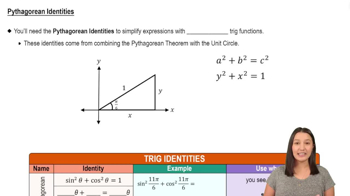
Pythagorean Identity
The Pythagorean identity states that for any angle θ, sin²θ + cos²θ = 1. This fundamental trigonometric identity is derived from the Pythagorean theorem and holds true for all real values of θ.
Recommended video:
Pythagorean Identities
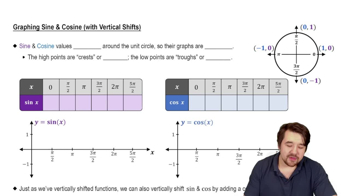
Range of Sine and Cosine Functions
The sine and cosine functions each have values ranging between -1 and 1. Consequently, their squares, sin²θ and cos²θ, range from 0 to 1, which restricts the possible sums of these squares.
Recommended video:
Graph of Sine and Cosine Function
Evaluating the Possibility of a Statement
To determine if a trigonometric statement is possible, compare it against known identities and function ranges. Since sin²θ + cos²θ always equals 1, the statement sin²θ + cos²θ = 2 is impossible.
Recommended video:
Evaluate Composite Functions - Values Not on Unit Circle
Related Videos
Related Practice
Textbook Question
1
views