Solve each quadratic equation using the square root property. See Example 6. (3x - 1)² = 12
Table of contents
- 0. Review of College Algebra4h 43m
- 1. Measuring Angles40m
- 2. Trigonometric Functions on Right Triangles2h 5m
- 3. Unit Circle1h 19m
- 4. Graphing Trigonometric Functions1h 19m
- 5. Inverse Trigonometric Functions and Basic Trigonometric Equations1h 41m
- 6. Trigonometric Identities and More Equations2h 34m
- 7. Non-Right Triangles1h 38m
- 8. Vectors2h 25m
- 9. Polar Equations2h 5m
- 10. Parametric Equations1h 6m
- 11. Graphing Complex Numbers1h 7m
- OLD 1. Angles and the Trigonometric Functions Coming soon
- OLD 2. Trigonometric Functions graphs, Inverse Trigonometric Functions Coming soon
- OLD 3. Trigonometric Identities and Equations Coming soon
- OLD 4. Laws of Sines, Cosines and Vectors Coming soon
- OLD 5. Complex Numbers, Polar Coordinates and Parametric Equations Coming soon
- NEW (not used) 7. Laws of Sines, Cosines and Vectors Coming soon
- NEW (not used) 8. Vectors Coming soon
- NEW(not used) 9. Polar equations Coming soon
- NEW (not used) 11. Graphing Complex Numbers Coming soon
0. Review of College Algebra
Solving Quadratic Equations
Problem R.6.65
Textbook Question
Solve each quadratic equation using the quadratic formula. See Example 7. x² - 6x = -7
Verified step by step guidance1
Rewrite the quadratic equation in standard form \(ax^2 + bx + c = 0\). For the given equation \(x^2 - 6x = -7\), add 7 to both sides to get \(x^2 - 6x + 7 = 0\).
Identify the coefficients \(a\), \(b\), and \(c\) from the standard form. Here, \(a = 1\), \(b = -6\), and \(c = 7\).
Recall the quadratic formula: \(x = \frac{-b \pm \sqrt{b^2 - 4ac}}{2a}\). This formula gives the solutions to any quadratic equation.
Substitute the values of \(a\), \(b\), and \(c\) into the quadratic formula: \(x = \frac{-(-6) \pm \sqrt{(-6)^2 - 4 \times 1 \times 7}}{2 \times 1}\).
Simplify inside the square root and the numerator step-by-step to find the two possible values of \(x\).
Verified video answer for a similar problem:This video solution was recommended by our tutors as helpful for the problem above
Video duration:
5mPlay a video:
0 Comments
Key Concepts
Here are the essential concepts you must grasp in order to answer the question correctly.
Quadratic Equation Standard Form
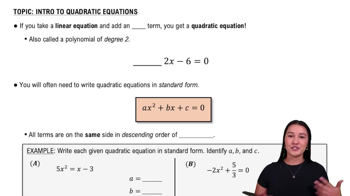
A quadratic equation is typically written in the standard form ax² + bx + c = 0, where a, b, and c are constants and a ≠ 0. To apply the quadratic formula, the equation must first be rearranged into this form by moving all terms to one side.
Recommended video:
Introduction to Quadratic Equations
Quadratic Formula
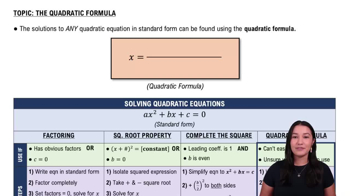
The quadratic formula x = (-b ± √(b² - 4ac)) / (2a) provides the solutions to any quadratic equation in standard form. It uses the coefficients a, b, and c to find the roots, including real and complex solutions depending on the discriminant.
Recommended video:
Quadratic Formula
Discriminant and Nature of Roots
The discriminant, given by b² - 4ac, determines the nature of the roots of a quadratic equation. If positive, there are two distinct real roots; if zero, one real root; and if negative, two complex conjugate roots.
Recommended video:
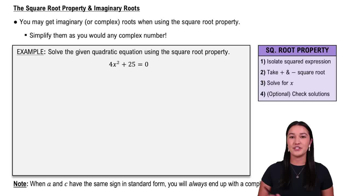
Imaginary Roots with the Square Root Property
Related Videos
Related Practice
Textbook Question