In Exercises 49–58, convert each rectangular equation to a polar equation that expresses r in terms of θ. (x − 2)² + y² = 4
Table of contents
- 0. Review of College Algebra4h 43m
- 1. Measuring Angles40m
- 2. Trigonometric Functions on Right Triangles2h 5m
- 3. Unit Circle1h 19m
- 4. Graphing Trigonometric Functions1h 19m
- 5. Inverse Trigonometric Functions and Basic Trigonometric Equations1h 41m
- 6. Trigonometric Identities and More Equations2h 34m
- 7. Non-Right Triangles1h 38m
- 8. Vectors2h 25m
- 9. Polar Equations2h 5m
- 10. Parametric Equations1h 6m
- 11. Graphing Complex Numbers1h 7m
- OLD 1. Angles and the Trigonometric Functions Coming soon
- OLD 2. Trigonometric Functions graphs, Inverse Trigonometric Functions Coming soon
- OLD 3. Trigonometric Identities and Equations Coming soon
- OLD 4. Laws of Sines, Cosines and Vectors Coming soon
- OLD 5. Complex Numbers, Polar Coordinates and Parametric Equations Coming soon
- NEW (not used) 7. Laws of Sines, Cosines and Vectors Coming soon
- NEW (not used) 8. Vectors Coming soon
- NEW(not used) 9. Polar equations Coming soon
- NEW (not used) 11. Graphing Complex Numbers Coming soon
9. Polar Equations
Convert Equations Between Polar and Rectangular Forms
Problem 5.3.65
Textbook Question
In Exercises 59–74, convert each polar equation to a rectangular equation. Then use a rectangular coordinate system to graph the rectangular equation. r = 4 csc θ
Verified step by step guidance1
Recall the relationship between polar and rectangular coordinates: \(x = r \cos \theta\) and \(y = r \sin \theta\). Also, \(r = \sqrt{x^2 + y^2}\).
Given the polar equation \(r = 4 \csc \theta\), rewrite \(\csc \theta\) in terms of sine: \(\csc \theta = \frac{1}{\sin \theta}\), so the equation becomes \(r = \frac{4}{\sin \theta}\).
Multiply both sides of the equation by \(\sin \theta\) to get \(r \sin \theta = 4\).
Substitute \(r \sin \theta\) with \(y\) (from the coordinate relationships), resulting in the rectangular equation \(y = 4\).
Interpret the rectangular equation \(y = 4\) as a horizontal line crossing the y-axis at 4, which can be graphed on the rectangular coordinate system.
Verified video answer for a similar problem:This video solution was recommended by our tutors as helpful for the problem above
Video duration:
1mPlay a video:
0 Comments
Key Concepts
Here are the essential concepts you must grasp in order to answer the question correctly.
Polar and Rectangular Coordinate Systems
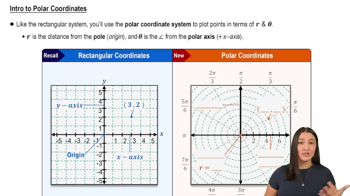
Polar coordinates represent points using a radius and an angle (r, θ), while rectangular coordinates use (x, y) positions on a plane. Understanding how these systems relate is essential for converting equations and graphing accurately.
Recommended video:
Intro to Polar Coordinates
Conversion Formulas Between Polar and Rectangular Coordinates
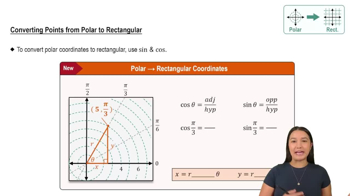
Key formulas include x = r cos θ, y = r sin θ, r² = x² + y², and tan θ = y/x. These allow transformation of polar equations into rectangular form by substituting r and θ with expressions involving x and y.
Recommended video:
Convert Points from Polar to Rectangular
Trigonometric Functions and Their Reciprocal Identities
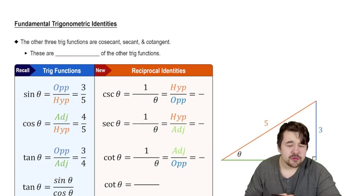
The cosecant function, csc θ, is the reciprocal of sin θ (csc θ = 1/sin θ). Recognizing this helps rewrite the given polar equation r = 4 csc θ in terms of sine, facilitating substitution and conversion to rectangular coordinates.
Recommended video:
Fundamental Trigonometric Identities
Related Videos
Related Practice
Textbook Question
7
views