Ch. 4 - Laws of Sines and Cosines; Vectors
Blitzer - Trigonometry 3rd Edition
Blitzer3rd EditionTrigonometryISBN: 9780137316601Not the one you use?Change textbook
Chapter 4, Problem 46

In Exercises 45–46, find the area of the triangle with the given vertices. Round to the nearest square unit. (-2, -3), (-2, 2), (2, 1)

Verified step by step guidance
1
Identify the coordinates of the vertices of the triangle: \(A(-2, -3)\), \(B(-2, 2)\), and \(C(2, 1)\).
Use the formula for the area of a triangle given coordinates \(A(x_1, y_1)\), \(B(x_2, y_2)\), and \(C(x_3, y_3)\): \(\text{Area} = \frac{1}{2} \left| x_1(y_2 - y_3) + x_2(y_3 - y_1) + x_3(y_1 - y_2) \right|\)
Substitute the coordinates into the formula: \(\text{Area} = \frac{1}{2} \left| (-2)(2 - 1) + (-2)(1 - (-3)) + 2((-3) - 2) \right|\)
Simplify the expression inside the absolute value by performing the operations inside the parentheses and then the multiplications.
Calculate the absolute value of the simplified expression, multiply by \(\frac{1}{2}\), and then round the result to the nearest whole number to find the area of the triangle.

Verified video answer for a similar problem:

This video solution was recommended by our tutors as helpful for the problem above.
Video duration:
5m
Was this helpful?

Key Concepts

Here are the essential concepts you must grasp in order to answer the question correctly.

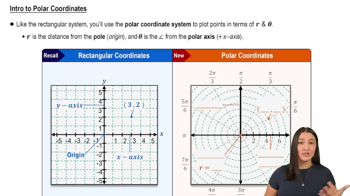
Coordinate Geometry and Triangles

Understanding how to represent points in the coordinate plane is essential. Each vertex of the triangle is given as an (x, y) coordinate, which allows the use of algebraic methods to calculate distances, slopes, and areas.
Recommended video:
05:32
Intro to Polar Coordinates

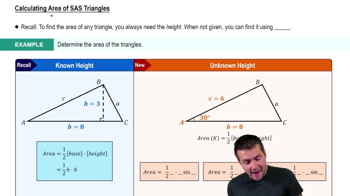
Area of a Triangle Using Coordinates

The area of a triangle with vertices at coordinates can be found using the formula: Area = 1/2 |x1(y2 - y3) + x2(y3 - y1) + x3(y1 - y2)|. This formula uses the determinant method to calculate the absolute value of the signed area.
Recommended video:
4:02
Calculating Area of SAS Triangles

Rounding and Approximation

After calculating the exact area, rounding to the nearest square unit is necessary. This involves understanding decimal values and applying standard rounding rules to present the final answer in a simplified, practical form.
Recommended video:
4:45
How to Use a Calculator for Trig Functions