Determine the intervals of the domain over which each function is continuous. See Example 9.
Verified step by step guidance
1
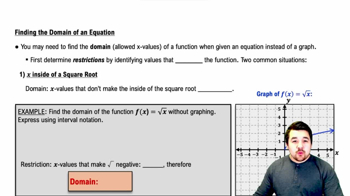
Identify the given function and its domain. Understanding the type of function (polynomial, rational, trigonometric, piecewise, etc.) is crucial because continuity depends on the function's nature and domain restrictions.
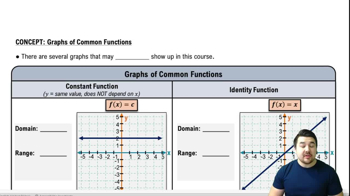
Recall that polynomial and trigonometric functions are continuous everywhere on their domains, while rational functions may have discontinuities where the denominator is zero.
For rational functions, find the values of the variable that make the denominator zero by solving the equation where the denominator equals zero. These points are potential discontinuities.
For piecewise functions, check the continuity at the boundary points between pieces by evaluating the left-hand limit, right-hand limit, and the function value at those points to ensure they are equal.
Combine all the information to write the intervals where the function is continuous, excluding points where discontinuities occur (such as zeros of denominators or jump points in piecewise functions).
Verified video answer for a similar problem:
This video solution was recommended by our tutors as helpful for the problem above
Video duration:
2m
Play a video:
0 Comments
Key Concepts
Here are the essential concepts you must grasp in order to answer the question correctly.
Continuity of a Function
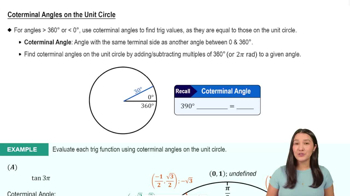
A function is continuous at a point if the limit of the function as it approaches that point equals the function's value there. For trigonometric functions, continuity generally holds except at points where the function is undefined, such as vertical asymptotes.
The domain of a trigonometric function includes all input values for which the function is defined. For example, sine and cosine are defined for all real numbers, while tangent and secant are undefined where cosine is zero, causing discontinuities.
Discontinuities occur where a function is not defined or where limits do not match function values. In trigonometry, these often arise at points causing division by zero, such as vertical asymptotes in tangent or cotangent functions, which segment the domain into continuous intervals.

 2:16 minutes
 Verified step by step guidance
 5:57
5:57