For each expression in Column I, choose the expression from Column II that completes an identity. One or both expressions may need to be rewritten. cos² x
II A. sin ^2 x/cos ^2 x B.1/(sec ^2 x) C. sin (-x) D. csc ^2 x-cot ^2 x + sin ^2 x E. tan x
Verified step by step guidance
1
Recall the Pythagorean identity in trigonometry: \(\cos^{2} x + \sin^{2} x = 1\).
From this identity, express \(\cos^{2} x\) in terms of \(\sin^{2} x\) by rearranging the equation: \(\cos^{2} x = 1 - \sin^{2} x\).
Recognize that sometimes expressions in Column II might be written differently, such as \(1 - \sin^{2} x\) or other equivalent forms.
Check if the expression in Column II matches \(1 - \sin^{2} x\) or can be rewritten to this form to complete the identity with \(\cos^{2} x\).
Confirm that rewriting expressions using fundamental identities like the Pythagorean identity helps in matching equivalent expressions and completing the identity.
Verified video answer for a similar problem:
This video solution was recommended by our tutors as helpful for the problem above
Play a video:
0 Comments
Key Concepts
Here are the essential concepts you must grasp in order to answer the question correctly.
Pythagorean Identities
Pythagorean identities relate the squares of sine and cosine functions, such as sin²x + cos²x = 1. These identities are fundamental for rewriting expressions like cos²x in terms of sine or other trigonometric functions.
Manipulating trigonometric expressions involves rewriting functions using identities or algebraic techniques to simplify or match given forms. This skill is essential when matching expressions from different columns or proving identities.
Recognizing that cos²x means (cos x)² is crucial for correctly applying identities and rewriting expressions. Misinterpreting notation can lead to errors in simplification or matching equivalent expressions.

 Verified step by step guidance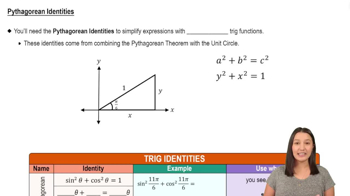
 6:25
6:25