Start by isolating the arctan expression. Multiply both sides of the equation by \( \frac{3}{4} \) to get \( \arctan \left( \frac{x}{2} \right) = \frac{3}{4} \pi \).
Recall that \( \arctan(y) = \theta \) means \( \tan(\theta) = y \). So rewrite the equation as \( \tan \left( \frac{3}{4} \pi \right) = \frac{x}{2} \).
Evaluate \( \tan \left( \frac{3}{4} \pi \right) \) by considering the unit circle or known tangent values at special angles.
Once you find \( \tan \left( \frac{3}{4} \pi \right) \), set it equal to \( \frac{x}{2} \) and solve for \( x \) by multiplying both sides by 2.
Remember to consider the domain and range of the arctan function and check if there are any additional solutions based on the periodicity of the tangent function.
Verified video answer for a similar problem:
This video solution was recommended by our tutors as helpful for the problem above
Play a video:
0 Comments
Key Concepts
Here are the essential concepts you must grasp in order to answer the question correctly.
Inverse Trigonometric Functions (Arctan)
The arctan function is the inverse of the tangent function, returning the angle whose tangent is a given number. It is essential for solving equations where the variable is inside a tangent function, allowing us to isolate the variable by applying arctan to both sides.
Equations involving fractions and π require careful manipulation of constants and variables. Understanding how to isolate the variable by multiplying or dividing both sides, and recognizing the value of π (approximately 3.1416), is crucial for accurate solutions.
Algebraic skills are necessary to isolate the variable x after applying inverse functions. This includes multiplying both sides by constants, simplifying expressions, and solving for x step-by-step to find the exact or approximate solution.

 Verified step by step guidance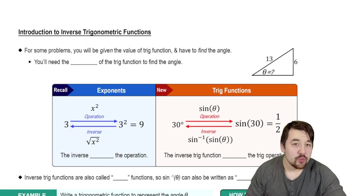
 4:28
4:28