Use the Law of Sines to find the angle to the nearest tenth of a degree.
Table of contents
- 0. Review of College Algebra4h 43m
- 1. Measuring Angles40m
- 2. Trigonometric Functions on Right Triangles2h 5m
- 3. Unit Circle1h 19m
- 4. Graphing Trigonometric Functions1h 19m
- 5. Inverse Trigonometric Functions and Basic Trigonometric Equations1h 41m
- 6. Trigonometric Identities and More Equations2h 34m
- 7. Non-Right Triangles1h 38m
- 8. Vectors2h 25m
- 9. Polar Equations2h 5m
- 10. Parametric Equations1h 6m
- 11. Graphing Complex Numbers1h 7m
- OLD 1. Angles and the Trigonometric Functions Coming soon
- OLD 2. Trigonometric Functions graphs, Inverse Trigonometric Functions Coming soon
- OLD 3. Trigonometric Identities and Equations Coming soon
- OLD 4. Laws of Sines, Cosines and Vectors Coming soon
- OLD 5. Complex Numbers, Polar Coordinates and Parametric Equations Coming soon
- NEW (not used) 7. Laws of Sines, Cosines and Vectors Coming soon
- NEW (not used) 8. Vectors Coming soon
- NEW(not used) 9. Polar equations Coming soon
- NEW (not used) 11. Graphing Complex Numbers Coming soon
7. Non-Right Triangles
Law of Sines
Problem 1
Textbook Question
Which one of the following sets of data does not determine a unique triangle?
a. A = 50°, b = 21, a = 19
b. A = 45°, b = 10, a = 12
c. A = 130°, b = 4, a = 7
d. A = 30°, b = 8, a = 4
Verified step by step guidance1
Identify the given information for each case: angle A, side b, and side a. We want to check if these data sets determine a unique triangle.
Recall the Law of Sines formula: \(\frac{a}{\sin A} = \frac{b}{\sin B}\). We can use this to find angle B for each set by rearranging to \(\sin B = \frac{b \sin A}{a}\).
Calculate \(\sin B\) for each set using the given values (without final numeric evaluation): \(\sin B = \frac{b \sin A}{a}\). Then analyze the possible values of angle B.
Check the range of \(\sin B\). If \(\sin B > 1\), no triangle exists. If \(0 < \sin B < 1\), there can be one or two possible angles for B (since \(\sin \theta = \sin (180^\circ - \theta)\)), which affects uniqueness.
Determine for each set whether the data leads to zero, one, or two possible triangles. The set that leads to two possible triangles does not determine a unique triangle.
Verified video answer for a similar problem:This video solution was recommended by our tutors as helpful for the problem above
Play a video:
0 Comments
Key Concepts
Here are the essential concepts you must grasp in order to answer the question correctly.
Law of Sines
The Law of Sines relates the ratios of sides to the sines of their opposite angles in a triangle: (a/sin A) = (b/sin B) = (c/sin C). It is essential for solving triangles when given two sides and an angle not included between them (SSA), helping determine possible triangle configurations.
Recommended video:
Guided course
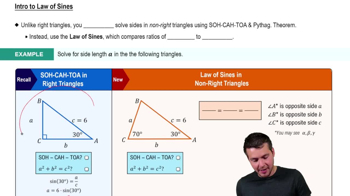
Intro to Law of Sines
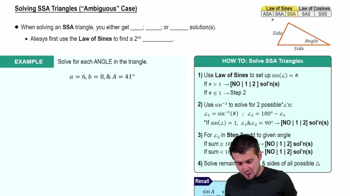
Ambiguous Case of SSA Triangles
The SSA condition can produce zero, one, or two possible triangles depending on the given measurements. This ambiguity arises because the given side opposite the known angle may or may not form a valid triangle, leading to no solution, a unique triangle, or two distinct triangles.
Recommended video:
Guided course
Solving SSA Triangles ("Ambiguous" Case)
Triangle Angle Sum Property
The sum of the interior angles in any triangle is always 180°. This property helps verify the validity of computed angles and ensures that the solutions derived from the Law of Sines or other methods correspond to a real triangle.
Recommended video:
Sum and Difference of Tangent
Related Videos
Related Practice
Multiple Choice