CONCEPT PREVIEW Find the exact length of each arc intercepted by the given central angle.
Verified step by step guidance
1
Identify the given central angle \( \theta \) and the radius \( r \) of the circle. The arc length depends on these two values.
Recall the formula for the length of an arc intercepted by a central angle: \[ \text{Arc length} = r \times \theta \] where \( \theta \) must be in radians.
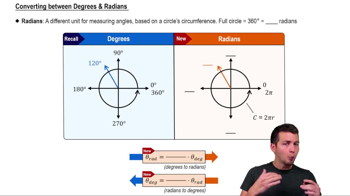
If the central angle \( \theta \) is given in degrees, convert it to radians using the conversion formula: \[ \theta_{radians} = \theta_{degrees} \times \frac{\pi}{180} \].
Substitute the radius \( r \) and the central angle in radians \( \theta \) into the arc length formula to express the arc length.
Simplify the expression if possible to find the exact length of the arc in terms of \( r \) and \(\pi\) \), without approximating \( \pi \).
Verified video answer for a similar problem:
This video solution was recommended by our tutors as helpful for the problem above
Play a video:
0 Comments
Key Concepts
Here are the essential concepts you must grasp in order to answer the question correctly.
Central Angle
A central angle is an angle whose vertex is at the center of a circle and whose sides intersect the circle, creating an arc. Understanding the measure of this angle is essential because it directly relates to the length of the intercepted arc on the circle.
The arc length of a circle segment is calculated using the formula: Arc Length = radius × central angle (in radians). This formula connects the radius and the angle to find the exact length of the arc, making it crucial for solving problems involving arcs.
Radians measure angles based on the radius of the circle, where one radian equals the angle subtended by an arc equal in length to the radius. Converting degrees to radians is often necessary to use the arc length formula correctly.

 Verified step by step guidance
 04:46
04:46