In Exercises 21–28, an object moves in simple harmonic motion described by the given equation, where t is measured in seconds and d in inches. In each exercise, find the following: a. the maximum displacement b. the frequency c. the time required for one cycle. d = 10 cos 2πt
Ch. 2 - Graphs of the Trigonometric Functions; Inverse Trigonometric Functions

All textbooks
Blitzer 3rd Edition
Ch. 2 - Graphs of the Trigonometric Functions; Inverse Trigonometric Functions
Problem 23
Blitzer 3rd Edition
Ch. 2 - Graphs of the Trigonometric Functions; Inverse Trigonometric Functions
Problem 23Chapter 2, Problem 23
In Exercises 18–24, graph two full periods of the given tangent or cotangent function. y = − 1/2 cot π/2 x
Verified step by step guidance1
Identify the given function: \(y = -\frac{1}{2} \cot\left(\frac{\pi}{2} x\right)\). This is a cotangent function with a vertical stretch/compression and reflection.
Determine the period of the cotangent function. The general period of \(\cot(bx)\) is \(\frac{\pi}{b}\). Here, \(b = \frac{\pi}{2}\), so the period is \(\frac{\pi}{\frac{\pi}{2}} = 2\).
Since the problem asks for two full periods, calculate the interval for \(x\) over which to graph: from \(0\) to \(2 \times 2 = 4\).
Identify the vertical asymptotes of the cotangent function. For \(\cot(bx)\), asymptotes occur where \(bx = k\pi\), for integers \(k\). Solve \(\frac{\pi}{2} x = k\pi\) to find \(x = 2k\).
Plot key points between asymptotes, considering the reflection and vertical compression by \(-\frac{1}{2}\). The cotangent normally decreases from \(+\infty\) to \(-\infty\) between asymptotes; here it will be reflected and scaled accordingly.

Verified video answer for a similar problem:
This video solution was recommended by our tutors as helpful for the problem above.
Video duration:
7mWas this helpful?
Key Concepts
Here are the essential concepts you must grasp in order to answer the question correctly.
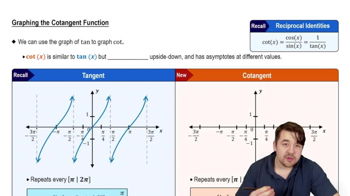
Period of Cotangent Function
The period of the basic cotangent function, cot(x), is π. When the function is transformed as cot(bx), the period changes to π divided by the absolute value of b. Understanding this helps determine the length of one full cycle on the x-axis, which is essential for graphing two full periods.
Recommended video:
Introduction to Cotangent Graph
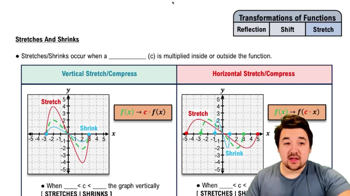
Amplitude and Vertical Stretch/Compression
The coefficient in front of the cotangent function, such as -1/2, affects the vertical stretch or compression and reflection. Here, -1/2 reflects the graph across the x-axis and compresses it vertically by a factor of 1/2, altering the shape but not the period or asymptotes.
Recommended video:
Stretches and Shrinks of Functions
Asymptotes and Key Points of Cotangent Graph
Cotangent functions have vertical asymptotes where the function is undefined, typically at multiples of the period. Identifying these asymptotes and key points like zeros helps in accurately sketching the graph. For cot(bx), asymptotes occur where bx equals multiples of π, guiding the placement of vertical lines.
Recommended video:
Introduction to Cotangent Graph
Related Practice
Textbook Question
25
views
3
rank
Textbook Question
In Exercises 1–26, find the exact value of each expression. _ csc⁻¹ (− 2√3/3)
1
views
Textbook Question
In Exercises 17–30, determine the amplitude, period, and phase shift of each function. Then graph one period of the function. y = 1/2 sin(x + π/2)
Textbook Question
In Exercises 17–24, graph two periods of the given cotangent function. y = 3 cot(x + π/2)
Textbook Question
Determine the amplitude, period, and phase shift of each function. Then graph one period of the function.
y = 1/2 sin(x + π)
Textbook Question
In Exercises 17–24, graph two periods of the given cotangent function. y = −3 cot π/2 x