In Exercises 53–60, use a vertical shift to graph one period of the function. y = −3 sin 2πx + 2
Verified step by step guidance
1
Identify the base function and its components. The given function is \(y = -3 \sin(2\pi x) + 2\), where \(-3\) is the amplitude multiplier, \(2\pi\) affects the period, and \(+2\) is the vertical shift.
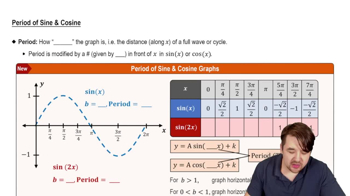
Determine the period of the sine function using the formula for period: \(\text{Period} = \frac{2\pi}{B}\), where \(B\) is the coefficient of \(x\) inside the sine. Here, \(B = 2\pi\), so calculate the period accordingly.
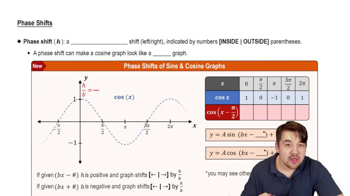
Understand the effect of the vertical shift. The \(+2\) outside the sine function shifts the entire graph up by 2 units, so the midline of the sine wave is at \(y = 2\) instead of \(y = 0\).
Sketch one period of the sine function starting from \(x = 0\) to \(x = \frac{2\pi}{2\pi} = 1\). Plot key points at \(x = 0\), \(x = \frac{1}{4}\), \(x = \frac{1}{2}\), \(x = \frac{3}{4}\), and \(x = 1\) by evaluating the sine values, applying the amplitude and vertical shift.
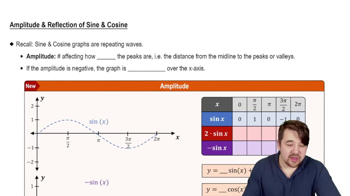
Use the amplitude \(3\) and the negative sign to reflect the sine wave vertically. The maximum and minimum values will be \$2 + 3 = 5\( and \)2 - 3 = -1$, respectively. Connect the points smoothly to complete one period of the graph.
Verified video answer for a similar problem:
This video solution was recommended by our tutors as helpful for the problem above
Video duration:
10m
Play a video:
0 Comments
Key Concepts
Here are the essential concepts you must grasp in order to answer the question correctly.
Vertical Shift in Trigonometric Functions
A vertical shift moves the entire graph of a function up or down without changing its shape. In the function y = -3 sin 2πx + 2, the '+ 2' shifts the sine wave 2 units upward, affecting the midline around which the wave oscillates.
Amplitude is the maximum distance the graph reaches above or below its midline. For y = -3 sin 2πx + 2, the amplitude is 3, indicating the wave oscillates 3 units above and below the midline, with the negative sign reflecting a vertical reflection.
The period is the length of one complete cycle of the sine wave. It is calculated as 2π divided by the coefficient of x inside the sine function. Here, with 2π as the coefficient, the period is 1, meaning the function completes one full cycle over an interval of length 1.

 10:31 minutes
 Verified step by step guidance
 6:31
6:31