

Ch. 9 - Inferences from Two Samples
Triola - Elementary Statistics 14th Edition
Triola14th EditionElementary StatisticsISBN: 9780137366446Not the one you use?Change textbook
Chapter 9, Problem 9.2.6b

In Exercises 5–20, assume that the two samples are independent simple random samples selected from normally distributed populations, and do not assume that the population standard deviations are equal. (Note: Answers in Appendix D include technology answers based on Formula 9-1 along with “Table” answers based on Table A-3 with df equal to the smaller of n1-1 and n2-1)


Readability of Font On a Computer Screen The statistics shown below were obtained from a standard test of readability of fonts on a computer screen (based on data from “Reading on the Computer Screen: Does Font Type Have Effects on Web Text Readability?” by Ali et al., International Education Studies, Vol. 6, No. 3). Reading speed and accuracy were combined into a readability performance score (x), where a higher score represents better font readability.


b. Construct the confidence interval suitable for testing the claim in part (a).


Verified step by step guidance
1
Step 1: Identify the given data for both samples. For the Roman font: sample size (n₁) = 24, sample mean (x̄₁) = 66.25, and sample standard deviation (s₁) = 12.96. For the Arial font: sample size (n₂) = 24, sample mean (x̄₂) = 65.62, and sample standard deviation (s₂) = 9.93.
Step 2: Use the formula for the confidence interval for the difference between two means when the population standard deviations are not assumed to be equal. The formula is: CI = (x̄₁ - x̄₂) ± t * √((s₁²/n₁) + (s₂²/n₂)), where t is the critical value from the t-distribution with degrees of freedom calculated using the Welch-Satterthwaite equation.
Step 3: Calculate the degrees of freedom (df) using the Welch-Satterthwaite equation: df = ((s₁²/n₁ + s₂²/n₂)²) / (((s₁²/n₁)² / (n₁ - 1)) + ((s₂²/n₂)² / (n₂ - 1))). Substitute the given values into this formula to find the approximate df.
Step 4: Determine the critical t-value (t) for the desired confidence level (e.g., 95%) using the calculated degrees of freedom and a t-distribution table or technology. Ensure you use a two-tailed test since the confidence interval is symmetric.
Step 5: Substitute the values of x̄₁, x̄₂, s₁, s₂, n₁, n₂, and t into the confidence interval formula to compute the lower and upper bounds of the confidence interval. This will give you the range of values for the difference in readability performance scores between the two fonts.

Verified video answer for a similar problem:

This video solution was recommended by our tutors as helpful for the problem above.
Video duration:
6m
Was this helpful?

Key Concepts

Here are the essential concepts you must grasp in order to answer the question correctly.

Confidence Interval

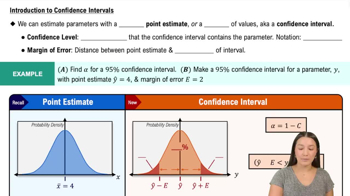
A confidence interval is a range of values, derived from sample statistics, that is likely to contain the true population parameter. It is calculated using the sample mean, standard deviation, and a critical value from the t-distribution, especially when the sample size is small. The width of the interval reflects the level of uncertainty about the estimate, with wider intervals indicating more uncertainty.
Recommended video:
06:33
Introduction to Confidence Intervals

Independent Samples

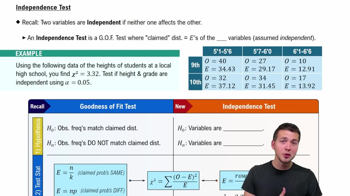
Independent samples refer to two or more groups that are not related or paired in any way. In statistical analysis, this means that the selection of one sample does not influence the selection of another. This concept is crucial when comparing means from different groups, as it allows for the application of specific statistical tests, such as the independent t-test.
Recommended video:
Guided course
06:28
Independence Test

Standard Deviation

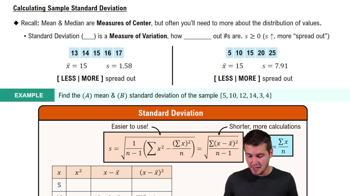
Standard deviation is a measure of the amount of variation or dispersion in a set of values. A low standard deviation indicates that the values tend to be close to the mean, while a high standard deviation indicates that the values are spread out over a wider range. In the context of the question, it helps assess the reliability of the readability performance scores for the different font types.
Recommended video:
Guided course
08:45
Calculating Standard Deviation
Related Practice
Textbook Question

In Exercises 5–20, assume that the two samples are independent simple random samples selected from normally distributed populations, and do not assume that the population standard deviations are equal. (Note: Answers in Appendix D include technology answers based on Formula 9-1 along with “Table” answers based on Table A-3 with df equal to the smaller of n1-1 and n2-1)


Color and Cognition Researchers from the University of British Columbia conducted a study to investigate the effects of color on cognitive tasks. Words were displayed on a computer screen with background colors of red and blue. Results from scores on a test of word recall are given below. Higher scores correspond to greater word recall.


b. Construct a confidence interval appropriate for the hypothesis test in part (a). What is it about the confidence interval that causes us to reach the same conclusion from part (a)?


" style="max-width: 100%; white-space-collapse: preserve;" width="440">

Textbook Question

Count Five Test for Comparing Variation in Two Populations Repeat Exercise 16 “Blanking Out on Tests,” but instead of using the F test, use the following procedure for the “count five” test of equal variations (which is not as complicated as it might appear).

b. Let c1 be the count of the number of absolute deviation values in the first sample that are greater than the largest absolute deviation value in the other sample. Also, let C2 be the count of the number of absolute deviation values in the second sample that are greater than the largest absolute deviation value in the other sample. (One of these counts will always be zero.)

1
views
Textbook Question

In Exercises 5–16, use the listed paired sample data, and assume that the samples are simple random samples and that the differences have a distribution that is approximately normal.


Measured and Reported Weights Listed below are measured and reported weights (lb) of random female subjects (from Data Set 4 “Measured and Reported” in Appendix B).


b. Construct the confidence interval that could be used for the hypothesis test described in part (a). What feature of the confidence interval leads to the same conclusion reached in part (a)?


Textbook Question

In Exercises 5–20, assume that the two samples are independent simple random samples selected from normally distributed populations, and do not assume that the population standard deviations are equal. (Note: Answers in Appendix D include technology answers based on Formula 9-1 along with “Table” answers based on Table A-3 with df equal to the smaller of n1-1 and n2-1)


Better Tips by Giving Candy An experiment was conducted to determine whether giving candy to dining parties resulted in greater tips. The mean tip percentages and standard deviations are given below along with the sample sizes (based on data from “Sweetening the Till: The Use of Candy to Increase Restaurant Tipping,” by Strohmetz et al., Journal of Applied Social Psychology, Vol. 32, No. 2).


b. Construct the confidence interval suitable for testing the claim in part (a).


Textbook Question

In Exercises 5–20, assume that the two samples are independent simple random samples selected from normally distributed populations, and do not assume that the population standard deviations are equal. (Note: Answers in Appendix D include technology answers based on Formula 9-1 along with “Table” answers based on Table A-3 with df equal to the smaller of n1-1 and n2-1)


Queues Listed on the next page are waiting times (seconds) of observed cars at a Delaware inspection station. The data from two waiting lines are real observations, and the data from the single waiting line are modeled from those real observations. These data are from Data Set 30 “Queues” in Appendix B. The data were collected by the author.


b. Construct the confidence interval suitable for testing the claim in part (a).


Textbook Question

In Exercises 5–20, assume that the two samples are independent simple random samples selected from normally distributed populations, and do not assume that the population standard deviations are equal. (Note: Answers in Appendix D include technology answers based on Formula 9-1 along with “Table” answers based on Table A-3 with df equal to the smaller of n1-1 and n2-1)


Bicycle Commuting A researcher used two different bicycles to commute to work. One bicycle was steel and weighed 30.0 lb; the other was carbon and weighed 20.9 lb. The commuting times (minutes) were recorded with the results shown below (based on data from “Bicycle Weights and Commuting Time,” by Jeremy Groves, British Medical Journal).


b. Construct the confidence interval suitable for testing the claim in part (a).