

Ch. 9 - Inferences from Two Samples
Triola - Elementary Statistics 14th Edition
Triola14th EditionElementary StatisticsISBN: 9780137366446Not the one you use?Change textbook
Chapter 9, Problem 9.3.6b

In Exercises 5–16, use the listed paired sample data, and assume that the samples are simple random samples and that the differences have a distribution that is approximately normal.


Do Men Talk Less than Women? Listed below are word counts of males and females in couple relationships (from Data Set 14 “Word Counts” in Appendix B).


b. Construct the confidence interval that could be used for the hypothesis test described in part (a). What feature of the confidence interval leads to the same conclusion reached in part (a)?


Verified step by step guidance
1
Step 1: Calculate the differences between the paired samples (word counts of men and women). For each pair, subtract the word count of men from the word count of women. This will give you the differences for each pair.
Step 2: Compute the mean of the differences. Add up all the differences obtained in Step 1 and divide by the number of pairs to find the average difference.
Step 3: Calculate the standard deviation of the differences. Use the formula for standard deviation: \( s = \sqrt{\frac{\sum (x_i - \bar{x})^2}{n-1}} \), where \( x_i \) are the differences, \( \bar{x} \) is the mean of the differences, and \( n \) is the number of pairs.
Step 4: Determine the margin of error for the confidence interval. Use the formula \( E = t \cdot \frac{s}{\sqrt{n}} \), where \( t \) is the critical value from the t-distribution for the desired confidence level, \( s \) is the standard deviation of the differences, and \( n \) is the number of pairs.
Step 5: Construct the confidence interval. Add and subtract the margin of error (calculated in Step 4) to the mean of the differences (calculated in Step 2). The resulting interval will be \( [\bar{x} - E, \bar{x} + E] \). Analyze whether the interval includes zero to determine the conclusion regarding the hypothesis test.

Verified video answer for a similar problem:

This video solution was recommended by our tutors as helpful for the problem above.
Video duration:
9m
Was this helpful?

Key Concepts

Here are the essential concepts you must grasp in order to answer the question correctly.

Paired Sample Data

Paired sample data involves two related groups where each member of one group is matched with a member of another group. This design is often used in studies to compare two conditions or treatments, allowing for the control of variability between subjects. In this case, the word counts of men and women in couple relationships are paired, enabling a direct comparison of their communication patterns.
Recommended video:
05:11
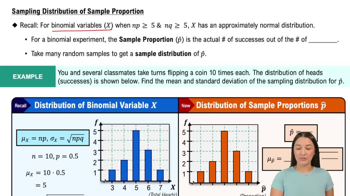
Sampling Distribution of Sample Proportion

Confidence Interval

A confidence interval is a range of values, derived from sample statistics, that is likely to contain the true population parameter with a specified level of confidence, typically 95%. In hypothesis testing, constructing a confidence interval helps to determine if the observed difference between groups is statistically significant. If the interval does not include zero, it suggests a significant difference in the means of the two groups being compared.
Recommended video:
06:33
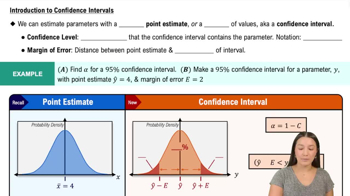
Introduction to Confidence Intervals

Hypothesis Testing

Hypothesis testing is a statistical method used to make inferences about population parameters based on sample data. It involves formulating a null hypothesis (no effect or difference) and an alternative hypothesis (there is an effect or difference), then using sample data to determine whether to reject the null hypothesis. The results of the hypothesis test can be supported or contradicted by the confidence interval, providing a comprehensive view of the data.
Recommended video:
Guided course
06:21
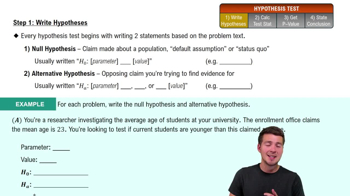
Step 1: Write Hypotheses
Related Practice
Textbook Question

Count Five Test for Comparing Variation in Two Populations Repeat Exercise 16 “Blanking Out on Tests,” but instead of using the F test, use the following procedure for the “count five” test of equal variations (which is not as complicated as it might appear).

b. Let c1 be the count of the number of absolute deviation values in the first sample that are greater than the largest absolute deviation value in the other sample. Also, let C2 be the count of the number of absolute deviation values in the second sample that are greater than the largest absolute deviation value in the other sample. (One of these counts will always be zero.)

1
views
Textbook Question

Friday the 13th Refer to the sample data from Exercise 1.


b. In general, what does ud represent?

Textbook Question

In Exercises 5–20, assume that the two samples are independent simple random samples selected from normally distributed populations, and do not assume that the population standard deviations are equal. (Note: Answers in Appendix D include technology answers based on Formula 9-1 along with “Table” answers based on Table A-3 with df equal to the smaller of n1-1 and n2-1)


Magnet Treatment of Pain People spend around \$5 billion annually for the purchase of magnets used to treat a wide variety of pains. Researchers conducted a study to determine whether magnets are effective in treating back pain. Pain was measured using the visual analog scale, and the results given below are among the results obtained in the study (based on data from “Bipolar Permanent Magnets for the Treatment of Chronic Lower Back Pain: A Pilot Study,” by Collacott, Zimmerman, White, and Rindone, Journal of the American Medical Association, Vol. 283, No. 10). Higher scores correspond to greater pain levels.


b. Construct the confidence interval appropriate for the hypothesis test in part (a).


" style="max-width: 100%; white-space-collapse: preserve;" width="550">

Textbook Question

In Exercises 5–20, assume that the two samples are independent simple random samples selected from normally distributed populations, and do not assume that the population standard deviations are equal. (Note: Answers in Appendix D include technology answers based on Formula 9-1 along with “Table” answers based on Table A-3 with df equal to the smaller of n1-1 and n2-1)


Better Tips by Giving Candy An experiment was conducted to determine whether giving candy to dining parties resulted in greater tips. The mean tip percentages and standard deviations are given below along with the sample sizes (based on data from “Sweetening the Till: The Use of Candy to Increase Restaurant Tipping,” by Strohmetz et al., Journal of Applied Social Psychology, Vol. 32, No. 2).


b. Construct the confidence interval suitable for testing the claim in part (a).


Textbook Question

Hypotheses and Conclusions Refer to the hypothesis test described in Exercise 1.


b. If the P-value for the test is reported as “less than 0.001,” what should we conclude about the original claim?

Textbook Question

In Exercises 5–20, assume that the two samples are independent simple random samples selected from normally distributed populations, and do not assume that the population standard deviations are equal. (Note: Answers in Appendix D include technology answers based on Formula 9-1 along with “Table” answers based on Table A-3 with df equal to the smaller of n1-1 and n2-1)


Queues Listed on the next page are waiting times (seconds) of observed cars at a Delaware inspection station. The data from two waiting lines are real observations, and the data from the single waiting line are modeled from those real observations. These data are from Data Set 30 “Queues” in Appendix B. The data were collected by the author.


b. Construct the confidence interval suitable for testing the claim in part (a).