Ch. 9 - Inferences from Two Samples
Triola - Elementary Statistics 14th Edition
Triola14th EditionElementary StatisticsISBN: 9780137366446Not the one you use?Change textbook
Chapter 9, Problem 9.1.12c

Clinical Trials of OxyContin OxyContin (oxycodone) is a drug used to treat pain, but it is well known for its addictiveness and danger. In a clinical trial, among subjects treated with OxyContin, 52 developed nausea and 175 did not develop nausea. Among other subjects given placebos, 5 developed nausea and 40 did not develop nausea (based on data from Purdue Pharma L.P.). Use a 0.05 significance level to test for a difference between the rates of nausea for those treated with OxyContin and those given a placebo.


c. Does nausea appear to be an adverse reaction resulting from OxyContin?

Verified step by step guidance
1
Step 1: Define the null and alternative hypotheses. The null hypothesis (H₀) states that there is no difference in the rates of nausea between the OxyContin group and the placebo group. The alternative hypothesis (H₁) states that there is a difference in the rates of nausea between the two groups.
Step 2: Calculate the proportions of nausea for each group. For the OxyContin group, the proportion is calculated as p₁ = 52 / (52 + 175). For the placebo group, the proportion is calculated as p₂ = 5 / (5 + 40).
Step 3: Compute the pooled proportion (p̂) using the formula: p̂ = (x₁ + x₂) / (n₁ + n₂), where x₁ and x₂ are the number of successes (nausea cases) in each group, and n₁ and n₂ are the total sample sizes for each group.
Step 4: Calculate the standard error (SE) for the difference in proportions using the formula: SE = √[p̂(1 - p̂)(1/n₁ + 1/n₂)].
Step 5: Compute the test statistic (z) using the formula: z = (p₁ - p₂) / SE. Then, compare the test statistic to the critical value for a significance level of 0.05, or use the p-value approach to determine whether to reject the null hypothesis. Interpret the results to assess whether nausea appears to be an adverse reaction resulting from OxyContin.

Verified video answer for a similar problem:

This video solution was recommended by our tutors as helpful for the problem above.
Video duration:
4m
Was this helpful?

Key Concepts

Here are the essential concepts you must grasp in order to answer the question correctly.

Hypothesis Testing

Hypothesis testing is a statistical method used to determine whether there is enough evidence to reject a null hypothesis in favor of an alternative hypothesis. In this context, the null hypothesis would state that there is no difference in the rates of nausea between the OxyContin and placebo groups, while the alternative hypothesis would suggest that a difference exists. The process involves calculating a test statistic and comparing it to a critical value based on a chosen significance level.
Recommended video:
Guided course
06:21
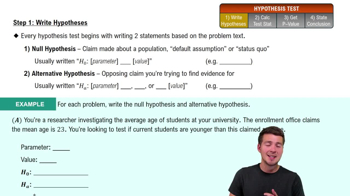
Step 1: Write Hypotheses

Significance Level

The significance level, often denoted as alpha (α), is the threshold for determining whether the results of a hypothesis test are statistically significant. In this case, a significance level of 0.05 indicates that there is a 5% risk of concluding that a difference exists when there is none (Type I error). If the p-value obtained from the test is less than 0.05, the null hypothesis can be rejected, suggesting that nausea may be an adverse reaction to OxyContin.
Recommended video:
Guided course
04:46
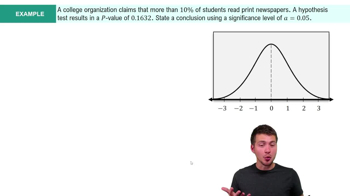
Step 4: State Conclusion Example 4

Contingency Table

A contingency table is a type of data representation that displays the frequency distribution of variables, allowing for the analysis of the relationship between them. In this scenario, the table would show the number of subjects who developed nausea versus those who did not, categorized by treatment type (OxyContin vs. placebo). This format is essential for calculating proportions and conducting tests like the Chi-square test to assess the association between treatment and nausea occurrence.
Recommended video:
Guided course
09:47
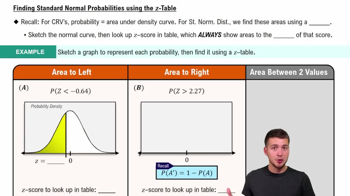
Finding Standard Normal Probabilities using z-Table
Related Practice
Textbook Question

Overlap of Confidence Intervals In the article “On Judging the Significance of Differences by Examining the Overlap Between Confidence Intervals,” by Schenker and Gentleman (American Statistician, Vol. 55, No. 3), the authors consider sample data in this statement: “Independent simple random samples, each of size 200, have been drawn, and 112 people in the first sample have the attribute, whereas 88 people in the second sample have the attribute.”


c. Use a 0.05 significance level to test the claim that the two population proportions are equal. What do you conclude?


Textbook Question

In Exercises 5–20, assume that the two samples are independent simple random samples selected from normally distributed populations, and do not assume that the population standard deviations are equal. (Note: Answers in Appendix D include technology answers based on Formula 9-1 along with “Table” answers based on Table A-3 with df equal to the smaller of n1-1 and n2-1)


Magnet Treatment of Pain People spend around \$5 billion annually for the purchase of magnets used to treat a wide variety of pains. Researchers conducted a study to determine whether magnets are effective in treating back pain. Pain was measured using the visual analog scale, and the results given below are among the results obtained in the study (based on data from “Bipolar Permanent Magnets for the Treatment of Chronic Lower Back Pain: A Pilot Study,” by Collacott, Zimmerman, White, and Rindone, Journal of the American Medical Association, Vol. 283, No. 10). Higher scores correspond to greater pain levels.


c. Does it appear that magnets are effective in treating back pain? Is it valid to argue that magnets might appear to be effective if the sample sizes are larger?


" style="max-width: 100%; white-space-collapse: preserve;" width="550">

Textbook Question

Independent Samples Which of the following involve independent samples?


c. Data Set 1 “Body Data” includes a sample of pulse rates of 147 women and a sample of pulse rates of 153 men.

Textbook Question

Are Seat Belts Effective? A simple random sample of front-seat occupants involved in car crashes is obtained. Among 2823 occupants not wearing seat belts, 31 were killed. Among 7765 occupants wearing seat belts, 16 were killed (based on data from “Who Wants Airbags?” by Meyer and Finney, Chance, Vol. 18, No. 2). We want to use a 0.05 significance level to test the claim that seat belts are effective in reducing fatalities.


c. What does the result suggest about the effectiveness of seat belts?

Textbook Question

In Exercises 5–16, use the listed paired sample data, and assume that the samples are simple random samples and that the differences have a distribution that is approximately normal.


The Freshman 15 The “Freshman 15” refers to the belief that college students gain 15 lb (or 6.8 kg) during their freshman year. Listed below are weights (kg) of randomly selected male college freshmen (from Data Set 13 “Freshman 15” in Appendix B). The weights were measured in September and later in April.


c. What do you conclude about the Freshman 15 belief?


Textbook Question

Confidence Interval Assume that we want to use the sample data in Exercise 1 for constructing a confidence interval to be used for testing the given claim.


c. If the resulting confidence interval is -5.8 admissions <ud < -0.9 admissions, what do you conclude?