
Ch. 9 - Inferences from Two Samples
Triola - Elementary Statistics 14th Edition
Triola14th EditionElementary StatisticsISBN: 9780137366446Not the one you use?Change textbook
Chapter 9, Problem 9.1.13b

Are Seat Belts Effective? A simple random sample of front-seat occupants involved in car crashes is obtained. Among 2823 occupants not wearing seat belts, 31 were killed. Among 7765 occupants wearing seat belts, 16 were killed (based on data from “Who Wants Airbags?” by Meyer and Finney, Chance, Vol. 18, No. 2). We want to use a 0.05 significance level to test the claim that seat belts are effective in reducing fatalities.


b. Test the claim by constructing an appropriate confidence interval.

Verified step by step guidance
1
Step 1: Define the problem and hypotheses. The claim is that seat belts are effective in reducing fatalities. This implies that the proportion of fatalities among those wearing seat belts is lower than the proportion of fatalities among those not wearing seat belts. Let p1 represent the proportion of fatalities for those not wearing seat belts, and p2 represent the proportion of fatalities for those wearing seat belts. The null hypothesis (H0) is that p1 = p2, and the alternative hypothesis (H1) is that p1 > p2.
Step 2: Calculate the sample proportions. For the group not wearing seat belts, the sample proportion is p1̂ = x1 / n1, where x1 = 31 (number of fatalities) and n1 = 2823 (total occupants). For the group wearing seat belts, the sample proportion is p2̂ = x2 / n2, where x2 = 16 (number of fatalities) and n2 = 7765 (total occupants).
Step 3: Compute the standard error for the difference in proportions. The formula for the standard error is SE = sqrt((p1̂(1 - p1̂) / n1) + (p2̂(1 - p2̂) / n2)). Substitute the values of p1̂, p2̂, n1, and n2 into the formula to calculate the standard error.
Step 4: Construct the confidence interval for the difference in proportions. The formula for the confidence interval is (p1̂ - p2̂) ± Z * SE, where Z is the critical value corresponding to the 0.05 significance level (for a two-tailed test, Z = 1.96). Substitute the values of p1̂, p2̂, SE, and Z into the formula to calculate the confidence interval.
Step 5: Interpret the confidence interval. If the confidence interval does not include 0 and the entire interval is positive, it supports the claim that the proportion of fatalities is higher for those not wearing seat belts, indicating that seat belts are effective in reducing fatalities. If the interval includes 0, there is insufficient evidence to support the claim.

Verified video answer for a similar problem:

This video solution was recommended by our tutors as helpful for the problem above.
Video duration:
8m
Was this helpful?

Key Concepts

Here are the essential concepts you must grasp in order to answer the question correctly.

Hypothesis Testing

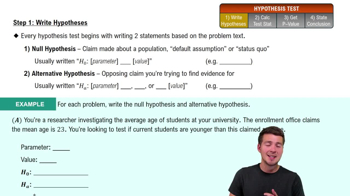
Hypothesis testing is a statistical method used to make decisions about a population based on sample data. In this context, we formulate a null hypothesis (that seat belts do not reduce fatalities) and an alternative hypothesis (that they do). By analyzing the sample data, we can determine whether to reject the null hypothesis at a specified significance level, which in this case is 0.05.
Recommended video:
Guided course
06:21
Step 1: Write Hypotheses

Confidence Interval

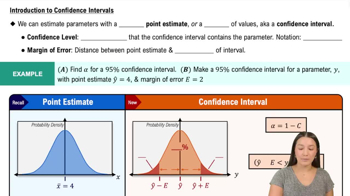
A confidence interval is a range of values, derived from sample statistics, that is likely to contain the true population parameter. In this scenario, constructing a confidence interval for the difference in fatality rates between occupants wearing and not wearing seat belts will help assess the effectiveness of seat belts. A confidence interval that does not include zero would suggest a significant difference in fatality rates.
Recommended video:
06:33
Introduction to Confidence Intervals

Proportion Comparison

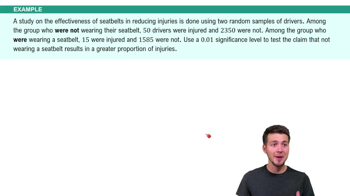
Proportion comparison involves analyzing the proportions of two groups to determine if there is a statistically significant difference between them. Here, we compare the proportion of fatalities among occupants wearing seat belts to those not wearing them. This analysis is crucial for understanding the effectiveness of seat belts in reducing fatalities in car crashes.
Recommended video:
Guided course
10:28
Difference in Proportions: Hypothesis Tests Example 1
Related Practice
Textbook Question

In Exercises 5–20, assume that the two samples are independent simple random samples selected from normally distributed populations, and do not assume that the population standard deviations are equal. (Note: Answers in Appendix D include technology answers based on Formula 9-1 along with “Table” answers based on Table A-3 with df equal to the smaller of n1-1 and n2-1)


Color and Creativity Researchers from the University of British Columbia conducted trials to investigate the effects of color on creativity. Subjects with a red background were asked to think of creative uses for a brick; other subjects with a blue background were given the same task. Responses were scored by a panel of judges and results from scores of creativity are given below. Higher scores correspond to more creativity. The researchers make the claim that “blue enhances performance on a creative task.”


b. Construct the confidence interval appropriate for the hypothesis test in part (a). What is it about the confidence interval that causes us to reach the same conclusion from part (a)?


" style="max-width: 100%; white-space-collapse: preserve;" width="460">

Textbook Question

F Test Statistic


b. Can the F test statistic ever be a negative number?


Textbook Question

Friday the 13th Refer to the sample data from Exercise 1.


b. In general, what does ud represent?

Textbook Question

In Exercises 5–20, assume that the two samples are independent simple random samples selected from normally distributed populations, and do not assume that the population standard deviations are equal. (Note: Answers in Appendix D include technology answers based on Formula 9-1 along with “Table” answers based on Table A-3 with df equal to the smaller of n1-1 and n2-1)


Magnet Treatment of Pain People spend around \$5 billion annually for the purchase of magnets used to treat a wide variety of pains. Researchers conducted a study to determine whether magnets are effective in treating back pain. Pain was measured using the visual analog scale, and the results given below are among the results obtained in the study (based on data from “Bipolar Permanent Magnets for the Treatment of Chronic Lower Back Pain: A Pilot Study,” by Collacott, Zimmerman, White, and Rindone, Journal of the American Medical Association, Vol. 283, No. 10). Higher scores correspond to greater pain levels.


b. Construct the confidence interval appropriate for the hypothesis test in part (a).


" style="max-width: 100%; white-space-collapse: preserve;" width="550">

Textbook Question

Cigarette Pack Warnings A study was conducted to find the effects of cigarette pack warnings that consisted of text or pictures. Among 1078 smokers given cigarette packs with text warnings, 366 tried to quit smoking. Among 1071 smokers given cigarette packs with warning pictures, 428 tried to quit smoking. (Results are based on data from “Effect of Pictorial Cigarette Pack Warnings on Changes in Smoking Behavior,” by Brewer et al., Journal of the American Medical Association.) Use a 0.01 significance level to test the claim that the proportion of smokers who tried to quit in the text warning group is less than the proportion in the picture warning group.


b. Test the claim by constructing an appropriate confidence interval.

Textbook Question

Hypotheses and Conclusions Refer to the hypothesis test described in Exercise 1.


b. If the P-value for the test is reported as “less than 0.001,” what should we conclude about the original claim?