Ch. 8 - Hypothesis Testing
Triola - Elementary Statistics 14th Edition
Triola14th EditionElementary StatisticsISBN: 9780137366446Not the one you use?Change textbook
Chapter 8, Problem 8.2.5

Using Technology
In Exercises 5–8, identify the indicated values or interpret the given display. Use the normal distribution as an approximation to the binomial distribution, as described in Part 1 of this section. Use a 0.05 significance level and answer the following:


a. Is the test two-tailed, left-tailed, or right-tailed?
b. What is the test statistic?
c. What is the P-value?
d. What is the null hypothesis, and what do you conclude about it?
e. What is the final conclusion?


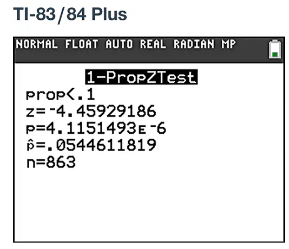
Adverse Reactions to Drug The drug Lipitor (atorvastatin) is used to treat high cholesterol. In a clinical trial of Lipitor, 47 of 863 treated subjects experienced headaches (based on data from Pfizer). The accompanying TI-83/84 Plus calculator display shows results from a test of the claim that fewer than 10% of treated subjects experience headaches.
TI-83/84 Plus display showing 1-PropZTest results: z=-4.459, p=4.115e-6, p̂=0.054, n=863, prop<0.1.

Verified step by step guidance
1
Step 1: Determine the type of test. The problem states that the claim is 'fewer than 10% of treated subjects experience headaches,' which indicates a left-tailed test because we are testing if the proportion is less than a specific value.
Step 2: Identify the test statistic. From the TI-83/84 Plus calculator display, the test statistic is z = -4.45929186. This value measures how many standard deviations the sample proportion is from the hypothesized proportion under the null hypothesis.
Step 3: Find the P-value. The calculator display shows p = 4.1151493e-6, which is the P-value. This represents the probability of observing a test statistic as extreme as the one calculated, assuming the null hypothesis is true.
Step 4: State the null hypothesis. The null hypothesis (H₀) is that the proportion of treated subjects experiencing headaches is equal to or greater than 10% (p ≥ 0.1). The alternative hypothesis (H₁) is that the proportion is less than 10% (p < 0.1).
Step 5: Draw a conclusion. Since the P-value is much smaller than the significance level of 0.05, we reject the null hypothesis. This means there is sufficient evidence to support the claim that fewer than 10% of treated subjects experience headaches.

Verified video answer for a similar problem:

This video solution was recommended by our tutors as helpful for the problem above.
Video duration:
5m
Was this helpful?

Key Concepts

Here are the essential concepts you must grasp in order to answer the question correctly.

Hypothesis Testing

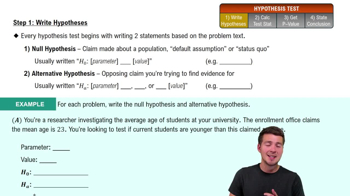
Hypothesis testing is a statistical method used to make decisions about a population based on sample data. It involves formulating a null hypothesis (H0) and an alternative hypothesis (H1), then using sample data to determine whether to reject H0. In this case, the null hypothesis states that the proportion of subjects experiencing headaches is 10% or more, while the alternative hypothesis suggests it is less than 10%.
Recommended video:
Guided course
06:21
Step 1: Write Hypotheses

P-value

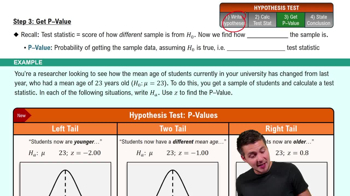
The P-value is a measure that helps determine the strength of the evidence against the null hypothesis. It represents the probability of observing the test results, or something more extreme, assuming that the null hypothesis is true. A smaller P-value indicates stronger evidence against H0. In this scenario, the P-value is extremely low (approximately 4.115e-6), suggesting strong evidence to reject the null hypothesis.
Recommended video:
Guided course
06:50
Step 3: Get P-Value

Test Statistic

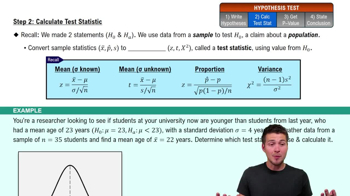
The test statistic is a standardized value that is calculated from sample data during a hypothesis test. It measures how far the sample statistic is from the null hypothesis value, expressed in terms of standard deviations. In this case, the test statistic (z) is -4.459, indicating that the sample proportion of subjects experiencing headaches is significantly lower than the hypothesized proportion of 10%.
Recommended video:
Guided course
06:34
Step 2: Calculate Test Statistic
Related Practice
Textbook Question

Finding P-values

In Exercises 5–8, either use technology to find the P-value or use Table A-3 to find a range of values for the P-value. Based on the result, what is the final conclusion?


Weights of Quarters The claim is that weights (grams) of quarters made after 1964 have a mean equal to 5.670 g as required by mint specifications. The sample size is and the test statistic is t = -3.135.

Textbook Question

Testing Claims About Proportions

In Exercises 9–32, test the given claim. Identify the null hypothesis, alternative hypothesis, test statistic, P-value, or critical value(s), then state the conclusion about the null hypothesis, as well as the final conclusion that addresses the original claim. Use the P-value method unless your instructor specifies otherwise. Use the normal distribution as an approximation to the binomial distribution, as described in Part 1 of this section.


Births A random sample of 860 births in New York State included 426 boys. Use a 0.05 significance level to test the claim that 51.2% of newborn babies are boys. Do the results support the belief that 51.2% of newborn babies are boys?

Textbook Question

Testing Claims About Variation

In Exercises 5–16, test the given claim. Identify the null hypothesis, alternative hypothesis, test statistic, P-value, or critical value(s), then state the conclusion about the null hypothesis, as well as the final conclusion that addresses the original claim. Assume that a simple random sample is selected from a normally distributed population.


Bank Lines The Jefferson Valley Bank once had a separate customer waiting line at each teller window, but it now has a single waiting line that feeds the teller windows as vacancies occur. The standard deviation of customer waiting times with the old multiple-line configuration was 1.8 min. Listed below is a simple random sample of waiting times (minutes) with the single waiting line. Use a 0.05 significance level to test the claim that with a single waiting line, the waiting times have a standard deviation less than 1.8 min. What improvement occurred when banks changed from multiple waiting lines to a single waiting line?


6.5 6.6 6.7 6.8 7.1 7.3 7.4 7.7 7.7 7.7

Textbook Question

Randomization: Testing a Claim About a Proportion

In Exercises 5–8, use the randomization procedure for the indicated exercise.

Section 8-2, Exercise 9 “Cursed Movie”

Textbook Question

Finding P-values

In Exercises 5–8, either use technology to find the P-value or use Table A-3 to find a range of values for the P-value. Based on the result, what is the final conclusion?


Cotinine in Smokers The claim is that smokers have a mean cotinine level greater than the level of 2.84 ng/mL found for nonsmokers. (Cotinine is used as a biomarker for exposure to nicotine.) The sample size is n = 902 and the test statistic is t = 56.319.