Ch. 8 - Hypothesis Testing
Triola - Elementary Statistics 14th Edition
Triola14th EditionElementary StatisticsISBN: 9780137366446Not the one you use?Change textbook
Chapter 8, Problem 8.c.1e

Lightning Deaths Listed below are the numbers of deaths from lightning strikes in the United States each year for a sequence of recent and consecutive years. Find the values of the indicated statistics.
46 51 44 51 43 32 38 48 45 27 34 29 26 28 23 26 28 40 16 20
e. Range

Verified step by step guidance
1
Step 1: Understand the concept of range. The range is a measure of variability in a dataset and is calculated as the difference between the maximum and minimum values in the dataset.
Step 2: Identify the maximum value in the dataset. Look through the given numbers (46, 51, 44, 51, 43, 32, 38, 48, 45, 27, 34, 29, 26, 28, 23, 26, 28, 40, 16, 20) and determine the largest number.
Step 3: Identify the minimum value in the dataset. Look through the same numbers and determine the smallest number.
Step 4: Subtract the minimum value from the maximum value. Use the formula: Range=Maximum-Minimum.
Step 5: The result of this subtraction will give you the range of the dataset, which represents the spread of the data.

Verified video answer for a similar problem:

This video solution was recommended by our tutors as helpful for the problem above.
Video duration:
1m
Was this helpful?

Key Concepts

Here are the essential concepts you must grasp in order to answer the question correctly.

Range

The range is a measure of dispersion that indicates the difference between the highest and lowest values in a data set. It provides a simple way to understand the spread of the data. To calculate the range, subtract the smallest value from the largest value. In the context of the lightning deaths data, the range will help illustrate the variability in the number of deaths over the years.
Recommended video:
Guided course
05:45
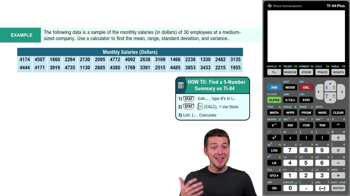
Find 5-Number Summary - TI-84 Calculator Example 1

Descriptive Statistics

Descriptive statistics summarize and describe the main features of a data set. This includes measures such as mean, median, mode, and range, which provide insights into the central tendency and variability of the data. Understanding descriptive statistics is essential for interpreting the data effectively and making informed conclusions about trends or patterns in the lightning deaths.
Recommended video:
Guided course
05:53
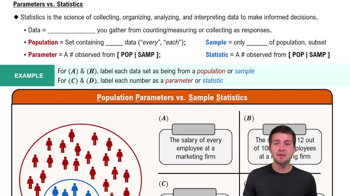
Parameters vs. Statistics

Data Set

A data set is a collection of related values or observations, often organized in a structured format. In this case, the data set consists of the annual lightning death counts over a series of years. Analyzing a data set involves calculating various statistics to understand its characteristics, such as the range, which reflects the extent of variation in the recorded deaths.
Recommended video:
Guided course
04:39
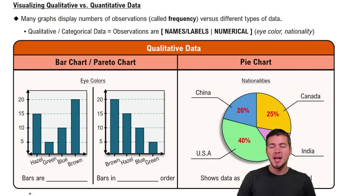
Visualizing Qualitative vs. Quantitative Data
Related Practice
Textbook Question

Lightning Deaths Listed below are the numbers of deaths from lightning strikes in the United States each year for a sequence of recent and consecutive years. Find the values of the indicated statistics.

46 51 44 51 43 32 38 48 45 27 34 29 26 28 23 26 28 40 16 20

d. Variance

Textbook Question

RESAMPLING

c. When testing a claim about a proportion or mean or standard deviation, what is an important advantage of using a resampling method instead of the parametric method described in the preceding sections of this chapter?

Textbook Question

Using Confidence Intervals to Test Hypotheses When analyzing the last digits of telephone numbers in Port Jefferson, it is found that among 1000 randomly selected digits, 119 are zeros. If the digits are randomly selected, the proportion of zeros should be 0.1.


d. Compare the results from the critical value method, the P-value method, and the confidence interval method. Do they all lead to the same conclusion?

Textbook Question

Technology

In Exercises 9–12, test the given claim by using the display provided from technology. Use a 0.05 significance level. Identify the null and alternative hypotheses, test statistic, P-value (or range of P-values), or critical value(s), and state the final conclusion that addresses the original claim.


Peanut Butter Cups Data Set 38 “Candies” includes weights of Reese’s peanut butter cups. The accompanying Statdisk display results from using all 38 weights to test the claim that the sample is from a population with a mean equal to 8.953 g.


Textbook Question

Using Confidence Intervals to Test Hypotheses When analyzing the last digits of telephone numbers in Port Jefferson, it is found that among 1000 randomly selected digits, 119 are zeros. If the digits are randomly selected, the proportion of zeros should be 0.1.


c. Use the sample data to construct a 95% confidence interval estimate of the proportion of zeros. What does the confidence interval suggest about the claim that the proportion of zeros equals 0.1?

Textbook Question

Technology

In Exercises 9–12, test the given claim by using the display provided from technology. Use a 0.05 significance level. Identify the null and alternative hypotheses, test statistic, P-value (or range of P-values), or critical value(s), and state the final conclusion that addresses the original claim.


Tower of Terror Data Set 33 “Disney World Wait Times” includes wait times (minutes) for the Tower of Terror ride at 5:00 PM. Using the first 40 times to test the claim that the mean of all such wait times is more than 30 minutes, the accompanying Excel display is obtained.