
Ch. 8 - Hypothesis Testing
Triola - Elementary Statistics 14th Edition
Triola14th EditionElementary StatisticsISBN: 9780137366446Not the one you use?Change textbook
Chapter 8, Problem 8.RE.1

Job Search A Gallup poll of 195,600 employees showed that 51% of them were actively searching for new jobs. Use a 0.01 significance level to test the claim that the majority of employees are searching for new jobs

Verified step by step guidance
1
Formulate the null hypothesis (H₀) and the alternative hypothesis (Hₐ). The null hypothesis is H₀: p ≤ 0.5 (the proportion of employees actively searching for new jobs is 50% or less). The alternative hypothesis is Hₐ: p > 0.5 (the proportion of employees actively searching for new jobs is greater than 50%).
Identify the significance level (α). The problem specifies a significance level of 0.01, which means there is a 1% risk of rejecting the null hypothesis when it is true.
Calculate the test statistic using the formula for a one-proportion z-test: z = (p̂ - p₀) / √((p₀(1 - p₀)) / n), where p̂ is the sample proportion (0.51), p₀ is the hypothesized proportion (0.5), and n is the sample size (195,600).
Determine the critical value for a one-tailed z-test at the 0.01 significance level. Use a z-table or statistical software to find the z-value corresponding to a cumulative probability of 0.99.
Compare the calculated z-test statistic to the critical value. If the test statistic is greater than the critical value, reject the null hypothesis. Otherwise, fail to reject the null hypothesis. Interpret the result in the context of the problem.

Verified video answer for a similar problem:

This video solution was recommended by our tutors as helpful for the problem above.
Video duration:
5m
Was this helpful?

Key Concepts

Here are the essential concepts you must grasp in order to answer the question correctly.

Hypothesis Testing

Hypothesis testing is a statistical method used to make decisions about a population based on sample data. It involves formulating a null hypothesis (H0) and an alternative hypothesis (H1). In this case, H0 would state that 50% or fewer employees are searching for new jobs, while H1 would claim that more than 50% are. The test assesses whether the sample data provides enough evidence to reject H0 in favor of H1.
Recommended video:
Guided course
06:21
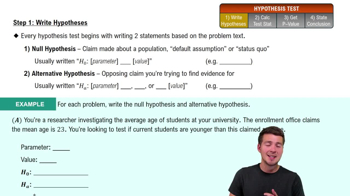
Step 1: Write Hypotheses

Significance Level

The significance level, denoted as alpha (α), is the threshold for determining whether to reject the null hypothesis. A significance level of 0.01 indicates a 1% risk of concluding that a difference exists when there is none (Type I error). In this scenario, it means that the results must be statistically significant at the 1% level to support the claim that the majority of employees are job searching.
Recommended video:
Guided course
04:46
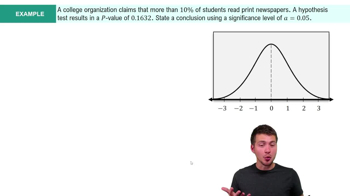
Step 4: State Conclusion Example 4

P-Value

The p-value is a statistic that helps determine the strength of the evidence against the null hypothesis. It represents the probability of observing the sample data, or something more extreme, if the null hypothesis is true. If the p-value is less than the significance level (0.01 in this case), it suggests that the observed data is unlikely under H0, leading to its rejection and supporting the claim that the majority of employees are searching for new jobs.
Recommended video:
Guided course
06:50
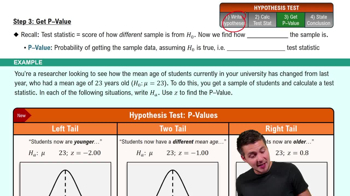
Step 3: Get P-Value
Related Practice
Textbook Question

Perception and Reality In a presidential election, 308 out of 611 voters surveyed said that they voted for the candidate who won (based on data from ICR Survey Research Group). Use a 0.05 significance level to test the claim that among all voters, the percentage who believe that they voted for the winning candidate is equal to 43%, which is the actual percentage of votes for the winning candidate. What does the result suggest about voter perceptions?

Textbook Question

Hypothesis Test for Lightning Deaths Refer to the sample data given in Cumulative Review Exercise 1 and consider those data to be a random sample of annual lightning deaths from recent years. Use those data with a 0.01 significance level to test the claim that the mean number of annual lightning deaths is less than the mean of 72.6 deaths from the 1980s. If the mean is now lower than in the past, identify one of the several factors that could explain the decline.

Textbook Question

Lightning Deaths The graph in Cumulative Review Exercise 5 was created by using data consisting of 242 male deaths from lightning strikes and 64 female deaths from lightning strikes. Assume that these data are randomly selected lightning deaths and proceed to test the claim that the proportion of male deaths is greater than . Use a 0.01 significance level. Any explanation for the result?

Textbook Question

Statistical Literacy and Critical Thinking

In Exercises 1–4, use the results from a Hankook Tire Gauge Index survey of a simple random sample of 1020 adults. Among the 1020 respondents, 86% rated themselves as above average drivers. We want to test the claim that more than 3/4 of adults rate themselves as above average drivers.


Number and Proportions


a. Identify the actual number of respondents who rated themselves as above average drivers.

Textbook Question

Identifying H0 and H1

In Exercises 5–8, do the following:


a. Express the original claim in symbolic form.

b. Identify the null and alternative hypotheses.


Light Year Claim: Most adults know that a light year is a measure of distance. Sample data: A Pew Research Center survey of 3278 adults showed that 72% knew that a light year is a measure of distance.

Textbook Question

Type I Error and Type II Error


a. In general, what is a type I error? In general, what is a type II error?