
Ch. 7 - Estimating Parameters and Determining Sample Sizes
Triola - Elementary Statistics 14th Edition
Triola14th EditionElementary StatisticsISBN: 9780137366446Not the one you use?Change textbook
Chapter 7, Problem 7.1.38c

Women Who Give Birth An epidemiologist plans to conduct a survey to estimate the percentage of women who give birth. How many women must be surveyed in order to be 99% confident that the estimated percentage is in error by no more than two percentage points?


c. What is wrong with surveying randomly selected adult women?

Verified step by step guidance
1
Determine the confidence level and margin of error: The problem specifies a 99% confidence level and a margin of error of 2 percentage points (0.02). These values will be used to calculate the required sample size.
Use the formula for sample size estimation for proportions: The formula is given by: n = (Z² × p × (1 - p)) / E², where Z is the z-score corresponding to the confidence level, p is the estimated proportion, and E is the margin of error.
Find the z-score for a 99% confidence level: The z-score corresponds to the critical value for a 99% confidence level. For a two-tailed test, this value is approximately Z = 2.576.
Assume the worst-case scenario for the proportion: If no prior estimate of the proportion p is available, use p = 0.5, as this maximizes the product p × (1 - p) and ensures the largest sample size.
Substitute the values into the formula: Plug in Z = 2.576, p = 0.5, and E = 0.02 into the formula to calculate the required sample size. Simplify the expression to find the value of n.

Verified video answer for a similar problem:

This video solution was recommended by our tutors as helpful for the problem above.
Video duration:
3m
Was this helpful?

Key Concepts

Here are the essential concepts you must grasp in order to answer the question correctly.

Sample Size Determination

Sample size determination is a statistical method used to calculate the number of observations or replicates needed in a survey to achieve a desired level of confidence and precision. In this case, the epidemiologist needs to ensure that the sample size is large enough to estimate the percentage of women who give birth with a 99% confidence level and a margin of error of two percentage points.
Recommended video:
05:11
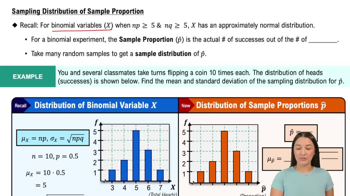
Sampling Distribution of Sample Proportion

Confidence Level

The confidence level represents the degree of certainty that the true population parameter lies within the estimated range. A 99% confidence level indicates that if the survey were repeated multiple times, 99% of the calculated confidence intervals would contain the true percentage of women who give birth. This high level of confidence requires a larger sample size.
Recommended video:
06:33
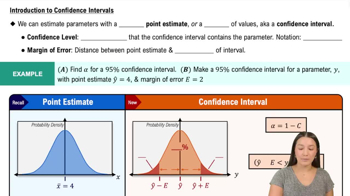
Introduction to Confidence Intervals

Random Sampling Bias

Random sampling bias occurs when the sample selected for a survey does not accurately represent the population being studied. In the context of surveying randomly selected adult women, this could lead to skewed results if the sample does not include women of childbearing age or if it over-represents certain demographics, thus affecting the validity of the findings.
Recommended video:
05:11
Sampling Distribution of Sample Proportion
Related Practice
Textbook Question

Smart Phone Apple is planning for the launch of a new and improved iPhone. The marketing team wants to know the worldwide percentage of consumers who intend to purchase the new model, so a survey is being planned. How many people must be surveyed in order to be 90% confident that the estimated percentage is within three percentage points of the true population percentage?


c. Given that the required sample size is relatively small, could you simply survey the people that you know?

Textbook Question

Tour de France Listed below are the average speeds (km/h) of winners of the Tour de France men’s bicycle race. The speeds are listed in order by year, beginning with the year 2000.


a. Construct a 95% confidence interval estimate of the population mean.


Textbook Question

Critical Thinking. In Exercises 17–28, use the data and confidence level to construct a confidence interval estimate of p, then address the given question.


Touch Therapy When she was 9 years of age, Emily Rosa did a science fair experiment in which she tested professional touch therapists to see if they could sense her energy field. She flipped a coin to select either her right hand or her left hand, and then she asked the therapists to identify the selected hand by placing their hand just under Emily’s hand without seeing it and without touching it. Among 280 trials, the touch therapists were correct 123 times (based on data in “A Close Look at Therapeutic Touch,” Journal of the American Medical Association, Vol. 279, No. 13).


c. Using Emily’s sample results, construct a 99% confidence interval estimate of the proportion of correct responses made by touch therapists.


Textbook Question

Critical Thinking. In Exercises 17–28, use the data and confidence level to construct a confidence interval estimate of p, then address the given question.


Tennis Challenges In a recent U. S. Open tennis tournament, women playing singles matches used challenges on 137 calls made by the line judges. Among those challenges, 33 were found to be successful with the call overturned.


b. Compare the result from part (a) to this 99% confidence interval for the percentage of successful challenges made by the men playing singles matches: . Does it appear that either gender is more successful than the other?

Textbook Question

Touch Your Nose With Your Tongue Find the sample size needed to estimate the percentage of adults who can touch their nose with their tongue. Use a margin of error of 2 percentage points and use a confidence level of 90%.


b. Assume that a previous study showed that 10% of adults can touch their nose with their tongue (based on data from Onedio).


Textbook Question

Critical Thinking. In Exercises 17–28, use the data and confidence level to construct a confidence interval estimate of p, then address the given question.


Job Interviews In a Harris poll of 514 human resource professionals, 45.9% said that body piercings and tattoos were big personal grooming red flags.


c. Repeat part (b) using a confidence level of 80%.