
Ch. 7 - Estimating Parameters and Determining Sample Sizes
Triola - Elementary Statistics 14th Edition
Triola14th EditionElementary StatisticsISBN: 9780137366446Not the one you use?Change textbook
Chapter 7, Problem 7.1.31b

Wiggle Your Ears Find the sample size needed to estimate the percentage of adults who can wiggle their ears. Use a margin of error of 3 percentage points and use a confidence level of 99%.


b. Assume that 22% of adults can wiggle their ears (based on data from Soul Publishing).

Verified step by step guidance
1
Step 1: Identify the formula for determining the required sample size for estimating a population proportion. The formula is: n = (z² * p * (1 - p)) / E², where 'n' is the sample size, 'z' is the z-score corresponding to the confidence level, 'p' is the estimated population proportion, and 'E' is the margin of error.
Step 2: Determine the z-score for a 99% confidence level. For a 99% confidence level, the z-score is approximately 2.576. This value is obtained from a standard normal distribution table or z-score calculator.
Step 3: Substitute the given values into the formula. Here, the estimated population proportion is p = 0.22, the margin of error is E = 0.03, and the z-score is z = 2.576. Plug these values into the formula: n = (2.576² * 0.22 * (1 - 0.22)) / 0.03².
Step 4: Simplify the numerator. Calculate 2.576², then multiply it by 0.22 and (1 - 0.22). This will give you the value of the numerator.
Step 5: Simplify the denominator and divide. Calculate 0.03² for the denominator, then divide the numerator by the denominator to find the required sample size 'n'. Round up to the nearest whole number, as sample size must be an integer.

Verified video answer for a similar problem:

This video solution was recommended by our tutors as helpful for the problem above.
Video duration:
2m
Was this helpful?

Key Concepts

Here are the essential concepts you must grasp in order to answer the question correctly.

Sample Size Calculation

Sample size calculation is a statistical method used to determine the number of observations or replicates needed to ensure that the results of a study are reliable and valid. It takes into account the desired margin of error, confidence level, and the estimated proportion of the population. In this case, the sample size will help estimate the percentage of adults who can wiggle their ears with a specified accuracy.
Recommended video:
05:11
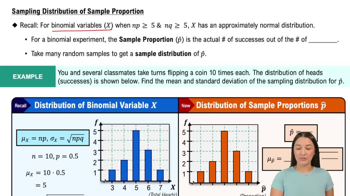
Sampling Distribution of Sample Proportion

Margin of Error

The margin of error is a statistic that expresses the amount of random sampling error in a survey's results. It indicates the range within which the true population parameter is expected to fall, given a certain confidence level. For example, a margin of error of 3 percentage points means that if the survey result is 22%, the true percentage could be as low as 19% or as high as 25%.
Recommended video:
04:08
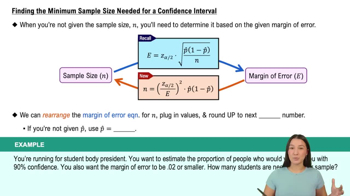
Finding the Minimum Sample Size Needed for a Confidence Interval

Confidence Level

The confidence level is the probability that the value of a parameter falls within a specified range of values. Common confidence levels are 90%, 95%, and 99%. A 99% confidence level indicates that if the same population were sampled multiple times, 99% of the calculated confidence intervals would contain the true population parameter, providing a high degree of certainty in the results.
Recommended video:
06:33
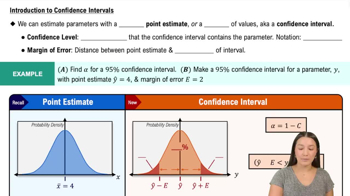
Introduction to Confidence Intervals
Related Practice
Textbook Question

Smart Phone Apple is planning for the launch of a new and improved iPhone. The marketing team wants to know the worldwide percentage of consumers who intend to purchase the new model, so a survey is being planned. How many people must be surveyed in order to be 90% confident that the estimated percentage is within three percentage points of the true population percentage?


b. Assume that 11% of consumers have a smartphone and plan to upgrade to a new model.


Textbook Question

Finite Population Correction Factor If a simple random sample of size n is selected without replacement from a finite population of size (n>0.05N), and the sample size is more than 5% of the population size , better results can be obtained by using the finite population correction factor, which involves multiplying the margin of error E by [Image]. Refer to the weights of the M&M candies in Data Set 38 “Candies” in Appendix B.


b. Use only the red M&Ms and treat that sample as a simple random sample selected from the population of the 345 M&Ms listed in the data set. Find the 95% confidence interval estimate of the mean weight of all 345 M&Ms. Compare the result to the actual mean of the population of all 345 M&Ms.


Textbook Question

E-Cigarettes A New York Times article reported that a survey conducted in 2014 included 36,000 adults, with 3.7% of them being regular users of e-cigarettes. Because e-cigarette use is relatively new, there is a need to obtain today’s usage rate. How many adults must be surveyed now if we want a confidence level of 95% and a margin of error of 1.5 percentage points?


b. Use the results from the 2014 survey.


Textbook Question

Voting Survey In a survey of 1002 people, 70% said that they voted in a recent presidential election (based on data from ICR Research Group). Voting records show that 61% of eligible voters actually did vote.


b. Find a 95% confidence interval estimate of the percentage of people who say that they voted.


Textbook Question

Mean Body Temperature Data Set 5 “Body Temperatures” in Appendix B includes 106 body temperatures of adults for Day 2 at 12 AM, and they vary from a low of 96.5F to a high of 99.6F. Find the minimum sample size required to estimate the mean body temperature of all adults. Assume that we want 98% confidence that the sample mean is within 0.1F of the population mean.


b. Assume that sigma=0.62F, based on the value of s=0.62F for the sample of 106 body temperatures.


Textbook Question

Caffeine in Soft Drinks Listed below are measured amounts of caffeine (mg per 12 oz of drink) obtained in one can from each of 20 brands (7UP, A&W Root Beer, Cherry Coke, . . . , TaB).


b. Given that Exercise 20 in Section 7-2 used the same data for a 99% confidence interval based on use of the t distribution, and given that the data do not appear to be from a normally distributed population, which confidence interval is likely to be better: The confidence interval from part (a) or the confidence interval found in Exercise 20 in Section 7-2?