
Ch. 7 - Estimating Parameters and Determining Sample Sizes
Triola - Elementary Statistics 14th Edition
Triola14th EditionElementary StatisticsISBN: 9780137366446Not the one you use?Change textbook
Chapter 7, Problem 3

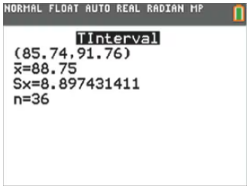
In Exercises 1–4, refer to the accompanying screen display that results from a simple random sample of times (minutes) between eruptions of the Old Faithful geyser. The confidence level of 95% was used.
img
Interpreting a Confidence Interval The results in the screen display are based on a 95% confidence level. Write a statement that correctly interprets the confidence interval.

Verified step by step guidance
1
Step 1: Understand the concept of a confidence interval. A confidence interval provides a range of values within which we expect the true population parameter (e.g., mean) to lie, given a specified confidence level (e.g., 95%).
Step 2: Identify the components of the confidence interval from the screen display. The interval is given as (85.74, 91.76), the sample mean (x̄) is 88.75, the sample standard deviation (Sx) is 8.897431411, and the sample size (n) is 36.
Step 3: Interpret the confidence interval. At a 95% confidence level, we can say that we are 95% confident that the true mean time between eruptions of the Old Faithful geyser lies between 85.74 minutes and 91.76 minutes.
Step 4: Note the role of the sample size and standard deviation. The sample size (n = 36) and the sample standard deviation (Sx = 8.897431411) influence the width of the confidence interval. Larger sample sizes and smaller standard deviations typically result in narrower intervals.
Step 5: Emphasize the probabilistic nature of the confidence interval. The 95% confidence level does not guarantee that the true mean is within the interval for this specific sample; rather, it means that if we were to take many samples and compute confidence intervals, approximately 95% of those intervals would contain the true mean.

Verified video answer for a similar problem:

This video solution was recommended by our tutors as helpful for the problem above.
Video duration:
2m
Was this helpful?

Key Concepts

Here are the essential concepts you must grasp in order to answer the question correctly.

Confidence Interval

A confidence interval is a range of values, derived from sample statistics, that is likely to contain the true population parameter with a specified level of confidence. For example, a 95% confidence interval suggests that if we were to take many samples and build intervals in this way, approximately 95% of those intervals would contain the true mean.
Recommended video:
06:33
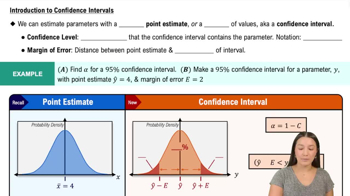
Introduction to Confidence Intervals

Sample Mean (x̄)

The sample mean, denoted as x̄, is the average of a set of sample data points. It serves as a point estimate of the population mean. In the context of the Old Faithful geyser data, the sample mean of 88.75 minutes indicates the average time between eruptions based on the sampled observations.
Recommended video:
05:11
Sampling Distribution of Sample Proportion

Sample Standard Deviation (Sx)

The sample standard deviation, represented as Sx, measures the amount of variation or dispersion in a set of sample data. A higher standard deviation indicates that the data points are spread out over a wider range of values. In this case, Sx of approximately 8.90 minutes reflects the variability in the eruption times of the geyser.
Recommended video:
Guided course
08:45
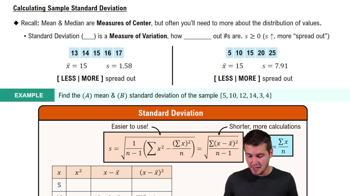
Calculating Standard Deviation
Related Practice
Textbook Question

In Exercises 1–4, refer to the accompanying screen display that results from a simple random sample of times (minutes) between eruptions of the Old Faithful geyser. The confidence level of 95% was used.

Degrees of Freedom


a. What is the number of degrees of freedom that should be used for finding the critical value ta/2?


Textbook Question

In Exercises 1–4, refer to the accompanying screen display that results from a simple random sample of times (minutes) between eruptions of the Old Faithful geyser. The confidence level of 95% was used.

Degrees of Freedom


b. Find the critical value ta/2 corresponding to a 95% confidence level.

1
views
Textbook Question

Second-Hand Smoke Refer to Data Set 15 “Passive and Active Smoke” and construct a 95% confidence interval estimates of the mean cotinine level in each of three samples: (1) people who smoke; (2) people who don’t smoke but are exposed to tobacco smoke at home or work; (3) people who don’t smoke and are not exposed to smoke. Measuring cotinine in people’s blood is the most reliable way to determine exposure to nicotine. What do the confidence intervals suggest about the effects of smoking and second-hand smoke?

Textbook Question

In Exercises 5–8, (a) identify the critical value ta/2 used for finding the margin of error, (b) find the margin of error, (c) find the confidence interval estimate of u, and (d) write a brief statement that interprets the confidence interval.


Birth Weights Here are summary statistics for randomly selected weights of newborn girls: n=36, x=3150.0g, s=695.5g (based on Data Set 6 “Births” in Appendix B). Use a confidence level of 95%.

Textbook Question

Mean IQ of Data Scientists See the preceding exercise, in which we can assume that sigma=15 for the IQ scores. Data scientists are a group with IQ scores that vary less than the IQ scores of the general population. Find the sample size needed to estimate the mean IQ of data scientists, given that we want 98% confidence that the sample mean is within 2 IQ points of the population mean. Does the sample size appear to be practical?

Textbook Question

In Exercises 1–4, refer to the accompanying screen display that results from a simple random sample of times (minutes) between eruptions of the Old Faithful geyser. The confidence level of 95% was used.

Refer to the accompanying screen display.


a. Express the confidence interval in the format that uses the “less than” symbol. Round the confidence interval limits given that the original times are all rounded to one decimal place.