Ch. 7 - Estimating Parameters and Determining Sample Sizes
Triola - Elementary Statistics 14th Edition
Triola14th EditionElementary StatisticsISBN: 9780137366446Not the one you use?Change textbook
Chapter 7, Problem 7.CQQ.8

Degrees of Freedom In general, what does “degrees of freedom” refer to? For the sample data described in Exercise 7 “Requirements,” find the number of degrees of freedom, assuming that you want to construct a confidence interval estimate of u using the t distribution.

Verified step by step guidance
1
Step 1: Understand the concept of 'degrees of freedom' (df). In statistics, degrees of freedom refer to the number of independent values or quantities that can vary in an analysis without violating any given constraints. For example, in a sample of size n, the degrees of freedom are often related to the number of values that are free to vary after certain parameters (like the mean) are fixed.
Step 2: Identify the context of the problem. Here, we are constructing a confidence interval for the population mean (μ) using the t-distribution. The t-distribution is used when the population standard deviation is unknown, and the sample standard deviation is used instead.
Step 3: Recall the formula for degrees of freedom when using the t-distribution. For a single sample, the degrees of freedom are calculated as: df = n - 1, where n is the sample size.
Step 4: Locate the sample size (n) from the problem or the referenced Exercise 7 'Requirements.' Subtract 1 from the sample size to determine the degrees of freedom. For example, if the sample size is 10, the degrees of freedom would be: df = 10 - 1 = 9.
Step 5: Use the calculated degrees of freedom (df) in the t-distribution table or software to find the critical t-value for constructing the confidence interval. This value depends on the desired confidence level (e.g., 95%) and the degrees of freedom.

Verified video answer for a similar problem:

This video solution was recommended by our tutors as helpful for the problem above.
Video duration:
1m
Was this helpful?

Key Concepts

Here are the essential concepts you must grasp in order to answer the question correctly.

Degrees of Freedom

Degrees of freedom (df) refer to the number of independent values or quantities that can vary in a statistical calculation. In the context of estimating parameters, it often represents the number of observations minus the number of parameters being estimated. For example, in a sample of size n, when estimating the mean, the degrees of freedom would be n-1.
Recommended video:
05:50
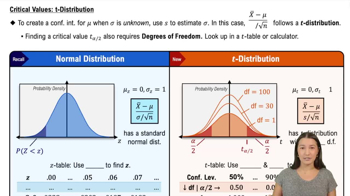
Critical Values: t-Distribution

t Distribution

The t distribution is a type of probability distribution that is symmetric and bell-shaped, similar to the normal distribution but with heavier tails. It is used primarily in hypothesis testing and constructing confidence intervals when the sample size is small and the population standard deviation is unknown. The shape of the t distribution changes with the degrees of freedom, becoming closer to the normal distribution as df increases.
Recommended video:
05:50
Critical Values: t-Distribution

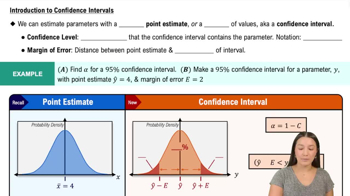
Confidence Interval

A confidence interval is a range of values, derived from sample statistics, that is likely to contain the true population parameter with a specified level of confidence, typically expressed as a percentage (e.g., 95%). It provides an estimate of uncertainty around the sample mean and is calculated using the sample mean, the t value from the t distribution, and the standard error of the mean. The width of the interval reflects the variability in the data and the sample size.
Recommended video:
06:33
Introduction to Confidence Intervals
Related Practice
Textbook Question

Cell Phone Radiation. Listed below are amounts of cell phone radiation (W/kg) measured from randomly selected cell phones (based on data from the Federal Communications Commission). Use these values for Exercises 1–6.


[Image]


Level of Measurement What is the level of measurement of these data (nominal, ordinal, interval, ratio)? Are the original unrounded amounts of radiation continuous data or discrete data?

2
views
Textbook Question

Estimating the Median Use the sample data listed in Exercise 1 “Bootstrap Requirements” to generate 1000 bootstrap samples, and find the median in each of those samples. After obtaining the 1000 sample medians, find the 95% confidence interval estimate of the population median by evaluating p2.5 and p97.5 from the sorted 1000 medians. Given that the sample times in Exercise 1 are from the 50 times in Data Set 20 “Alcohol and Tobacco in Movies” and those 50 times have a median of 5.5, how well did the bootstrap method work to create a “good” confidence interval?

Textbook Question

Archeology Archeologists have studied sizes of Egyptian skulls in an attempt to determine whether breeding occurred between different cultures. Listed below are the widths (mm) of skulls from 150 A.D. (based on data from Ancient Races of the Thebaid by Thomson and Randall-Maciver). Construct a 99% confidence interval estimate of the mean skull width.


Textbook Question

Controversial Song The song “Baby It’s Cold Outside” generated much controversy because of its lyrics and tone. CBS New York conducted a survey by asking viewers to use the Internet to respond to a question asking whether that song was really too offensive to play. Among 1043 Internet users who chose to respond, 986 said that the song was not too offensive, and 57 of the respondents said that the song was too offensive.


b. Based on the result from part (a), is it safe to say that the majority of the population does not feel that the song is too offensive.


Textbook Question

Requirements A construction quality control analyst has collected a random sample of six concrete road barriers, and she plans to weigh each of them and construct a 95% confidence interval estimate of the mean weight of all such barriers. What requirements must be satisfied in order to construct the confidence interval with the method from Section 7-2 that uses the t distribution?

Textbook Question

Controversial Song The song “Baby It’s Cold Outside” generated much controversy because of its lyrics and tone. CBS New York conducted a survey by asking viewers to use the Internet to respond to a question asking whether that song was really too offensive to play. Among 1043 Internet users who chose to respond, 986 said that the song was not too offensive, and 57 of the respondents said that the song was too offensive.

.

c. What is wrong with this survey? Based on this survey, what do we really know about the population?