

Ch. 6 - Normal Probability Distributions
Triola - Elementary Statistics 14th Edition
Triola14th EditionElementary StatisticsISBN: 9780137366446Not the one you use?Change textbook
Chapter 6, Problem 6.6.13

Tennis Replay In a recent year, there were 879 challenges made to referee calls in professional tennis singles play. Among those challenges, 231 challenges were upheld with the call overturned. Assume that in general, 25% of the challenges are successfully upheld with the call overturned.


a. If the 25% rate is correct, find the probability that among the 879 challenges, the number of overturned calls is exactly 231.

Verified step by step guidance
1
Step 1: Recognize that this is a binomial probability problem. The problem involves a fixed number of trials (n = 879), two possible outcomes (success = overturned call, failure = call not overturned), and a constant probability of success (p = 0.25). The goal is to find the probability of exactly 231 successes (k = 231).
Step 2: Write the formula for the binomial probability distribution: P(X = k) = (n choose k) * p^k * (1 - p)^(n - k). Here, (n choose k) is the binomial coefficient, which can be calculated as (n! / (k! * (n - k)!)).
Step 3: Substitute the given values into the formula. Use n = 879, k = 231, and p = 0.25. The formula becomes: P(X = 231) = (879 choose 231) * (0.25)^231 * (0.75)^(879 - 231).
Step 4: Calculate the binomial coefficient (879 choose 231). This is done using the formula: (879! / (231! * (879 - 231)!)). This step involves factorials, which can be computed using a calculator or software.
Step 5: Multiply the binomial coefficient by the probabilities raised to their respective powers. Specifically, compute (0.25)^231 and (0.75)^(879 - 231), then multiply these values by the binomial coefficient to find the final probability.

Verified video answer for a similar problem:

This video solution was recommended by our tutors as helpful for the problem above.
Video duration:
6m
Was this helpful?

Key Concepts

Here are the essential concepts you must grasp in order to answer the question correctly.

Binomial Distribution

The binomial distribution models the number of successes in a fixed number of independent Bernoulli trials, each with the same probability of success. In this context, the number of challenges (879) represents the trials, while the probability of a challenge being upheld (25%) is the success probability. This distribution is essential for calculating the probability of observing exactly 231 overturned calls.
Recommended video:
Guided course
03:28
Mean & Standard Deviation of Binomial Distribution

Probability Mass Function (PMF)

The probability mass function gives the probability of a discrete random variable taking on a specific value. For a binomial distribution, the PMF can be calculated using the formula P(X = k) = (n choose k) * p^k * (1-p)^(n-k), where n is the number of trials, k is the number of successes, and p is the probability of success. This function is crucial for determining the likelihood of exactly 231 challenges being upheld.
Recommended video:
5:37
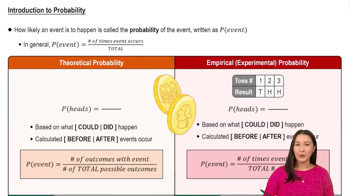
Introduction to Probability

Normal Approximation to the Binomial

For large sample sizes, the binomial distribution can be approximated by a normal distribution, which simplifies calculations. This approximation is valid when both np and n(1-p) are greater than 5. In this scenario, with 879 challenges and a 25% success rate, the normal approximation can be used to estimate probabilities and assess the likelihood of observing 231 overturned calls.
Recommended video:
06:23
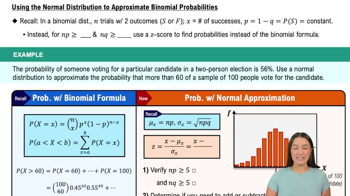
Using the Normal Distribution to Approximate Binomial Probabilities
Related Practice