Ch. 6 - Normal Probability Distributions
Triola - Elementary Statistics 14th Edition
Triola14th EditionElementary StatisticsISBN: 9780137366446Not the one you use?Change textbook
Chapter 6, Problem 6.1.10

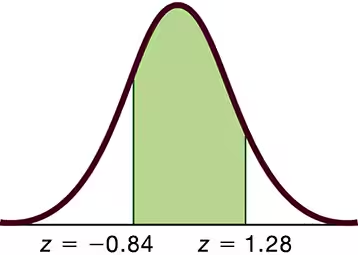
Standard Normal Distribution. In Exercises 9–12, find the area of the shaded region. The graph depicts the standard normal distribution of bone density scores with mean 0 and standard deviation 1.


Standard normal distribution curve with shaded area between z = -0.84 and z = 1.28.

Verified step by step guidance
1
Step 1: Understand the problem. The graph represents a standard normal distribution with a mean of 0 and a standard deviation of 1. The shaded region corresponds to the area between z = -0.84 and z = 1.28. We need to calculate this area.
Step 2: Recall that the area under the standard normal curve represents probabilities. To find the area between two z-scores, we calculate the cumulative probability for each z-score using the standard normal table or a statistical software.
Step 3: Look up the cumulative probability for z = -0.84 in the standard normal table. This gives the area to the left of z = -0.84.
Step 4: Look up the cumulative probability for z = 1.28 in the standard normal table. This gives the area to the left of z = 1.28.
Step 5: Subtract the cumulative probability for z = -0.84 from the cumulative probability for z = 1.28. This difference represents the area of the shaded region between the two z-scores.

Verified video answer for a similar problem:

This video solution was recommended by our tutors as helpful for the problem above.
Video duration:
2m
Was this helpful?

Key Concepts

Here are the essential concepts you must grasp in order to answer the question correctly.

Standard Normal Distribution

The standard normal distribution is a special case of the normal distribution where the mean is 0 and the standard deviation is 1. It is represented by the bell-shaped curve, which is symmetric about the mean. This distribution is crucial for statistical analysis as it allows for the calculation of probabilities and the use of z-scores to determine how far a data point is from the mean in terms of standard deviations.
Recommended video:
Guided course
09:47
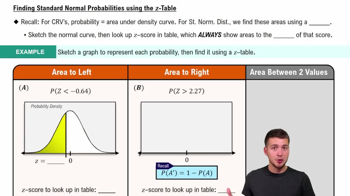
Finding Standard Normal Probabilities using z-Table

Z-scores

A z-score indicates how many standard deviations an element is from the mean of a distribution. It is calculated by subtracting the mean from the value and then dividing by the standard deviation. In the context of the standard normal distribution, z-scores help in identifying the position of a score relative to the mean, allowing for the determination of probabilities associated with specific ranges of data.
Recommended video:
Guided course
06:31
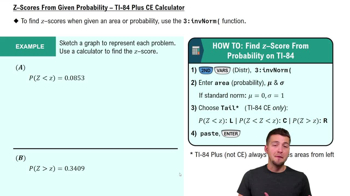
Z-Scores From Given Probability - TI-84 (CE) Calculator

Area under the Curve

The area under the curve of a probability distribution represents the total probability of all outcomes. For the standard normal distribution, the area between two z-scores corresponds to the probability of a score falling within that range. This area can be found using z-tables or statistical software, and it is essential for answering questions related to probabilities and confidence intervals in statistics.
Recommended video:
Guided course
08:50
Z-Scores from Probabilities
Related Practice
Textbook Question

Notation Common tests such as the SAT, ACT, LSAT, and MCAT tests use multiple choice test questions, each with possible answers of a, b, c, d, e, and each question has only one correct answer. For people who make random guesses for answers to a block of 100 questions, identify the values of p, q, μ, and σ. What do μ and σ measure?

Textbook Question

Continuous Uniform Distribution. In Exercises 5–8, refer to the continuous uniform distribution depicted in Figure 6-2 and described in Example 1. Assume that a passenger is randomly selected, and find the probability that the waiting time is within the given range.


Between 2 minutes and 3 minutes

Textbook Question

Hypothesis Testing. In Exercises 17–19, apply the central limit theorem to test the given claim. (Hint: See Example 3.)


Adult Sleep Times (hours) of sleep for randomly selected adult subjects included in the National Health and Nutrition Examination Study are listed below. Here are the statistics for this sample: n = 12, x_bar = 6.8 hours, s = 20 hours. The times appear to be from a normally distributed population. A common recommendation is that adults should sleep between 7 hours and 9 hours each night. Assuming that the mean sleep time is 7 hours, find the probability of getting a sample of 12 adults with a mean of 6.8 hours or less. What does the result suggest about a claim that “the mean sleep time is less than 7 hours”?


4 8 4 4 8 6 9 7 7 10 7 8

Textbook Question

Continuous Uniform Distribution. In Exercises 5–8, refer to the continuous uniform distribution depicted in Figure 6-2 and described in Example 1. Assume that a passenger is randomly selected, and find the probability that the waiting time is within the given range.

Less than 4.00 minutes

1
views
Textbook Question

Births: Sampling Distribution of Sample Proportion When two births are randomly selected, the sample space for genders is bb, bg, gb, and gg (where and Assume that those four outcomes are equally likely. Construct a table that describes the sampling distribution of the sample proportion of girls from two births. Does the mean of the sample proportions equal the proportion of girls in two births? Does the result suggest that a sample proportion is an unbiased estimator of a population proportion?

Textbook Question

Distributions In a continuous uniform distribution,


" style="" width="290">


a. Find the mean and standard deviation for the distribution of the waiting times represented in Figure 6-2, which accompanies Exercises 5–8.

1
views