
Ch. 6 - Normal Probability Distributions
Triola - Elementary Statistics 14th Edition
Triola14th EditionElementary StatisticsISBN: 9780137366446Not the one you use?Change textbook
Chapter 6, Problem 6.RE.6c

Mensa Membership in Mensa requires a score in the top 2% on a standard intelligence test. The Wechsler IQ test is designed for a mean of 100 and a standard deviation of 15, and scores are normally distributed.


c. If 4 subjects take the Wechsler IQ test and they have a mean of 131 but the individual scores are lost, can we conclude that all 4 of them have scores of at least 131?

Verified step by step guidance
1
Step 1: Understand the problem. The question asks whether we can conclude that all 4 subjects have scores of at least 131, given that their mean score is 131. Recall that the mean is the average of the scores, and it does not necessarily imply that all individual scores are equal to or greater than the mean.
Step 2: Recall the formula for the mean: \( \text{Mean} = \frac{\text{Sum of all scores}}{\text{Number of scores}} \). Here, the mean is 131, and the number of scores is 4. Using this formula, calculate the total sum of the scores: \( \text{Sum of scores} = \text{Mean} \times \text{Number of scores} = 131 \times 4 \).
Step 3: Consider the possibility of variability in the individual scores. The mean of 131 only tells us the average, but individual scores could vary above or below the mean. For example, one score could be higher than 131 while another could be lower, as long as their average remains 131.
Step 4: To determine if all scores are at least 131, consider the extreme case where one or more scores are below 131. If even one score is below 131, then the others must compensate by being higher than 131 to maintain the mean. This means we cannot conclude definitively that all scores are at least 131 based solely on the mean.
Step 5: Conclude that without additional information about the individual scores or their distribution, it is not possible to determine whether all 4 subjects scored at least 131. The mean alone does not provide sufficient evidence to make this conclusion.

Verified video answer for a similar problem:

This video solution was recommended by our tutors as helpful for the problem above.
Video duration:
1m
Was this helpful?

Key Concepts

Here are the essential concepts you must grasp in order to answer the question correctly.

Normal Distribution

Normal distribution is a probability distribution that is symmetric about the mean, indicating that data near the mean are more frequent in occurrence than data far from the mean. In the context of IQ scores, this means that most individuals score around the average (100), with fewer individuals scoring significantly higher or lower. Understanding this concept is crucial for interpreting how individual scores relate to the mean.
Recommended video:
Guided course
09:47
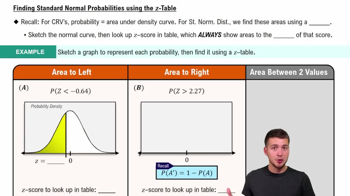
Finding Standard Normal Probabilities using z-Table

Mean and Individual Scores

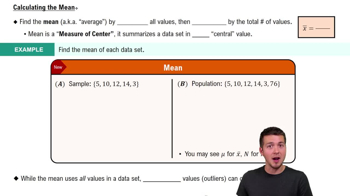
The mean is the average of a set of values, calculated by summing all the scores and dividing by the number of scores. However, the mean does not provide information about the individual scores themselves. In this case, while the mean IQ score of the four subjects is 131, it does not guarantee that each individual score is at least 131, as some scores could be lower, provided they average out to 131.
Recommended video:
Guided course
04:52
Calculating the Mean

Statistical Inference

Statistical inference involves drawing conclusions about a population based on a sample of data. In this scenario, even though the mean IQ score of the four subjects is known, we cannot infer that all individual scores meet a specific threshold without additional information. This highlights the importance of understanding the limitations of statistical conclusions when dealing with averages.
Recommended video:
Guided course
05:53
Parameters vs. Statistics
Related Practice
Textbook Question

Ergonomics. Exercises 9–16 involve applications to ergonomics, as described in the Chapter Problem.


Doorway Height The Boeing 757-200 ER airliner carries 200 passengers and has doors with a height of 72 in. Heights of men are normally distributed with a mean of 68.6 in. and a standard deviation of 2.8 in. (based on Data Set 1 “Body Data” in Appendix B).


a. If a male passenger is randomly selected, find the probability that he can fit through the doorway without bending.

Textbook Question

College Presidents There are about 4200 college presidents in the United States, and they have annual incomes with a distribution that is skewed instead of being normal. Many different samples of 40 college presidents are randomly selected, and the mean annual income is computed for each sample.

a. What is the approximate shape of the distribution of the sample means (uniform, normal, skewed, other)?

Textbook Question

Arm Circumferences Arm circumferences of adult men are normally distributed with a mean of 33.64 cm and a standard deviation of 4.14 cm (based on Data Set 1 “Body Data” in Appendix B). A sample of 25 men is randomly selected and the mean of the arm circumferences is obtained.

b. What is the mean of all such sample means?

Textbook Question

Birth Weights Based on Data Set 6 “Births” in Appendix B, birth weights of girls are normally distributed with a mean of 3037.1 g and a standard deviation of 706.3 g.


b. What is the value of the median?

Textbook Question

Birth Weights Based on Data Set 6 “Births” in Appendix B, birth weights of girls are normally distributed with a mean of 3037.1 g and a standard deviation of 706.3 g.


c. What is the value of the mode?

Textbook Question

In Exercises 7–10, use the same population of {4, 5, 9} that was used in Examples 2 and 5. As in Examples 2 and 5, assume that samples of size n = 2 are randomly selected with replacement.


Sampling Distribution of the Sample Variance


a. Find the value of the population variance σ2.