Ch. 6 - Normal Probability Distributions
Triola - Elementary Statistics 14th Edition
Triola14th EditionElementary StatisticsISBN: 9780137366446Not the one you use?Change textbook
Chapter 6, Problem 6.2.8

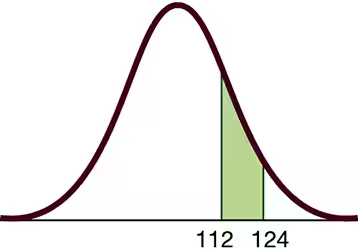
IQ Scores. In Exercises 5–8, find the area of the shaded region. The graphs depict IQ scores of adults, and those scores are normally distributed with a mean of 100 and a standard deviation of 15 (as on the Wechsler IQ test).
Bell curve showing IQ scores with shaded area between 112 and 124, representing a section of the normal distribution.

Verified step by step guidance
1
Step 1: Recognize that the problem involves finding the area under the normal distribution curve between two IQ scores, 112 and 124. The mean (μ) is 100, and the standard deviation (σ) is 15.
Step 2: Convert the IQ scores (112 and 124) into z-scores using the formula: z = (X - μ) / σ. For X = 112, substitute μ = 100 and σ = 15 into the formula. Similarly, calculate the z-score for X = 124.
Step 3: Use a standard normal distribution table or a statistical software to find the cumulative probability corresponding to each z-score. This gives the area under the curve to the left of each z-score.
Step 4: Subtract the cumulative probability of the z-score for 112 from the cumulative probability of the z-score for 124. This difference represents the area of the shaded region between the two z-scores.
Step 5: Interpret the result as the proportion of adults with IQ scores between 112 and 124, based on the normal distribution.

Verified video answer for a similar problem:

This video solution was recommended by our tutors as helpful for the problem above.
Video duration:
4m
Was this helpful?

Key Concepts

Here are the essential concepts you must grasp in order to answer the question correctly.

Normal Distribution

Normal distribution is a probability distribution that is symmetric about the mean, depicting that data near the mean are more frequent in occurrence than data far from the mean. It is characterized by its bell-shaped curve, defined by its mean and standard deviation. In the context of IQ scores, the mean is 100 and the standard deviation is 15, indicating how scores are spread around the average.
Recommended video:
Guided course
09:47
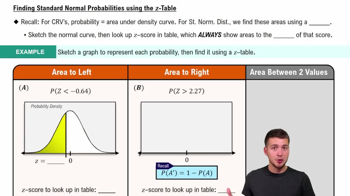
Finding Standard Normal Probabilities using z-Table

Z-Scores

A Z-score indicates how many standard deviations an element is from the mean. It is calculated by subtracting the mean from the score and then dividing by the standard deviation. Z-scores are essential for determining the area under the normal curve, which helps in finding probabilities associated with specific IQ scores, such as those between 112 and 124 in this case.
Recommended video:
Guided course
06:31
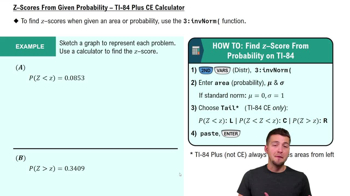
Z-Scores From Given Probability - TI-84 (CE) Calculator

Area Under the Curve

The area under the curve in a normal distribution represents the probability of a score falling within a certain range. To find the area between two scores, such as 112 and 124, one can use Z-scores to look up corresponding probabilities in a standard normal distribution table. This area gives insight into the proportion of the population that falls within that IQ score range.
Recommended video:
Guided course
08:50
Z-Scores from Probabilities
Related Practice
Textbook Question

Good Sample? An economist is investigating the incomes of college students. Because she lives in Maine, she obtains sample data from that state. Is the resulting mean income of college students a good estimator of the mean income of college students in the United States? Why or why not?

Textbook Question

Standard Normal Distribution. In Exercises 17–36, assume that a randomly selected subject is given a bone density test. Those test scores are normally distributed with a mean of 0 and a standard deviation of 1. In each case, draw a graph, then find the probability of the given bone density test scores. If using technology instead of Table A-2, round answers to four decimal places.


Less than -2.00

Textbook Question

Continuous Uniform Distribution. In Exercises 5–8, refer to the continuous uniform distribution depicted in Figure 6-2 and described in Example 1. Assume that a passenger is randomly selected, and find the probability that the waiting time is within the given range.


" style="" width="225">


Greater than 3.00 minutes

Textbook Question

Pulse Rates. In Exercises 13–24, use the data in the table below for pulse rates of adult males and females (based on Data Set 1 “Body Data” in Appendix B). Hint: Draw a graph in each case.


" style="" width="340">


For males, find P90 which is the pulse rate separating the bottom 90% from the top 10%.

Textbook Question

Interpreting Normal Quantile Plots. In Exercises 5–8, examine the normal quantile plot and determine whether the sample data appear to be from a population with a normal distribution.


Ages of Presidents The normal quantile plot represents the ages of presidents of the United States at the times of their inaugurations. The data are from Data Set 22 “Presidents” in Appendix B.

Textbook Question

Critical Values. In Exercises 41–44, find the indicated critical value. Round results to two decimal places.


z0.90