
Ch. 6 - Normal Probability Distributions
Triola - Elementary Statistics 14th Edition
Triola14th EditionElementary StatisticsISBN: 9780137366446Not the one you use?Change textbook
Chapter 6, Problem 6.4.11b

Ergonomics. Exercises 9–16 involve applications to ergonomics, as described in the Chapter Problem.


Water Taxi Safety Passengers died when a water taxi sank in Baltimore’s Inner Harbor. Men are typically heavier than women and children, so when loading a water taxi, assume a worst-case scenario in which all passengers are men. Assume that weights of men are normally distributed with a mean of 189 lb and a standard deviation of 39 lb (based on Data Set 1 “Body Data” in Appendix B). The water taxi that sank had a stated capacity of 25 passengers, and the boat was rated for a load limit of 3500 lb.


b. If the water taxi is filled with 25 randomly selected men, what is the probability that their mean weight exceeds the value from part (a)?

Verified step by step guidance
1
Step 1: Identify the key parameters of the problem. The mean weight of men is given as 189 lb, and the standard deviation is 39 lb. The sample size is 25 men, and we are tasked with finding the probability that the mean weight of these 25 men exceeds a certain value.
Step 2: Recall the Central Limit Theorem. Since the weights of men are normally distributed, the sampling distribution of the sample mean will also be normally distributed. The mean of the sampling distribution will be the same as the population mean (μ = 189 lb), and the standard deviation of the sampling distribution (standard error) is calculated as σ/√n, where σ is the population standard deviation and n is the sample size.
Step 3: Calculate the standard error of the mean. Use the formula: σn. Substitute σ = 39 lb and n = 25 into the formula to compute the standard error.
Step 4: Determine the z-score for the mean weight threshold provided in part (a). The z-score is calculated using the formula: X̄-μSE, where X̄ is the threshold mean weight, μ is the population mean, and SE is the standard error.
Step 5: Use the z-score to find the probability. Look up the z-score in the standard normal distribution table or use statistical software to find the area to the right of the z-score. This area represents the probability that the mean weight of the 25 men exceeds the threshold value.

Verified video answer for a similar problem:

This video solution was recommended by our tutors as helpful for the problem above.
Video duration:
4m
Was this helpful?

Key Concepts

Here are the essential concepts you must grasp in order to answer the question correctly.

Normal Distribution

Normal distribution is a probability distribution that is symmetric about the mean, showing that data near the mean are more frequent in occurrence than data far from the mean. In this context, the weights of men are normally distributed with a specified mean and standard deviation, which allows us to use the properties of the normal distribution to calculate probabilities related to sample means.
Recommended video:
Guided course
09:47
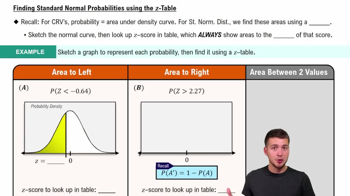
Finding Standard Normal Probabilities using z-Table

Central Limit Theorem

The Central Limit Theorem states that the sampling distribution of the sample mean will be normally distributed, regardless of the shape of the population distribution, provided the sample size is sufficiently large (typically n > 30). In this scenario, since we are considering the mean weight of 25 men, this theorem justifies the use of normal distribution to find the probability of their mean weight exceeding a certain value.
Recommended video:
Guided course
04:52
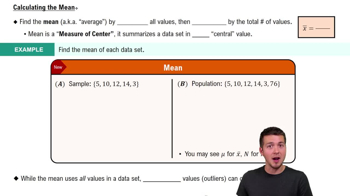
Calculating the Mean

Z-Score

A Z-score is a statistical measurement that describes a value's relationship to the mean of a group of values, expressed in terms of standard deviations. It is calculated by subtracting the mean from the value and dividing by the standard deviation. In this problem, calculating the Z-score for the mean weight of the 25 men will help determine the probability that their mean weight exceeds a specified threshold.
Recommended video:
Guided course
06:31
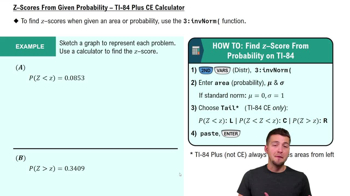
Z-Scores From Given Probability - TI-84 (CE) Calculator
Related Practice
Textbook Question

Ergonomics. Exercises 9–16 involve applications to ergonomics, as described in the Chapter Problem.


Safe Loading of Elevators The elevator in the car rental building at San Francisco International Airport has a placard stating that the maximum capacity is “4000 lb—27 passengers.” Because 4000/27=148, this converts to a mean passenger weight of 148 lb when the elevator is full. We will assume a worst-case scenario in which the elevator is filled with 27 adult males. Based on Data Set 1 “Body Data” in Appendix B, assume that adult males have weights that are normally distributed with a mean of 189 lb and a standard deviation of 39 lb.


b. Find the probability that a sample of 27 randomly selected adult males has a mean weight greater than 148 lb.

Textbook Question

In Exercises 7–10, use the same population of {4, 5, 9} that was used in Examples 2 and 5. As in Examples 2 and 5, assume that samples of size n = 2 are randomly selected with replacement.


Sampling Distribution of the Sample Proportion


a. For the population, find the proportion of odd numbers.

Textbook Question

Hershey Kisses Based on Data Set 38 “Candies” in Appendix B, weights of the chocolate in Hershey Kisses are normally distributed with a mean of 4.5338 g and a standard deviation of 0.1039 g


b. What is the value of the median?

1
views
Textbook Question

MCAT The Medical College Admissions Test (MCAT) is used to help screen applicants to medical schools. Like many such tests, the MCAT uses multiple-choice questions with each question having five choices, one of which is correct. Assume that you must make random guesses for two such questions. Assume that both questions have correct answers of “a.”


b. Find the mean of the sampling distribution of the sample proportion.

Textbook Question

Using the Central Limit Theorem. In Exercises 5–8, assume that the amounts of weight that male college students gain during their freshman year are normally distributed with a mean of 1.2 kg and a standard deviation of 4.9 kg (based on Data Set 13 “Freshman 15” in Appendix B).


b. If 9 male college students are randomly selected, find the probability that their mean weight gain during freshman year is between 0 kg and 3 kg.

Textbook Question

Smartphones Based on an LG smartphone survey, assume that 51% of adults with smartphones use them in theaters. In a separate survey of 250 adults with smartphones, it is found that 109 use them in theaters.


a. If the 51% rate is correct, find the probability of getting 109 or fewer smartphone owners who use them in theaters.

1
views