
Ch. 6 - Normal Probability Distributions
Triola - Elementary Statistics 14th Edition
Triola14th EditionElementary StatisticsISBN: 9780137366446Not the one you use?Change textbook
Chapter 6, Problem 33a

Durations of Pregnancies The lengths of pregnancies are normally distributed with a mean of 268 days and a standard deviation of 15 days.


a. In a letter to “Dear Abby,” a wife claimed to have given birth 308 days after a brief visit from her husband, who was working in another country. Find the probability of a pregnancy lasting 308 days or longer. What does the result suggest?

Verified step by step guidance
1
Step 1: Identify the key parameters of the normal distribution. The mean (μ) is 268 days, and the standard deviation (σ) is 15 days. The problem asks for the probability of a pregnancy lasting 308 days or longer.
Step 2: Convert the raw score (308 days) into a z-score using the z-score formula: z = (X - μ) / σ. Here, X is the value of interest (308 days), μ is the mean (268 days), and σ is the standard deviation (15 days).
Step 3: Once the z-score is calculated, use a standard normal distribution table or a statistical software to find the cumulative probability corresponding to the z-score. This cumulative probability represents the probability of a pregnancy lasting less than 308 days.
Step 4: To find the probability of a pregnancy lasting 308 days or longer, subtract the cumulative probability from 1. This is because the total probability under the normal curve is 1, and we are interested in the upper tail of the distribution.
Step 5: Interpret the result. If the probability is extremely small, it suggests that a pregnancy lasting 308 days or longer is highly unusual under normal circumstances. This could raise questions about the claim made in the letter.

Verified video answer for a similar problem:

This video solution was recommended by our tutors as helpful for the problem above.
Video duration:
4m
Was this helpful?

Key Concepts

Here are the essential concepts you must grasp in order to answer the question correctly.

Normal Distribution

Normal distribution is a probability distribution that is symmetric about the mean, showing that data near the mean are more frequent in occurrence than data far from the mean. It is characterized by its bell-shaped curve, defined by its mean and standard deviation. In this context, the lengths of pregnancies follow a normal distribution with a mean of 268 days and a standard deviation of 15 days.
Recommended video:
Guided course
09:47
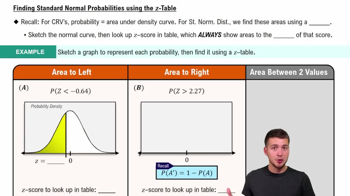
Finding Standard Normal Probabilities using z-Table

Z-Score

A Z-score is a statistical measurement that describes a value's relationship to the mean of a group of values. It is calculated by subtracting the mean from the value and then dividing by the standard deviation. In this case, to find the probability of a pregnancy lasting 308 days or longer, we would calculate the Z-score for 308 days to determine how many standard deviations it is from the mean.
Recommended video:
Guided course
06:31
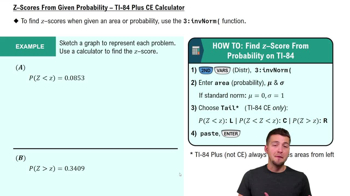
Z-Scores From Given Probability - TI-84 (CE) Calculator

Probability

Probability is a measure of the likelihood that an event will occur, expressed as a number between 0 and 1. In this scenario, we are interested in finding the probability of a pregnancy lasting 308 days or longer, which involves using the Z-score to find the corresponding area under the normal distribution curve. This probability can provide insights into how unusual or common such a long pregnancy is within the context of typical pregnancy durations.
Recommended video:
5:37
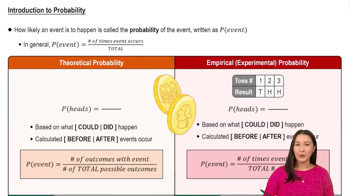
Introduction to Probability
Related Practice
Textbook Question

Water Taxi Safety When a water taxi sank in Baltimore’s Inner Harbor, an investigation revealed that the safe passenger load for the water taxi was 3500 lb. It was also noted that the mean weight of a passenger was assumed to be 140 lb. Assume a “worst-case” scenario in which all of the passengers are adult men. Assume that weights of men are normally distributed with a mean of 188.6 lb and a standard deviation of 38.9 lb (based on Data Set 1 “Body Data” in Appendix B).


c. With a load limit of 3500 lb, how many male passengers are allowed if we assume the updated mean weight of 188.6 lb?

Textbook Question

In Exercises 25–28, use these parameters (based on Data Set 1 “Body Data” in Appendix B):


Men’s heights are normally distributed with mean 68.6 in. and standard deviation 2.8 in.

Women’s heights are normally distributed with mean 63.7 in. and standard deviation 2.9 in.


Snow White Disney World requires that women employed as a Snow White character must have a height between 64 in. and 67 in.


a. Find the percentage of women meeting the height requirement.

Textbook Question

Aircraft Seat Width Engineers want to design seats in commercial aircraft so that they are wide enough to fit 99% of all adults. (Accommodating 100% of adults would require very wide seats that would be much too expensive.) Assume adults have hip widths that are normally distributed with a mean of 14.3 in. and a standard deviation of 0.9 in. (based on data from Applied Ergonomics). Find P99. That is, find the hip width for adults that separates the smallest 99% from the largest 1%.

Textbook Question

Designing Helmets Engineers must consider the circumferences of adult heads when designing motorcycle helmets. Adult head circumferences are normally distributed with a mean of 570.0 mm and a standard deviation of 18.3 mm (based on Data Set 3 “ANSUR II 2012”). Due to financial constraints, the helmets will be designed to fit all adults except those with head circumferences that are in the smallest 5% or largest 5%. Find the minimum and maximum head circumferences that the helmets will fit.

Textbook Question

Water Taxi Safety When a water taxi sank in Baltimore’s Inner Harbor, an investigation revealed that the safe passenger load for the water taxi was 3500 lb. It was also noted that the mean weight of a passenger was assumed to be 140 lb. Assume a “worst-case” scenario in which all of the passengers are adult men. Assume that weights of men are normally distributed with a mean of 188.6 lb and a standard deviation of 38.9 lb (based on Data Set 1 “Body Data” in Appendix B).


a. If one man is randomly selected, find the probability that he weighs less than 174 lb (the new value suggested by the National Transportation and Safety Board).