
Ch. 6 - Normal Probability Distributions
Triola - Elementary Statistics 14th Edition
Triola14th EditionElementary StatisticsISBN: 9780137366446Not the one you use?Change textbook
Chapter 6, Problem 20b

Correcting for a Finite Population In a study of babies born with very low birth weights, 275 children were given IQ tests at age 8, and their scores approximated a normal distribution with μ = 95.5 and σ = 16.0 (based on data from “Neurobehavioral Outcomes of School-age Children Born Extremely Low Birth Weight or Very Preterm,” by Anderson et al., Journal of the American Medical Association, Vol. 289, No. 24). Fifty of those children are to be randomly selected without replacement for a follow-up study.


b. Find the probability that the mean IQ score of the follow-up sample is between 95 and 105.

Verified step by step guidance
1
Step 1: Identify the key parameters of the problem. The population mean (μ) is 95.5, the population standard deviation (σ) is 16.0, the sample size (n) is 50, and the population size (N) is 275. The goal is to find the probability that the sample mean IQ score is between 95 and 105.
Step 2: Adjust the standard error of the mean to account for the finite population correction factor. The formula for the corrected standard error is: σ = σ1n × N - nN - 1, where N is the population size, n is the sample size, and σ is the population standard deviation.
Step 3: Calculate the z-scores for the sample mean values of 95 and 105. The z-score formula is: z = - μσ, where x̄ is the sample mean, μ is the population mean, and σ is the corrected standard error of the mean.
Step 4: Use the z-scores to find the cumulative probabilities corresponding to the sample mean values of 95 and 105. This can be done using a standard normal distribution table or statistical software. The cumulative probability for a z-score represents the area under the standard normal curve to the left of that z-score.
Step 5: Subtract the cumulative probability for the lower z-score (corresponding to 95) from the cumulative probability for the higher z-score (corresponding to 105). This difference gives the probability that the sample mean IQ score is between 95 and 105.

Verified video answer for a similar problem:

This video solution was recommended by our tutors as helpful for the problem above.
Video duration:
8m
Was this helpful?

Key Concepts

Here are the essential concepts you must grasp in order to answer the question correctly.

Normal Distribution

A normal distribution is a probability distribution that is symmetric about the mean, indicating that data near the mean are more frequent in occurrence than data far from the mean. In this context, the IQ scores of the children are said to approximate a normal distribution, which allows for the application of statistical methods to calculate probabilities related to the mean and standard deviation.
Recommended video:
Guided course
09:47
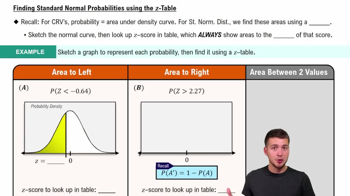
Finding Standard Normal Probabilities using z-Table

Sampling Distribution of the Mean

The sampling distribution of the mean refers to the distribution of sample means obtained from all possible samples of a specific size from a population. When sampling without replacement, the mean of the sample will tend to be normally distributed around the population mean, especially as the sample size increases, which is crucial for calculating probabilities regarding the sample mean.
Recommended video:
05:11
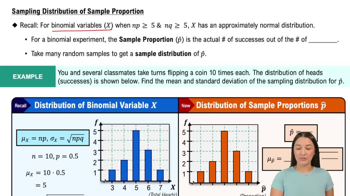
Sampling Distribution of Sample Proportion

Central Limit Theorem

The Central Limit Theorem states that the distribution of the sample mean will approach a normal distribution as the sample size increases, regardless of the shape of the population distribution, provided the samples are independent. This theorem is essential for determining the probability that the mean IQ score of the follow-up sample falls within a specified range, as it justifies the use of normal distribution properties for the sample mean.
Recommended video:
Guided course
04:52
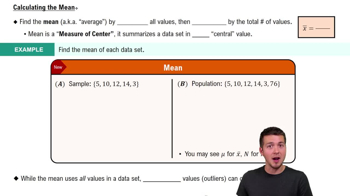
Calculating the Mean
Related Practice
Textbook Question

In Exercises 11–14, use the population of {2, 3, 5, 9} of the lengths of hospital stay (days) of mothers who gave birth, found from Data Set 6 “Births” in Appendix B. Assume that random samples of size n = 2 are selected with replacement.


Sampling Distribution of the Sample Mean


a. After identifying the 16 different possible samples, find the mean of each sample, and then construct a table representing the sampling distribution of the sample mean. In the table, combine values of the sample mean that are the same. (Hint: See Table 6-3 in Example 2.)

Textbook Question

In Exercises 25–28, use these parameters (based on Data Set 1 “Body Data” in Appendix B):


Men’s heights are normally distributed with mean 68.6 in. and standard deviation 2.8 in.

Women’s heights are normally distributed with mean 63.7 in. and standard deviation 2.9 in.


Snow White Disney World requires that women employed as a Snow White character must have a height between 64 in. and 67 in.


a. Find the percentage of women meeting the height requirement.

Textbook Question

Quarters Assume that weights of quarters minted after 1964 are normally distributed with a mean of 5.670 g and a standard deviation of 0.062 g (based on U.S. Mint specifications).

d. If a vending machine is designed to accept quarters with weights above the 10th percentile P10 find the weight separating acceptable quarters from those that are not acceptable.

Textbook Question

Quarters Assume that weights of quarters minted after 1964 are normally distributed with a mean of 5.670 g and a standard deviation of 0.062 g (based on U.S. Mint specifications).

a. Find the probability that a randomly selected quarter weighs between 5.600 g and 5.700 g..

Textbook Question

Designing Helmets Engineers must consider the circumferences of adult heads when designing motorcycle helmets. Adult head circumferences are normally distributed with a mean of 570.0 mm and a standard deviation of 18.3 mm (based on Data Set 3 “ANSUR II 2012”). Due to financial constraints, the helmets will be designed to fit all adults except those with head circumferences that are in the smallest 5% or largest 5%. Find the minimum and maximum head circumferences that the helmets will fit.

Textbook Question

In Exercises 25–28, use these parameters (based on Data Set 1 “Body Data” in Appendix B):


Men’s heights are normally distributed with mean 68.6 in. and standard deviation 2.8 in.

Women’s heights are normally distributed with mean 63.7 in. and standard deviation 2.9 in.


Mickey Mouse Disney World requires that people employed as a Mickey Mouse character must have a height between 56 in. and 62 in.


a. Find the percentage of men meeting the height requirement. What does the result suggest about the genders of the people who are employed as Mickey Mouse characters?