
Ch. 6 - Normal Probability Distributions
Triola - Elementary Statistics 14th Edition
Triola14th EditionElementary StatisticsISBN: 9780137366446Not the one you use?Change textbook
Chapter 6, Problem 6.r.1a

Bone Density Test A bone mineral density test is used to identify a bone disease. The result of a bone density test is commonly measured as a z score, and the population of z scores is normally distributed with a mean of 0 and a standard deviation of 1.


a. For a randomly selected subject, find the probability of a bone density test score greater than -1.37.

Verified step by step guidance
1
Step 1: Understand the problem. The z-score represents the number of standard deviations a data point is from the mean. Here, the z-score is -1.37, and we are tasked with finding the probability that a randomly selected subject has a z-score greater than -1.37 in a standard normal distribution (mean = 0, standard deviation = 1).
Step 2: Recall that the cumulative distribution function (CDF) of the standard normal distribution gives the probability that a z-score is less than or equal to a given value. Denote this as P(Z ≤ -1.37).
Step 3: Use the complement rule to find the probability of a z-score greater than -1.37. This is given by P(Z > -1.37) = 1 - P(Z ≤ -1.37).
Step 4: Look up the cumulative probability P(Z ≤ -1.37) in a standard normal distribution table or use statistical software to find its value. This value represents the area under the curve to the left of z = -1.37.
Step 5: Subtract the cumulative probability P(Z ≤ -1.37) from 1 to find P(Z > -1.37). This result represents the probability of a bone density test score greater than -1.37.

Verified video answer for a similar problem:

This video solution was recommended by our tutors as helpful for the problem above.
Video duration:
3m
Was this helpful?

Key Concepts

Here are the essential concepts you must grasp in order to answer the question correctly.

Z Score

A Z score represents the number of standard deviations a data point is from the mean of a distribution. In the context of a bone density test, a Z score of 0 indicates the average bone density, while positive and negative values indicate above or below average densities, respectively. Understanding Z scores is crucial for interpreting test results and assessing the likelihood of a subject's score relative to the population.
Recommended video:
Guided course
06:31
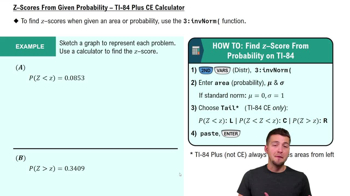
Z-Scores From Given Probability - TI-84 (CE) Calculator

Normal Distribution

Normal distribution is a probability distribution that is symmetric about the mean, depicting that data near the mean are more frequent in occurrence than data far from the mean. In this case, the Z scores of bone density tests follow a normal distribution with a mean of 0 and a standard deviation of 1. This property allows for the use of standard statistical methods to calculate probabilities and make inferences about the population.
Recommended video:
Guided course
09:47
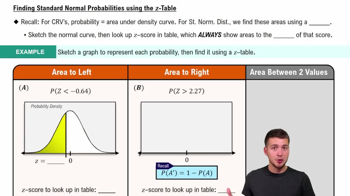
Finding Standard Normal Probabilities using z-Table

Probability Calculation

Probability calculation involves determining the likelihood of a specific outcome occurring within a defined set of possibilities. For the bone density test, calculating the probability of a score greater than -1.37 requires using the properties of the normal distribution, specifically the cumulative distribution function (CDF), to find the area under the curve to the right of the given Z score.
Recommended video:
Guided course
07:09
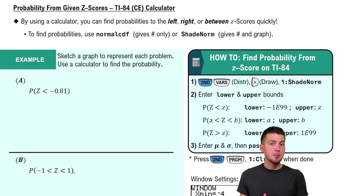
Probability From Given Z-Scores - TI-84 (CE) Calculator
Related Practice
Textbook Question

Seat Designs. In Exercises 7–9, assume that when seated, adult males have back-to-knee lengths that are normally distributed with a mean of 23.5 in. and a standard deviation of 1.1 in. (based on anthropometric survey data from Gordon, Churchill, et al.). These data are used often in the design of different seats, including aircraft seats, train seats, theater seats, and classroom seats.


Find the probability that nine males have back-to-knee lengths with a mean greater than 23.0 in.

Textbook Question

Bone Density Test A bone mineral density test is used to identify a bone disease. The result of a bone density test is commonly measured as a z score, and the population of z scores is normally distributed with a mean of 0 and a standard deviation of 1.


c. For a randomly selected subject, find the probability of a bone density test score between -0.67 and 1.29.

Textbook Question

In Exercises 7–10, use the same population of {4, 5, 9} that was used in Examples 2 and 5. As in Examples 2 and 5, assume that samples of size n = 2 are randomly selected with replacement.


Sampling Distribution of the Sample Median


c. Find the mean of the sampling distribution of the sample median.

Textbook Question

Bone Density Test. In Exercises 1–4, assume that scores on a bone mineral density test are normally distributed with a mean of 0 and a standard deviation of 1.


Bone Density For a randomly selected subject, find the probability of a bone density score between and 2.00.

Textbook Question

Normal Distribution Using a larger data set than the one given for the preceding exercises, assume that cell phone radiation amounts are normally distributed with a mean of 1.17 W/kg and a standard deviation of 0.29 W/kg.

b. Find the value of Q3, the cell phone radiation amount that is the third quartile.

Textbook Question

Seat Designs. In Exercises 7–9, assume that when seated, adult males have back-to-knee lengths that are normally distributed with a mean of 23.5 in. and a standard deviation of 1.1 in. (based on anthropometric survey data from Gordon, Churchill, et al.). These data are used often in the design of different seats, including aircraft seats, train seats, theater seats, and classroom seats.


Find the probability that a male has a back-to-knee length greater than 25.0 in.