Ch. 5 - Discrete Probability Distributions
Triola - Elementary Statistics 14th Edition
Triola14th EditionElementary StatisticsISBN: 9780137366446Not the one you use?Change textbook
Chapter 5, Problem 5.2.38d

Politics The County Clerk in Essex, New Jersey, was accused of cheating by not using randomness in assigning the order in which candidates’ names appeared on voting ballots. Among 41 different ballots, Democrats were assigned the desirable first line 40 times. Assume that Democrats and Republicans are assigned the first line using a method of random selection so that they are equally likely to get that first line.
.
d. Which probability is relevant for determining whether 40 first lines for Democrats is significantly high: the probability from part (b) or part (c)? Based on the relevant probability, is the result of 40 first lines for Democrats significantly high?

Verified step by step guidance
1
Step 1: Understand the problem. The question asks whether the result of Democrats being assigned the first line 40 out of 41 times is significantly high. To determine this, we need to calculate the probability of such an event occurring under the assumption of random selection, where Democrats and Republicans are equally likely to be assigned the first line.
Step 2: Identify the relevant probability. From part (b), the probability of Democrats being assigned the first line in a single ballot is 0.5 (since the selection is random and equally likely). From part (c), the probability of Democrats being assigned the first line 40 or more times out of 41 ballots can be calculated using the binomial probability formula.
Step 3: Recall the binomial probability formula: P(X = k) = (n choose k) * p^k * (1-p)^(n-k), where 'n' is the number of trials (41 ballots), 'k' is the number of successes (40 first lines for Democrats), and 'p' is the probability of success on a single trial (0.5). To find the probability of 40 or more successes, sum the probabilities for X = 40 and X = 41.
Step 4: Use the cumulative probability to determine if the result is significantly high. A result is considered significantly high if its probability is less than or equal to a threshold, often 0.05 (5%). Calculate the cumulative probability P(X ≥ 40) = P(X = 40) + P(X = 41).
Step 5: Compare the calculated probability to the significance threshold. If P(X ≥ 40) is less than or equal to 0.05, then the result of 40 first lines for Democrats is significantly high. Otherwise, it is not. Use this conclusion to answer the question.

Verified video answer for a similar problem:

This video solution was recommended by our tutors as helpful for the problem above.
Video duration:
5m
Was this helpful?

Key Concepts

Here are the essential concepts you must grasp in order to answer the question correctly.

Randomness in Probability

Randomness is a fundamental concept in probability that ensures each outcome has an equal chance of occurring. In the context of assigning candidates' names to ballots, randomness implies that both Democrats and Republicans should have an equal likelihood of being placed in any position. If the process is not random, it can lead to biased results, which is crucial for fair elections.
Recommended video:
Guided course
07:09
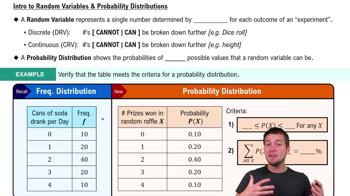
Intro to Random Variables & Probability Distributions

Significance Level

The significance level is a threshold used in hypothesis testing to determine whether an observed result is statistically significant. It helps to assess whether the occurrence of a particular outcome, such as Democrats appearing first on ballots 40 times, is due to random chance or indicates a potential bias. Common significance levels include 0.05 or 0.01, which correspond to a 5% or 1% risk of concluding that a difference exists when there is none.
Recommended video:
Guided course
04:46
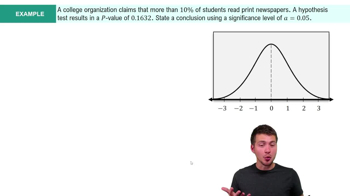
Step 4: State Conclusion Example 4

Hypothesis Testing

Hypothesis testing is a statistical method used to make inferences about a population based on sample data. It involves formulating a null hypothesis (no effect or no difference) and an alternative hypothesis (some effect or difference). In this scenario, testing whether the occurrence of 40 first lines for Democrats is significantly high would involve comparing the observed frequency against the expected frequency under the null hypothesis of random assignment.
Recommended video:
Guided course
06:21
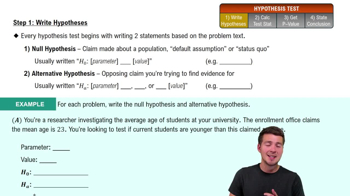
Step 1: Write Hypotheses
Related Practice
Textbook Question

In Exercises 25–28, find the probabilities and answer the questions.


Too Young to Tat Based on a Harris poll, among adults who regret getting tattoos, 20% say that they were too young when they got their tattoos. Assume that five adults who regret getting tattoos are randomly selected, and find the indicated probability.


d. If we randomly select five adults, is 1 a significantly low number who say that they were too young to get tattoos?

1
views
Textbook Question

Using Probabilities for Significant Events


c. Which probability is relevant for determining whether 1 is a significantly low number of matches: the result from part (a) or part (b)?


Textbook Question

In Exercises 9–16, use the Poisson distribution to find the indicated probabilities.


Births In a recent year (365 days), NYU-Langone Medical Center had 5942 births.


c. Find the probability that in a single day, there are no births. Would 0 births in a single day be a significantly low number of births?

Textbook Question

One of Mendel’s famous experiments with peas resulted in 580 offspring, and 152 of them were yellow peas. Mendel claimed that under the same conditions, 25% of offspring peas would be yellow. Assume that Mendel’s claim of 25% is true, and assume that a sample consists of 580 offspring peas.


c. Find the probability of 152 or more yellow peas.


1
views
Textbook Question

Expected Value for the Florida Pick 3 Lottery In the Florida Pick 3 lottery, you can bet \$1 by selecting three digits, each between 0 and 9 inclusive. If the same three numbers are drawn in the same order, you win and collect \(500.


d. Find the expected value for a \)1 bet.

1
views
Textbook Question

Expected Value in North Carolina’s Pick 4 Game In North Carolina’s Pick 4 lottery game, you can pay \(1 to select a four-digit number from 0000 through 9999. If you select the same sequence of four digits that are drawn, you win and collect \)5000.


d. Find the expected value.

1
views