Ch. 5 - Discrete Probability Distributions
Triola - Elementary Statistics 14th Edition
Triola14th EditionElementary StatisticsISBN: 9780137366446Not the one you use?Change textbook
Chapter 5, Problem 5.R.10c

Poisson: Deaths Currently, an average of 7 residents of the village of Westport (population 760) die each year (based on data from the U.S. National Center for Health Statistics).


c. Find the probability that on a given day, there is more than one death.

Verified step by step guidance
1
Understand the problem: This is a Poisson probability problem where the average number of deaths per year is given as 7. We need to find the probability that on a given day, there is more than one death.
Convert the average rate to a daily rate: Since there are 365 days in a year, divide the annual average (7 deaths) by 365 to find the average number of deaths per day (λ). Use the formula: λ = 7 / 365.
Set up the Poisson probability formula: The Poisson probability formula is P(X = k) = (λ^k * e^(-λ)) / k!, where λ is the average rate, k is the number of occurrences, and e is the base of the natural logarithm (approximately 2.718).
Calculate the probability for k = 0 and k = 1: Use the formula to calculate P(X = 0) and P(X = 1), where X is the number of deaths on a given day. Substitute λ (from step 2) into the formula for each value of k.
Find the probability of more than one death: The probability of more than one death is P(X > 1), which can be calculated as 1 - [P(X = 0) + P(X = 1)]. Add the probabilities from step 4 and subtract from 1 to get the final result.

Verified video answer for a similar problem:

This video solution was recommended by our tutors as helpful for the problem above.
Video duration:
4m
Was this helpful?

Key Concepts

Here are the essential concepts you must grasp in order to answer the question correctly.

Poisson Distribution

The Poisson distribution is a probability distribution that expresses the probability of a given number of events occurring in a fixed interval of time or space, given a known average rate of occurrence. It is particularly useful for modeling rare events, such as deaths in a population, where the events occur independently of each other.
Recommended video:
Guided course
06:38
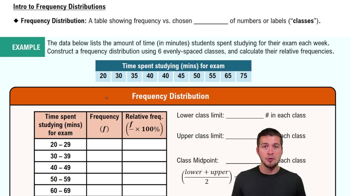
Intro to Frequency Distributions

Rate Parameter (λ)

In the context of the Poisson distribution, the rate parameter (λ) represents the average number of events (deaths, in this case) occurring in a specified interval. For the village of Westport, with an average of 7 deaths per year, λ would be 7. This parameter is crucial for calculating probabilities using the Poisson formula.
Recommended video:
Guided course
05:53
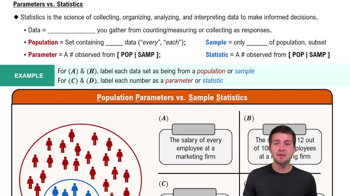
Parameters vs. Statistics

Cumulative Probability

Cumulative probability refers to the probability that a random variable takes on a value less than or equal to a certain threshold. In this question, to find the probability of more than one death on a given day, one would first calculate the cumulative probability of 0 and 1 death and then subtract this from 1 to find the desired probability.
Recommended video:
5:37
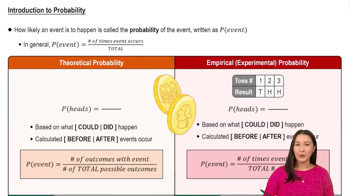
Introduction to Probability
Related Practice
Textbook Question

Poisson: Deaths Currently, an average of 7 residents of the village of Westport (population 760) die each year (based on data from the U.S. National Center for Health Statistics).


b. Find the probability that on a given day, there are no deaths.

Textbook Question

In Exercises 1–5, assume that 4.2% of workers test positive when tested for illegal drugs (based on data from Quest Diagnostics). Assume that a group of ten workers is randomly selected.


Workplace Drug Testing Find the mean and standard deviation for the numbers of workers in groups of ten who test positive for illegal drugs.

1
views
Textbook Question

In Exercises 1–5, assume that 4.2% of workers test positive when tested for illegal drugs (based on data from Quest Diagnostics). Assume that a group of ten workers is randomly selected.


Workplace Drug Testing If none of the ten workers tests positive for illegal drugs, is that a significantly low result?

1
views
Textbook Question

In Exercises 1–5, assume that 4.2% of workers test positive when tested for illegal drugs (based on data from Quest Diagnostics). Assume that a group of ten workers is randomly selected.


Workplace Drug Testing If four of the ten workers test positive for illegal drugs, is that a significantly high result?

1
views
Textbook Question

In Exercises 1–5, assume that 4.2% of workers test positive when tested for illegal drugs (based on data from Quest Diagnostics). Assume that a group of ten workers is randomly selected.


Workplace Drug Testing Find the probability that at least one of the ten workers tests positive for illegal drugs.

1
views
Textbook Question

Acrophobia USA Today reported results from a survey in which subjects were asked if they are afraid of heights in tall buildings. The results are summarized in the accompanying table. Does this table describe a probability distribution? Why or why not?

1
views