Ch. 5 - Discrete Probability Distributions
Triola - Elementary Statistics 14th Edition
Triola14th EditionElementary StatisticsISBN: 9780137366446Not the one you use?Change textbook
Chapter 5, Problem 5.CRE.2c

Kentucky Pick 4 In the Kentucky Pick 4 lottery game, you can pay \$1 for a “straight” bet in which you select four digits with repetition allowed. If you buy only one ticket and win, your prize is \$2500.


c. If you play this game once every day, find the probability of no wins in 365 days.

Verified step by step guidance
1
Step 1: Understand the problem. In the Kentucky Pick 4 lottery game, you select four digits with repetition allowed. The total number of possible outcomes is 10^4 (since there are 10 digits, 0 through 9, and repetition is allowed). The probability of winning on a single ticket is 1 divided by the total number of outcomes.
Step 2: Calculate the probability of losing on a single ticket. The probability of losing is the complement of the probability of winning, which is given by P(losing) = 1 - P(winning).
Step 3: Recognize that the problem involves repeated independent trials. If you play the game once every day for 365 days, the probability of no wins in 365 days is the probability of losing every single day. Since the trials are independent, the probability of losing every day is the product of the probability of losing on each day.
Step 4: Use the formula for the probability of no wins in 365 days: P(no wins) = P(losing)^365. Substitute the value of P(losing) from Step 2 into this formula.
Step 5: Simplify the expression for P(no wins) to get the final probability. You can leave the result in terms of powers or logarithms for further calculation if needed.

Verified video answer for a similar problem:

This video solution was recommended by our tutors as helpful for the problem above.
Video duration:
3m
Was this helpful?

Key Concepts

Here are the essential concepts you must grasp in order to answer the question correctly.

Probability of Winning

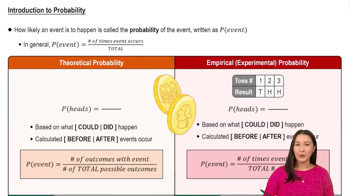
In the Kentucky Pick 4 lottery, the probability of winning a straight bet is calculated by determining the total number of possible combinations of four digits (0000 to 9999), which is 10,000. Therefore, the probability of winning with one ticket is 1 in 10,000, or 0.0001.
Recommended video:
5:37
Introduction to Probability

Complementary Probability

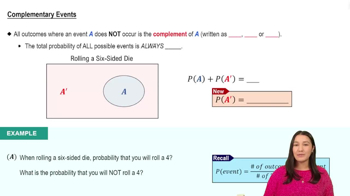
Complementary probability refers to the likelihood of an event not occurring. In this case, the probability of not winning with one ticket is 1 minus the probability of winning. Thus, the probability of no wins in a single day is 1 - 0.0001 = 0.9999.
Recommended video:
4:23
Complementary Events

Independent Events

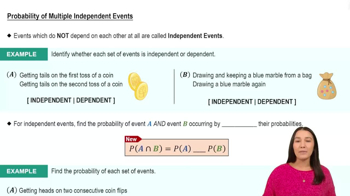
In probability theory, independent events are those whose outcomes do not affect each other. Playing the lottery each day is an independent event, meaning the outcome of one day does not influence the next. To find the probability of no wins over 365 days, we raise the daily no-win probability to the power of 365: (0.9999)^365.
Recommended video:
05:54
Probability of Multiple Independent Events
Related Practice
Textbook Question

Find the mean of the random variable x described in the preceding exercise.

1
views
Textbook Question

Tennis Challenge In a recent U.S. Open tennis tournament, there were 945 challenges made by singles players, and 255 of them resulted in referee calls that were overturned. The accompanying table lists the results by gender.


c. If two different challenges are randomly selected without replacement, find the probability that they both resulted in an overturned call.

1
views
Textbook Question

Kentucky Pick 4 In the Kentucky Pick 4 lottery game, you can pay \$1 for a “straight” bet in which you select four digits with repetition allowed. If you buy only one ticket and win, your prize is \$2500.


a. If you buy one ticket, what is the probability of winning?

1
views
Textbook Question

Is the mean found in the preceding exercise a statistic or a parameter?

Textbook Question

Tennis Challenge In a recent U.S. Open tennis tournament, there were 945 challenges made by singles players, and 255 of them resulted in referee calls that were overturned. The accompanying table lists the results by gender.


b. If one of the overturned calls is randomly selected, what is the probability that the challenge was made by a woman?

1
views
Textbook Question

Planets The planets of the solar system have the numbers of moons listed below in order from the sun. (Pluto is not included because it was uninvited from the solar system party in 2006.) Include appropriate units whenever relevant.


0 0 1 2 17 28 21 8


a. Find the mean.

b. Find the median.