Ch. 5 - Discrete Probability Distributions
Triola - Elementary Statistics 14th Edition
Triola14th EditionElementary StatisticsISBN: 9780137366446Not the one you use?Change textbook
Chapter 5, Problem 5.3.9a

In Exercises 9–16, use the Poisson distribution to find the indicated probabilities.


Births In a recent year (365 days), NYU-Langone Medical Center had 5942 births.


a. Find the mean number of births per day.

Verified step by step guidance
1
Step 1: Understand the Poisson distribution. The Poisson distribution is used to model the number of events (e.g., births) occurring in a fixed interval of time or space, given the events occur independently and at a constant average rate.
Step 2: Identify the total number of events and the time interval. In this problem, there are 5942 births over 365 days.
Step 3: Calculate the mean number of births per day. The mean (λ) for a Poisson distribution is the total number of events divided by the total time interval. Use the formula: λ = 5942365.
Step 4: Simplify the fraction to find the mean number of births per day. This value represents the average rate of births per day at the medical center.
Step 5: Use this mean (λ) for further calculations if needed, such as finding probabilities of specific numbers of births per day using the Poisson probability formula.

Verified video answer for a similar problem:

This video solution was recommended by our tutors as helpful for the problem above.
Video duration:
1m
Was this helpful?

Key Concepts

Here are the essential concepts you must grasp in order to answer the question correctly.

Poisson Distribution

The Poisson distribution is a probability distribution that expresses the probability of a given number of events occurring in a fixed interval of time or space, given that these events occur with a known constant mean rate and independently of the time since the last event. It is particularly useful for modeling rare events, such as the number of births in a day.
Recommended video:
Guided course
06:38
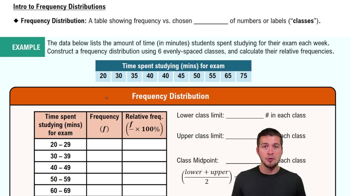
Intro to Frequency Distributions

Mean of a Poisson Distribution

In a Poisson distribution, the mean (λ) represents the average number of occurrences of the event in the specified interval. For the problem at hand, to find the mean number of births per day, you would divide the total number of births by the number of days in the year, providing a clear understanding of the expected daily occurrences.
Recommended video:
Guided course
03:28
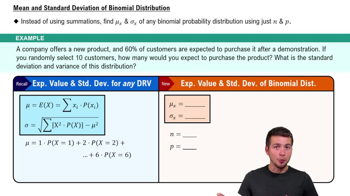
Mean & Standard Deviation of Binomial Distribution

Expected Value

The expected value is a key concept in probability that provides a measure of the center of a probability distribution. In the context of the Poisson distribution, the expected value is equal to the mean (λ), which indicates the average outcome one can anticipate over a specified period. This concept helps in making predictions about future occurrences based on historical data.
Recommended video:
Guided course
04:14
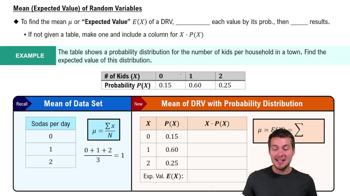
Expected Value (Mean) of Random Variables
Related Practice
Textbook Question

In Exercises 25–28, find the probabilities and answer the questions.


Too Young to Tat Based on a Harris poll, among adults who regret getting tattoos, 20% say that they were too young when they got their tattoos. Assume that five adults who regret getting tattoos are randomly selected, and find the indicated probability.


a. Find the probability that none of the selected adults say that they were too young to get tattoos.


1
views
Textbook Question

Lottery. In Exercises 15–20, refer to the accompanying table, which describes probabilities for the California Daily 4 lottery. The player selects four digits with repetition allowed, and the random variable x is the number of digits that match those in the same order that they are drawn (for a “straight” bet).


Using Probabilities for Significant Events


a. Find the probability of getting exactly 3 matches.

Textbook Question

In Exercises 5–8, assume that the Poisson distribution applies; assume that the mean number of Atlantic hurricanes in the United States is 5.5 per year, as in Example 1; and proceed to find the indicated probability.

a. Find the probability that in a year, there will be 10 hurricanes.

Textbook Question

Binomial Probability Formula. In Exercises 13 and 14, answer the questions designed to help understand the rationale for the binomial probability formula.


Guessing Answers Standard tests, such as the SAT, ACT, or Medical College Admission Test (MCAT), typically use multiple choice questions, each with five possible answers (a, b, c, d, e), one of which is correct. Assume that you guess the answers to the first three questions.


a. Use the multiplication rule to find the probability that the first two guesses are wrong and the third is correct. That is, find P(WWC), where W denotes a wrong answer and C denotes a correct answer.

1
views
Textbook Question

Family/Partner Groups of people aged 15–65 are randomly selected and arranged in groups of six. The random variable x is the number in the group who say that their family and/or partner contribute most to their happiness (based on a Coca-Cola survey). The accompanying table lists the values of x along with their corresponding probabilities. Does the table describe a probability distribution? If so, find the mean and standard deviation.


1
views
Textbook Question

In Exercises 5–8, assume that the Poisson distribution applies; assume that the mean number of Atlantic hurricanes in the United States is 5.5 per year, as in Example 1; and proceed to find the indicated probability.

a. Find the probability that in a year, there will be no hurricanes.