Ch. 5 - Discrete Probability Distributions
Triola - Elementary Statistics 14th Edition
Triola14th EditionElementary StatisticsISBN: 9780137366446Not the one you use?Change textbook
Chapter 5, Problem 5.2.32c

In Exercises 31 and 32, assume that hybridization experiments are conducted with peas having the property that for offspring, there is a 0.75 probability that a pea has green pods (as in one of Mendel’s famous experiments).


Hybrids Assume that offspring peas are randomly selected in groups of 16.


c. Is a result of 7 peas with green pods a result that is significantly low? Why or why not?

Verified step by step guidance
1
Step 1: Identify the type of probability distribution involved. Since the problem involves a fixed number of trials (16 peas), a constant probability of success (0.75 for green pods), and independent trials, this is a binomial distribution. The random variable X represents the number of peas with green pods.
Step 2: Write the formula for the binomial probability distribution. The probability of exactly k successes in n trials is given by: P(X=k)=n!k!(n-k)!pk(1-p)n-k, where n = 16, k = 7, and p = 0.75.
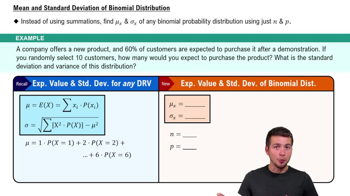
Step 3: To determine if 7 peas with green pods is significantly low, calculate the mean (μ) and standard deviation (σ) of the binomial distribution. The formulas are: μ=np and σ=np(1-p). Substitute n = 16 and p = 0.75 into these formulas.
Step 4: Use the range rule of thumb to determine if 7 is significantly low. A value is considered significantly low if it is below μ-2σ. Calculate this threshold using the mean and standard deviation from Step 3.
Step 5: Compare the observed value (7 peas with green pods) to the threshold calculated in Step 4. If 7 is below the threshold, it is significantly low; otherwise, it is not. Provide reasoning based on the comparison.

Verified video answer for a similar problem:

This video solution was recommended by our tutors as helpful for the problem above.
Video duration:
4m
Was this helpful?

Key Concepts

Here are the essential concepts you must grasp in order to answer the question correctly.

Binomial Distribution

The binomial distribution models the number of successes in a fixed number of independent Bernoulli trials, each with the same probability of success. In this case, the probability of a pea having green pods is 0.75, and we are looking at 16 trials (offspring). This distribution helps determine the likelihood of observing a specific number of successes, such as 7 green pods.
Recommended video:
Guided course
03:28
Mean & Standard Deviation of Binomial Distribution

Significance Level

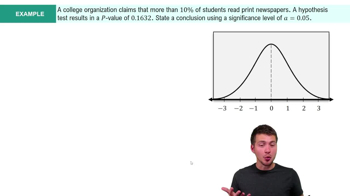
The significance level, often denoted as alpha (α), is a threshold used to determine whether a result is statistically significant. Commonly set at 0.05, it indicates the probability of rejecting the null hypothesis when it is true. In this context, we would compare the observed result of 7 green pods against the expected distribution to see if it falls below this threshold.
Recommended video:
Guided course
04:46
Step 4: State Conclusion Example 4

Hypothesis Testing

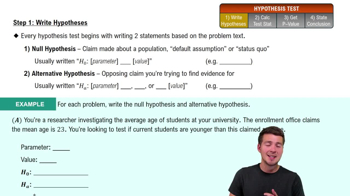
Hypothesis testing is a statistical method used to make inferences about a population based on sample data. It involves formulating a null hypothesis (e.g., the number of green pods follows the expected distribution) and an alternative hypothesis. By calculating the probability of observing the data under the null hypothesis, we can determine if the result of 7 green pods is significantly low or not.
Recommended video:
Guided course
06:21
Step 1: Write Hypotheses
Related Practice
Textbook Question

In Exercises 25–28, find the probabilities and answer the questions.


Too Young to Tat Based on a Harris poll, among adults who regret getting tattoos, 20% say that they were too young when they got their tattoos. Assume that five adults who regret getting tattoos are randomly selected, and find the indicated probability.


c. Find the probability that the number of selected adults saying they were too young is 0 or 1.


1
views
Textbook Question

Tennis Challenge In a recent U.S. Open tennis tournament, there were 945 challenges made by singles players, and 255 of them resulted in referee calls that were overturned. The accompanying table lists the results by gender.


e. If one of the challenges is randomly selected, find the probability that it was made by a man, given that the challenge was upheld with an overturned call.

1
views
Textbook Question

Happiness In a survey sponsored by Coca-Cola, subjects were asked what contributes most to their happiness, and the table summarizes their responses. Does the table represent a probability distribution? Explain.


1
views
Textbook Question

Tennis Challenge In a recent U.S. Open tennis tournament, there were 945 challenges made by singles players, and 255 of them resulted in referee calls that were overturned. The accompanying table lists the results by gender.


d. If 1 of the 945 challenges is randomly selected, find the probability that it was made by a man or was upheld with an overturned call.


1
views
Textbook Question

Politics The County Clerk in Essex, New Jersey, was accused of cheating by not using randomness in assigning the order in which candidates’ names appeared on voting ballots. Among 41 different ballots, Democrats were assigned the desirable first line 40 times. Assume that Democrats and Republicans are assigned the first line using a method of random selection so that they are equally likely to get that first line.


c. Find the probability of 40 or more first lines for Democrats.

1
views
Textbook Question

One of Mendel’s famous experiments with peas resulted in 580 offspring, and 152 of them were yellow peas. Mendel claimed that under the same conditions, 25% of offspring peas would be yellow. Assume that Mendel’s claim of 25% is true, and assume that a sample consists of 580 offspring peas.


c. Find the probability of 152 or more yellow peas.


1
views