Ch. 5 - Discrete Probability Distributions
Triola - Elementary Statistics 14th Edition
Triola14th EditionElementary StatisticsISBN: 9780137366446Not the one you use?Change textbook
Chapter 5, Problem 5.2.29a

In Exercises 29 and 30, assume that different groups of couples use the XSORT method of gender selection and each couple gives birth to one baby. The XSORT method is designed to increase the likelihood that a baby will be a girl, but assume that the method has no effect, so the probability of a girl is 0.5.


Gender Selection Assume that the groups consist of 36 couples.


a. Find the mean and standard deviation for the numbers of girls in groups of 36 births.

Verified step by step guidance
1
Step 1: Recognize that this is a binomial probability distribution problem. The number of trials (n) is 36 (since there are 36 couples), and the probability of success (p) is 0.5 (since the probability of having a girl is 0.5).
Step 2: Recall the formula for the mean (μ) of a binomial distribution: μ=n×p. Substitute n = 36 and p = 0.5 into the formula to calculate the mean.
Step 3: Recall the formula for the standard deviation (σ) of a binomial distribution: σ=n×p×(1-p). Substitute n = 36 and p = 0.5 into the formula to calculate the standard deviation.
Step 4: Simplify the expressions for both the mean and the standard deviation. For the mean, multiply n and p. For the standard deviation, calculate the product of n, p, and (1 - p), then take the square root of the result.
Step 5: Interpret the results. The mean represents the expected number of girls in 36 births, and the standard deviation measures the variability in the number of girls across different groups of 36 births.

Verified video answer for a similar problem:

This video solution was recommended by our tutors as helpful for the problem above.
Video duration:
1m
Was this helpful?

Key Concepts

Here are the essential concepts you must grasp in order to answer the question correctly.

Binomial Distribution

The binomial distribution models the number of successes in a fixed number of independent Bernoulli trials, each with the same probability of success. In this context, each birth can be seen as a trial where having a girl is a success, and the probability of having a girl is 0.5. The distribution is characterized by two parameters: the number of trials (n) and the probability of success (p).
Recommended video:
Guided course
03:28
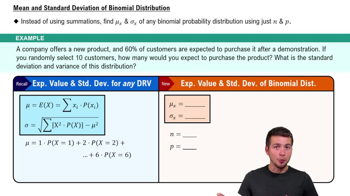
Mean & Standard Deviation of Binomial Distribution

Mean of a Binomial Distribution

The mean of a binomial distribution is calculated using the formula μ = n * p, where n is the number of trials and p is the probability of success. For this problem, with 36 couples and a probability of 0.5 for having a girl, the mean number of girls expected can be easily computed. This value represents the average outcome over many trials.
Recommended video:
Guided course
03:28
Mean & Standard Deviation of Binomial Distribution

Standard Deviation of a Binomial Distribution

The standard deviation of a binomial distribution measures the variability of the number of successes and is calculated using the formula σ = √(n * p * (1 - p)). This formula accounts for both the number of trials and the probabilities of success and failure. In this scenario, it helps to understand how much the actual number of girls born might deviate from the mean.
Recommended video:
Guided course
03:28
Mean & Standard Deviation of Binomial Distribution
Related Practice
Textbook Question

In Exercises 25–28, find the probabilities and answer the questions.


Too Young to Tat Based on a Harris poll, among adults who regret getting tattoos, 20% say that they were too young when they got their tattoos. Assume that five adults who regret getting tattoos are randomly selected, and find the indicated probability.


a. Find the probability that none of the selected adults say that they were too young to get tattoos.


1
views
Textbook Question

Lottery. In Exercises 15–20, refer to the accompanying table, which describes probabilities for the California Daily 4 lottery. The player selects four digits with repetition allowed, and the random variable x is the number of digits that match those in the same order that they are drawn (for a “straight” bet).


Using Probabilities for Significant Events


a. Find the probability of getting exactly 3 matches.

Textbook Question

One of Mendel’s famous experiments with peas resulted in 580 offspring, and 152 of them were yellow peas. Mendel claimed that under the same conditions, 25% of offspring peas would be yellow. Assume that Mendel’s claim of 25% is true, and assume that a sample consists of 580 offspring peas.


a. Use the range rule of thumb to identify the limits separating values that are significantly low and those that are significantly high. Based on the results, is the result of 152 yellow peas either significantly low or significantly high?


1
views
Textbook Question

Binomial Probability Formula. In Exercises 13 and 14, answer the questions designed to help understand the rationale for the binomial probability formula.


Guessing Answers Standard tests, such as the SAT, ACT, or Medical College Admission Test (MCAT), typically use multiple choice questions, each with five possible answers (a, b, c, d, e), one of which is correct. Assume that you guess the answers to the first three questions.


a. Use the multiplication rule to find the probability that the first two guesses are wrong and the third is correct. That is, find P(WWC), where W denotes a wrong answer and C denotes a correct answer.

1
views
Textbook Question

In Exercises 25–28, find the probabilities and answer the questions.


Internet Voting Based on a Consumer Reports survey, 39% of likely voters would be willing to vote by Internet instead of the in-person traditional method of voting. For each of the following, assume that 15 likely voters are randomly selected.


a. What is the probability that exactly 12 of those selected would do Internet voting?

1
views
Textbook Question

Expected Value in North Carolina’s Pick 4 Game In North Carolina’s Pick 4 lottery game, you can pay \(1 to select a four-digit number from 0000 through 9999. If you select the same sequence of four digits that are drawn, you win and collect \)5000.


a. How many different selections are possible?