
Ch. 4 - Probability
Triola - Elementary Statistics 14th Edition
Triola14th EditionElementary StatisticsISBN: 9780137366446Not the one you use?Change textbook
Chapter 4, Problem 4.3.21a

Redundancy in Computer Hard Drives The Seagate ST8000NM0055 hard drive has a 1.22% rate of failures in a year (based on data from Backblaze, Inc.). For the following, assume that all hard drives are that Seagate model.


a. If all of your computer data are stored on a hard disk drive with a copy stored on a second hard disk drive, what is the probability that during a year, you can avoid catastrophe with at least one working drive? Express the result with six decimal places.

Verified step by step guidance
1
Step 1: Understand the problem. The goal is to calculate the probability of avoiding catastrophe, which means having at least one working drive out of two. This involves using the complement rule and the concept of independent events, as the failure of one drive does not affect the failure of the other.
Step 2: Define the probability of failure for a single drive. The problem states that the failure rate for a single drive is 1.22%, which can be expressed as P(Failure) = 0.0122. The probability of a drive not failing (success) is therefore P(Success) = 1 - P(Failure) = 1 - 0.0122.
Step 3: Calculate the probability of both drives failing. Since the failures are independent, the probability of both drives failing is the product of their individual failure probabilities: P(Both Fail) = P(Failure) × P(Failure).
Step 4: Use the complement rule to find the probability of avoiding catastrophe. The complement of both drives failing is at least one drive working. Therefore, P(At Least One Working) = 1 - P(Both Fail).
Step 5: Substitute the values into the formula. Replace P(Failure) with 0.0122 in the equations from Steps 3 and 4 to compute the final probability. Ensure the result is expressed to six decimal places as required.

Verified video answer for a similar problem:

This video solution was recommended by our tutors as helpful for the problem above.
Video duration:
3m
Was this helpful?

Key Concepts

Here are the essential concepts you must grasp in order to answer the question correctly.

Probability of Failure

The probability of failure refers to the likelihood that a specific event, such as a hard drive malfunction, will occur within a given time frame. In this case, the Seagate ST8000NM0055 hard drive has a failure rate of 1.22% per year, which means that there is a 0.0122 probability that any single drive will fail within that year.
Recommended video:
5:37
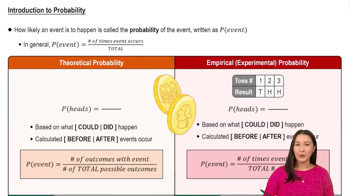
Introduction to Probability

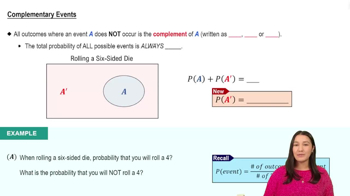
Complement Rule

The complement rule in probability states that the probability of an event occurring is equal to one minus the probability of the event not occurring. For example, if the probability of a hard drive failing is 0.0122, the probability of it not failing is 1 - 0.0122 = 0.9878. This concept is crucial for calculating the likelihood of at least one drive functioning when two drives are in use.
Recommended video:
4:23
Complementary Events

Independent Events

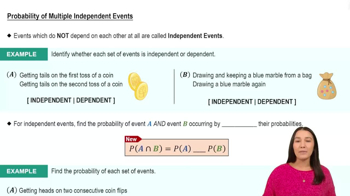
Independent events are those whose outcomes do not affect each other. In this scenario, the performance of one hard drive does not influence the performance of another. Therefore, when calculating the probability of at least one drive working, we can multiply the probabilities of each drive's independent outcomes to find the overall probability of success.
Recommended video:
05:54
Probability of Multiple Independent Events
Related Practice
Textbook Question

Redundancy in Computer Hard Drives It is generally recognized that it is wise to backup computer data. Assume that the following refer to use of Western Digital model WD60EFRX hard drives, which have an annual failure rate of 3.66% (based on data from Backblaze, Inc.).

a. If you store all of your computer data on a single hard drive, what is the probability that the drive will fail during a year?

Textbook Question

Phase I of a Clinical Trial A clinical test on humans of a new drug is normally done in three phases. Phase I is conducted with a relatively small number of healthy volunteers. For example, a phase I test of bexarotene involved only 14 subjects. Assume that we want to treat 14 healthy humans with this new drug and we have 16 suitable volunteers available.


a. If the subjects are selected and treated one at a time in sequence, how many different sequential arrangements are possible if 14 people are selected from the 16 that are available?


Textbook Question

Denomination Effect

In Exercises 13–16, use the data in the following table. In an experiment to study the effects of using four quarters versus a \$1 bill, some college students were given four quarters and others were given a \$1 bill, and they could either keep the money or spend it on gum. The results are summarized in the table (based on data from “The Denomination Effect,” by Priya Raghubir and Joydeep Srivastava, Journal of Consumer Research, Vol. 36).


Denomination Effect


a. Find the probability of randomly selecting a student who spent the money, given that the student was given four quarters.


2
views
Textbook Question

Alarm Clock Life Hack Each of us must sometimes wake up early for something really important, such as a final exam, job interview, or an early flight. (Professional golfer Jim Furyk was disqualified from a tournament when his cellphone lost power and he overslept.) Assume that a battery-powered alarm clock has a 0.005 probability of failure, a smartphone alarm clock has a 0.052 probability of failure, and an electric alarm clock has a 0.001 probability of failure.

a. What is the probability that your single battery-powered alarm clock works successfully when you need it?

Textbook Question

Is the Researcher Cheating? You become suspicious when a genetics researcher “randomly” selects numerous groups of 20 newborn babies and seems to consistently get 10 girls and 10 boys. The researcher claims that it is common to get 10 girls and 10 boys in such cases.


a. If 20 newborn babies are randomly selected, how many different gender sequences are possible?


Textbook Question

Dice and Coins


a. Find the probability that when a single six-sided die is rolled, the outcome is 5.