Ch. 4 - Probability
Triola - Elementary Statistics 14th Edition
Triola14th EditionElementary StatisticsISBN: 9780137366446Not the one you use?Change textbook
Chapter 4, Problem 4.1.28c

In Exercises 21-28, find the probability and answer the questions.


X-Linked Genetic Disease Men have XY (or YX) chromosomes and women have XX chromosomes. X-linked recessive genetic diseases (such as juvenile retinoschisis) occur when there is a defective X chromosome that occurs without a paired X chromosome that is not defective. In the following, represent a defective X chromosome with lowercase x, so a child with the xY or Yx pair of chromosomes will have the disease and a child with XX or XY or YX or xX or Xx will not have the disease. Each parent contributes one of the chromosomes to the child.


c. If a mother has one defective x chromosome and one good X chromosome and the father has good XY chromosomes, what is the probability that a son will inherit the disease?

Verified step by step guidance
1
Step 1: Understand the genetic inheritance. The mother has one defective x chromosome (x) and one good X chromosome (X), while the father has good XY chromosomes. Sons inherit one X chromosome from their mother and one Y chromosome from their father.
Step 2: List all possible combinations of chromosomes for a son. Since the son inherits the Y chromosome from the father, the possible combinations for the son are xY (defective X from the mother) or XY (good X from the mother).
Step 3: Determine the probability of each combination. The mother has a 50% chance of passing on the defective x chromosome and a 50% chance of passing on the good X chromosome. The father always contributes the Y chromosome.
Step 4: Identify the condition for the son to inherit the disease. The son will inherit the disease if he has the xY chromosome pair, which occurs when the mother passes on the defective x chromosome.
Step 5: Calculate the probability. Since the mother has a 50% chance of passing on the defective x chromosome, the probability that the son will inherit the disease is 50% or 0.5.

Verified video answer for a similar problem:

This video solution was recommended by our tutors as helpful for the problem above.
Video duration:
3m
Was this helpful?

Key Concepts

Here are the essential concepts you must grasp in order to answer the question correctly.

X-Linked Inheritance

X-linked inheritance refers to the pattern of genetic transmission of traits or diseases that are associated with genes located on the X chromosome. In this case, males (XY) are more likely to express X-linked recessive diseases because they have only one X chromosome. If the X chromosome inherited from the mother carries a recessive allele for a disease, the son will express that disease since he does not have a second X chromosome to mask the effect.
Recommended video:
Guided course
05:48
Introduction to Matched Pairs Example 1

Probability in Genetics

Probability in genetics involves calculating the likelihood of inheriting specific traits based on the genetic makeup of the parents. In this scenario, the probability of a son inheriting the disease can be determined by analyzing the combinations of chromosomes contributed by each parent. The mother, with one defective X chromosome, has a 50% chance of passing on either her defective or normal X chromosome to her son.
Recommended video:
5:37
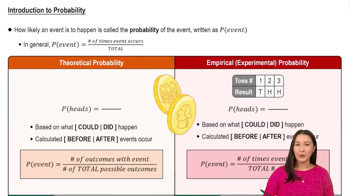
Introduction to Probability

Punnett Square

A Punnett square is a diagram used to predict the genetic outcomes of a cross between two parents. It helps visualize the possible combinations of alleles that offspring may inherit. In this case, constructing a Punnett square with the mother's X chromosomes (X and x) and the father's XY chromosomes will clarify the probability of the son inheriting the defective X chromosome and thus the disease.
Recommended video:
Guided course
04:48
Variance & Standard Deviation of Discrete Random Variables
Related Practice
Textbook Question

In Exercises 21–24, use these results from the “1-Panel-THC” test for marijuana use, which is provided by the company Drug Test Success: Among 143 subjects with positive test results, there are 24 false positive (incorrect) results; among 157 negative results, there are 3 false negative (incorrect) results. (Hint: Construct a table similar to Table 4-1.)


Testing for Marijuana Use


c. What is the probability that a randomly selected subject had a true negative result?

Textbook Question

Surge Protectors Refer to the accompanying figure showing surge protectors p and q used to protect an expensive television. If there is a surge in the voltage, the surge protector reduces it to a safe level. Assume that each surge protector has a 0.985 probability of working correctly when a voltage surge occurs.


c. Which arrangement should be used for better protection?

Textbook Question

Florida Pick 3 In the Florida Pick 3 lottery, you can place a “straight” bet of \(1 by selecting the exact order of three digits between 0 and 9 inclusive (with repetition allowed), so the probability of winning is 1/1000. If the same three numbers are drawn in the same order, you collect \)500, so your net profit is \$499.


c. Is there much of a difference between the actual odds against winning and the payoff odds?

Textbook Question

Mega Millions As of this writing, the Mega Millions lottery is run in 44 states. Winning the jackpot requires that you select the correct five different numbers from 1 to 70 and, in a separate drawing, you must also select the correct single number from 1 to 25.


c. How does the probability compare to the probability for the old Mega Millions game which involved the selection of five different numbers between 1 and 75 and a separate single number between 1 and 15?

Textbook Question

Organ Donors USA Today provided information about a survey (conducted for Donate Life America) of 5100 adult Internet users. Of the respondents, 2346 said they are willing to donate organs after death. In this survey, 100 adults were surveyed in each state and the District of Columbia, and results were weighted to account for the different state population sizes.


b. Based on the poll results, what is the probability of randomly selecting an adult who is willing to donate organs after death?


Textbook Question

Phase I of a Clinical Trial A clinical test on humans of a new drug is normally done in three phases. Phase I is conducted with a relatively small number of healthy volunteers. For example, a phase I test of bexarotene involved only 14 subjects. Assume that we want to treat 14 healthy humans with this new drug and we have 16 suitable volunteers available.


c. If 14 subjects are randomly selected and treated at the same time, what is the probability of selecting the 14 youngest subjects?