Ch. 4 - Probability
Triola - Elementary Statistics 14th Edition
Triola14th EditionElementary StatisticsISBN: 9780137366446Not the one you use?Change textbook
Chapter 4, Problem 4.1.15

In Exercises 13–20, express the indicated degree of likelihood as a probability value between 0 and 1.


Movies Based on a study of the movies made in a recent year, 33 out of every 100 movies have a female lead or co-lead.

Verified step by step guidance
1
Step 1: Understand the problem. The goal is to express the likelihood of a movie having a female lead or co-lead as a probability value between 0 and 1. Probability is calculated as the ratio of favorable outcomes to total outcomes.
Step 2: Identify the given values. From the problem, we know that 33 out of every 100 movies have a female lead or co-lead. This means the number of favorable outcomes is 33, and the total number of outcomes is 100.
Step 3: Write the formula for probability. The formula is: P=favorable outcomestotal outcomes
Step 4: Substitute the given values into the formula. Replace 'favorable outcomes' with 33 and 'total outcomes' with 100 in the formula: P=33100
Step 5: Simplify the fraction if necessary. The probability value should be expressed as a decimal or fraction between 0 and 1. If the fraction can be simplified, do so, or convert it to a decimal by dividing the numerator by the denominator.

Verified video answer for a similar problem:

This video solution was recommended by our tutors as helpful for the problem above.
Video duration:
1m
Was this helpful?

Key Concepts

Here are the essential concepts you must grasp in order to answer the question correctly.

Probability

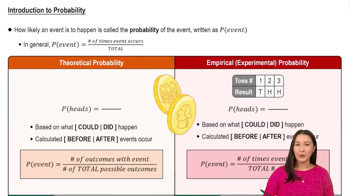
Probability is a measure of the likelihood that a particular event will occur, expressed as a value between 0 and 1. A probability of 0 indicates that the event cannot happen, while a probability of 1 indicates certainty that the event will occur. In this context, it quantifies the chance of a movie having a female lead or co-lead based on observed data.
Recommended video:
5:37
Introduction to Probability

Proportion

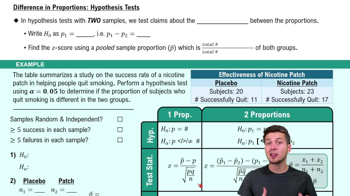
Proportion is a statistical measure that represents the part of a whole. It is calculated by dividing the number of favorable outcomes by the total number of outcomes. In the given scenario, the proportion of movies with a female lead or co-lead is 33 out of 100, which can be converted into a probability value.
Recommended video:
Guided course
09:27
Difference in Proportions: Hypothesis Tests

Data Interpretation

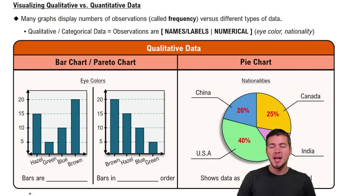
Data interpretation involves analyzing and making sense of numerical information to draw conclusions. In this case, interpreting the data from the study of movies allows us to understand the representation of female leads in films. This skill is essential for converting raw data into meaningful probability values.
Recommended video:
Guided course
04:39
Visualizing Qualitative vs. Quantitative Data
Related Practice
Textbook Question

In Exercises 33–40, use the given probability value to determine whether the sample results are significant.


Voting Repeat the preceding Exercise 33 after replacing 40 Democrats being placed on the first line of voting ballots with 26 Democrats being placed on the first line. The probability of getting a result as high as 26 is 0.058638.

Textbook Question

In Exercises 29–32, use the given sample space or construct the required sample space to find the indicated probability.


Three Children Use this sample space listing the eight simple events that are possible when a couple has three children (as in Example 2): {bbb, bbg, bgb, bgg, gbb, gbg, ggb, ggg}. Assume that boys and girls are equally likely, so that the eight simple events are equally likely. Find the probability that when a couple has three children, there is exactly one girl.

Textbook Question

In Exercises 9–12, assume that 100 births are randomly selected. Use subjective judgment to describe the given number of girls as (a) significantly low, (b) significantly high, or (c) neither significantly low nor significantly high.


53 girls.

Textbook Question

In Exercises 29–32, use the given sample space or construct the required sample space to find the indicated probability.


Four Children Exercise 29 lists the sample space for a couple having three children. After identifying the sample space for a couple having four children, find the probability of getting three girls and one boy (in any order).

Textbook Question

Teed Off When four golfers are about to begin a game, they often toss a tee to randomly select the order in which they tee off. What is the probability that they tee off in alphabetical order by last name?

Textbook Question

Quinela In a horse race, a quinela bet is won if you selected the two horses that finish first and second, and they can be selected in any order. The 144th running of the Kentucky Derby had a field of 20 horses. What is the probability of winning a quinela bet if you randomly select the horses?

1
views