Ch. 3 - Describing, Exploring, and Comparing Data
Triola - Elementary Statistics 14th Edition
Triola14th EditionElementary StatisticsISBN: 9780137366446Not the one you use?Change textbook
Chapter 3, Problem 3.2.26

Large Data Sets from Appendix B. In Exercises 25–28, refer to the indicated data set in Appendix B. Use software or a calculator to find the range, variance, and standard deviation. Express answers using appropriate units, such as “minutes.”


Earthquakes Use the magnitudes (Richter scale) of the 600 earthquakes listed in Data Set 24 “Earthquakes” in Appendix B. In 1989, the San Francisco Bay Area was struck with an earthquake that measured 7.0 on the Richter scale. If we add that value of 7.0 to those listed in the data set, do the measures of variation change much?

Verified step by step guidance
1
Step 1: Understand the problem. You are tasked with calculating the range, variance, and standard deviation of the magnitudes of 600 earthquakes from Data Set 24. Additionally, you need to assess how adding a new value (7.0) affects these measures of variation.
Step 2: Calculate the range. The range is the difference between the maximum and minimum values in the data set. Use software or a calculator to identify the maximum and minimum magnitudes in the original data set, then compute the range as: Range=Max-Min.
Step 3: Calculate the variance. Variance measures the average squared deviation from the mean. Use the formula: σ2=(x-μ)2n, where μ is the mean, x represents each data point, and n is the number of data points. Use software or a calculator to compute this.
Step 4: Calculate the standard deviation. The standard deviation is the square root of the variance. Use the formula: σ=σ2. Use software or a calculator to compute this value.
Step 5: Assess the impact of adding 7.0. Add the value 7.0 to the data set and recalculate the range, variance, and standard deviation. Compare the new values to the original ones to determine if the measures of variation change significantly. Consider how the new value affects the spread and distribution of the data.

Verified video answer for a similar problem:

This video solution was recommended by our tutors as helpful for the problem above.
Video duration:
11m
Was this helpful?

Key Concepts

Here are the essential concepts you must grasp in order to answer the question correctly.

Range

The range is a measure of dispersion that indicates the difference between the maximum and minimum values in a data set. It provides a simple way to understand the spread of data points, but it can be sensitive to outliers, which may skew the perception of variability.
Recommended video:
Guided course
05:45
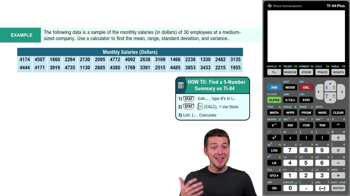
Find 5-Number Summary - TI-84 Calculator Example 1

Variance and Standard Deviation

Variance quantifies the degree to which data points differ from the mean, while standard deviation is the square root of variance, providing a measure of spread in the same units as the data. Both metrics are essential for understanding the distribution of data and how much individual data points deviate from the average.
Recommended video:
Guided course
08:45
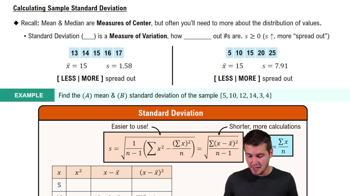
Calculating Standard Deviation

Impact of Outliers

Outliers are data points that significantly differ from other observations in a dataset. Their presence can greatly affect measures of central tendency and variability, such as the mean, variance, and standard deviation, leading to potentially misleading interpretations of the data's overall characteristics.
Recommended video:
Guided course
04:48
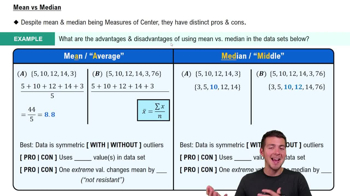
Comparing Mean vs. Median
Related Practice