
Ch. 3 - Describing, Exploring, and Comparing Data
Triola - Elementary Statistics 14th Edition
Triola14th EditionElementary StatisticsISBN: 9780137366446Not the one you use?Change textbook
Chapter 3, Problem 3.1.35a

Degrees of Freedom Five recent U.S. presidents had a mean age of 56.2 years at the time of their inauguration. Four of these ages are 64, 46, 54, and 47.


a. Find the missing value.

Verified step by step guidance
1
Step 1: Recall the formula for the mean: \( \text{Mean} = \frac{\text{Sum of all values}}{\text{Number of values}} \). In this case, the mean age is given as 56.2 years, and there are 5 values in total.
Step 2: Represent the missing value as \( x \). The sum of all ages can be expressed as \( 64 + 46 + 54 + 47 + x \). Substitute the mean and the number of values into the formula: \( 56.2 = \frac{64 + 46 + 54 + 47 + x}{5} \).
Step 3: Multiply both sides of the equation by 5 to eliminate the denominator: \( 56.2 \times 5 = 64 + 46 + 54 + 47 + x \).
Step 4: Calculate the sum of the known ages: \( 64 + 46 + 54 + 47 \). Subtract this sum from \( 56.2 \times 5 \) to isolate \( x \).
Step 5: Solve for \( x \), which represents the missing age. This will give you the missing value needed to complete the set of ages.

Verified video answer for a similar problem:

This video solution was recommended by our tutors as helpful for the problem above.
Video duration:
1m
Was this helpful?

Key Concepts

Here are the essential concepts you must grasp in order to answer the question correctly.

Mean

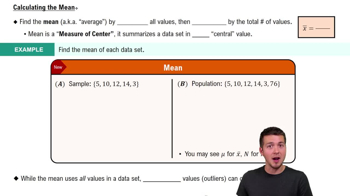
The mean is the average of a set of values, calculated by summing all the values and dividing by the number of values. In this context, the mean age of the five presidents is given as 56.2 years, which serves as a reference point to find the missing age. Understanding how to manipulate the mean is crucial for solving the problem.
Recommended video:
Guided course
04:52
Calculating the Mean

Degrees of Freedom

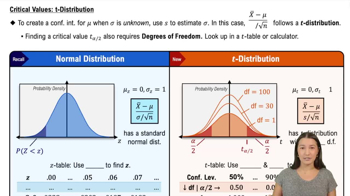
Degrees of freedom refer to the number of independent values or quantities that can vary in a statistical calculation. In this case, with five presidents, the degrees of freedom are relevant when calculating the mean, as knowing four ages allows us to determine the fifth. This concept is essential for understanding how constraints affect statistical calculations.
Recommended video:
05:50
Critical Values: t-Distribution

Solving for a Variable

Solving for a variable involves rearranging an equation to isolate the variable of interest. In this scenario, we need to find the missing age by setting up an equation based on the mean. This process requires basic algebraic skills to manipulate the equation correctly and derive the unknown value.
Recommended video:
Guided course
07:09
Intro to Random Variables & Probability Distributions
Related Practice
Textbook Question

z Scores. In Exercises 5–8, express all z scores with two decimal places.


Diastolic Blood Pressure of Females For the diastolic blood pressure measurements of females listed in Data Set 1 “Body Data” in Appendix B, the highest measurement is 98 mm Hg. The 147 diastolic blood pressure measurements of females have a mean of 70.2 mm Hg and a standard deviation of 11.2 mm Hg.


b. How many standard deviations is that [the difference found in part (a)]?

Textbook Question

Boxplot Using the same differences from Exercise 1, construct a boxplot and include the values of the 5-number summary.

1
views
Textbook Question

z Scores. In Exercises 5–8, express all z scores with two decimal places.


New York City Commute Time New York City commute times (minutes) are listed in Data Set 31 “Commute Times” in Appendix B. The 1000 times have a mean of 42.6 minutes and a standard deviation of 26.2 minutes. Consider the commute time of 95.0 minutes.


b. How many standard deviations is that [the difference found in part (a)]?

Textbook Question

z Scores. In Exercises 5–8, express all z scores with two decimal places.


New York City Commute Time New York City commute times (minutes) are listed in Data Set 31 “Commute Times” in Appendix B. The 1000 times have a mean of 42.6 minutes and a standard deviation of 26.2 minutes. Consider the commute time of 95.0 minutes.


a. What is the difference between the commute time of 95.0 minutes and the mean commute time?

Textbook Question

z Scores. In Exercises 5–8, express all z scores with two decimal places.


Diastolic Blood Pressure of Females For the diastolic blood pressure measurements of females listed in Data Set 1 “Body Data” in Appendix B, the highest measurement is 98 mm Hg. The 147 diastolic blood pressure measurements of females have a mean of 70.2 mm Hg and a standard deviation of 11.2 mm Hg.


a. What is the difference between the highest diastolic blood pressure and the mean of the diastolic blood pressures for females?

Textbook Question

Why Divide by ? Let a population consist of the values 9 cigarettes, 10 cigarettes, and 20 cigarettes smoked in a day (based on data from the California Health Interview Survey). Assume that samples of two values are randomly selected with replacement from this population. (That is, a selected value is replaced before the second selection is made.)

b. After listing the nine different possible samples of two values selected with replacement, find the sample variance (which includes division by ) for each of them; then find the mean of the nine sample variances s2.