Ch. 2 - Exploring Data with Tables and Graphs
Triola - Elementary Statistics 14th Edition
Triola14th EditionElementary StatisticsISBN: 9780137366446Not the one you use?Change textbook
Chapter 2, Problem 2.1.10

In Exercises 9–12, using a loose interpretation of the criteria for determining whether a frequency distribution is approximately a normal distribution, determine whether the given frequency distribution is approximately a normal distribution. Give a brief explanation.
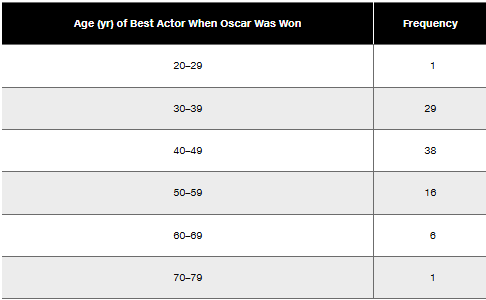
Best Actors Refer to the frequency distribution from Exercise 6
Table showing the age distribution of Best Actors when they won an Oscar, with frequency counts for each age range.

Verified step by step guidance
1
Step 1: Observe the frequency distribution table provided. The table lists the age ranges of Best Actor winners and their corresponding frequencies. The age ranges are 20–29, 30–39, 40–49, 50–59, 60–69, and 70–79, with frequencies of 1, 29, 38, 16, 6, and 1 respectively.
Step 2: Check for symmetry in the frequency distribution. A normal distribution typically has a bell-shaped curve, meaning the frequencies should increase to a peak and then decrease symmetrically. Here, the frequencies increase from 1 to 38 and then decrease to 1, suggesting some symmetry.
Step 3: Evaluate the peak of the distribution. The highest frequency occurs in the 40–49 age range, which is the center of the distribution. This aligns with the characteristic of a normal distribution where the peak is at the center.
Step 4: Assess the spread of frequencies. In a normal distribution, the frequencies should taper off gradually on both sides of the peak. In this case, the frequencies decrease from 38 to 16, then to 6, and finally to 1, which suggests a gradual tapering.
Step 5: Conclude whether the distribution is approximately normal. Based on the symmetry, central peak, and gradual tapering of frequencies, the distribution appears to be approximately normal. However, the small frequencies at the extremes (20–29 and 70–79) may slightly deviate from a perfect normal distribution.

Verified video answer for a similar problem:

This video solution was recommended by our tutors as helpful for the problem above.
Video duration:
3m
Was this helpful?

Key Concepts

Here are the essential concepts you must grasp in order to answer the question correctly.

Normal Distribution

A normal distribution is a probability distribution that is symmetric about the mean, showing that data near the mean are more frequent in occurrence than data far from the mean. It is characterized by its bell-shaped curve, where the mean, median, and mode are all equal. Understanding this concept is crucial for determining if a frequency distribution approximates a normal distribution.
Recommended video:
Guided course
09:47
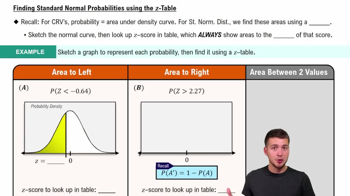
Finding Standard Normal Probabilities using z-Table

Frequency Distribution

A frequency distribution is a summary of how often each value occurs in a dataset. It can be represented in a table or graph, showing the number of occurrences (frequency) for each category or range of values. Analyzing the frequency distribution helps in assessing the shape and spread of the data, which is essential for evaluating normality.
Recommended video:
Guided course
06:38
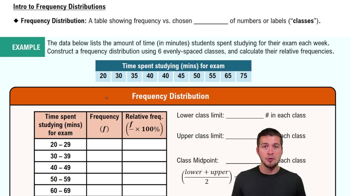
Intro to Frequency Distributions

Criteria for Normality

The criteria for determining whether a distribution is approximately normal include assessing the symmetry of the distribution, the presence of a single peak (unimodality), and the tails of the distribution. A loose interpretation may involve checking if the data roughly follows a bell shape and if the frequencies taper off symmetrically from the center. These criteria guide the evaluation of the given frequency distribution.
Recommended video:
Guided course
09:47
Finding Standard Normal Probabilities using z-Table