Ch. 2 - Exploring Data with Tables and Graphs
Triola - Elementary Statistics 14th Edition
Triola14th EditionElementary StatisticsISBN: 9780137366446Not the one you use?Change textbook
Chapter 2, Problem 2.4.4c

Estimating r For each of the following, estimate the value of the linear correlation coefficient r for the given paired data obtained from 50 randomly selected adults.


c. Their pulse rates are measured and their IQ scores are measured .

Verified step by step guidance
1
Understand the problem: The goal is to estimate the linear correlation coefficient (r), which measures the strength and direction of the linear relationship between two variables. Here, the variables are pulse rates and IQ scores for 50 adults.
Visualize the data: Create a scatterplot of the paired data (pulse rates on one axis and IQ scores on the other). This will help you observe the pattern of the relationship (e.g., positive, negative, or no correlation).
Assess the direction of the relationship: Look at the scatterplot to determine if the points trend upward (positive correlation), downward (negative correlation), or show no clear trend (no correlation).
Evaluate the strength of the relationship: Observe how closely the points cluster around a straight line. If the points are tightly clustered, the correlation is strong. If they are widely scattered, the correlation is weak.
Estimate the value of r: Based on the scatterplot, assign an approximate value to r. Recall that r ranges from -1 to 1, where values close to -1 or 1 indicate strong negative or positive correlation, respectively, and values near 0 indicate no correlation.

Verified video answer for a similar problem:

This video solution was recommended by our tutors as helpful for the problem above.
Video duration:
3m
Was this helpful?

Key Concepts

Here are the essential concepts you must grasp in order to answer the question correctly.

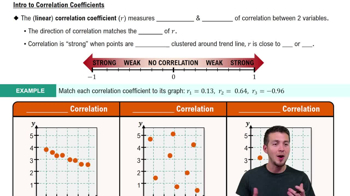
Linear Correlation Coefficient (r)

The linear correlation coefficient, denoted as r, quantifies the strength and direction of a linear relationship between two variables. Its value ranges from -1 to 1, where 1 indicates a perfect positive correlation, -1 indicates a perfect negative correlation, and 0 indicates no correlation. Understanding r is crucial for interpreting the relationship between pulse rates and IQ scores in the given data.
Recommended video:
Guided course
05:43
Correlation Coefficient

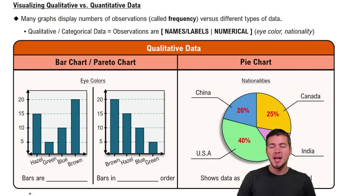
Paired Data

Paired data refers to two sets of related observations, where each pair consists of one measurement from each variable. In this context, each adult's pulse rate is paired with their corresponding IQ score. Analyzing paired data allows for the examination of potential relationships or correlations between the two variables, which is essential for estimating r.
Recommended video:
Guided course
04:39
Visualizing Qualitative vs. Quantitative Data

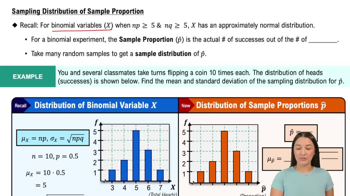
Random Sampling

Random sampling is a technique used to select a subset of individuals from a larger population, ensuring that every individual has an equal chance of being chosen. This method helps to eliminate bias and allows for generalization of results. In this question, the pulse rates and IQ scores are obtained from 50 randomly selected adults, which enhances the validity of the correlation analysis.
Recommended video:
05:11
Sampling Distribution of Sample Proportion
Related Practice
Textbook Question

In Exercises 1–5, use the data listed in the margin, which are magnitudes (Richter scale) and depths (km) of earthquakes from Data Set 24 “Earthquakes” in Appendix B

[Image]

Frequency Distribution For the frequency distribution from Exercise 1, find the following.


a. Class limits of the first class

b. Class boundaries of the first class

c. Class midpoint of the first class

1
views
Textbook Question

In Exercises 1–5, use the data listed in the margin, which are magnitudes (Richter scale) and depths (km) of earthquakes from Data Set 24 “Earthquakes” in Appendix B

Frequency Distribution Construct a frequency distribution of the magnitudes. Use a class width of 0.50 and use a starting value of 1.00.

1
views
Textbook Question

Estimating r For each of the following, estimate the value of the linear correlation coefficient r for the given paired data obtained from 50 randomly selected adults.


a. Their heights are measured in inches and those same heights are recorded in centimeters .

Textbook Question

Interpreting Normal Quantile Plots Which of the following normal quantile plots appear to represent data from a population having a normal distribution? Explain.


a. " style="" width="380">

Textbook Question

Body Temperatures Listed below are the temperatures from nine males measured at 8 AM and again at 12 AM (from Data Set 5 “Body Temperatures” in Appendix B). Construct a scatterplot. Based on the graph, does there appear to be a relationship between 8 AM temperatures and 12 AM temperatures?

Textbook Question

In Exercises 1–5, use the data listed in the margin, which are magnitudes (Richter scale) and depths (km) of earthquakes from Data Set 24 “Earthquakes” in Appendix B


Histogram Construct the histogram corresponding to the frequency distribution from Exercise 1. For the values on the horizontal axis, use the class midpoint values. Which of the following comes closest to describing the distribution: uniform, normal, skewed left, skewed right?


3
views