Ch. 12 - Analysis of Variance
Triola - Elementary Statistics 14th Edition
Triola14th EditionElementary StatisticsISBN: 9780137366446Not the one you use?Change textbook
Chapter 12, Problem 12.2.11d

Transformations of Data Example 1 illustrated the use of two-way ANOVA to analyze the sample data in Table 12-3. How are the results affected in each of the following cases?


d. The first sample value in the first cell is changed so that it becomes an outlier.

Verified step by step guidance
1
Understand the context of the problem: Two-way ANOVA is used to analyze the effects of two independent variables on a dependent variable, as well as their interaction. Outliers can significantly affect the results of statistical tests, including ANOVA, by distorting the means and increasing variability.
Identify the specific change: The problem states that the first sample value in the first cell is altered to become an outlier. This means the value is now significantly different from the other values in the same group or cell.
Consider the impact on assumptions: Two-way ANOVA assumes normality and homogeneity of variances. An outlier can violate these assumptions by skewing the data distribution or inflating the variance within a group.
Analyze the potential effects on results: The presence of an outlier can lead to misleading F-statistics, as it may artificially increase the within-group variance (denominator of the F-ratio) or distort the group means (numerator of the F-ratio). This can affect the significance of main effects and interaction effects.
Suggest a course of action: To address the outlier, consider using robust statistical methods, transforming the data (e.g., log transformation), or conducting a sensitivity analysis to determine how the results change with and without the outlier. Additionally, verify the assumptions of ANOVA after the outlier is introduced.

Verified video answer for a similar problem:

This video solution was recommended by our tutors as helpful for the problem above.
Video duration:
5m
Was this helpful?

Key Concepts

Here are the essential concepts you must grasp in order to answer the question correctly.

Two-Way ANOVA

Two-way ANOVA (Analysis of Variance) is a statistical method used to determine the effect of two independent categorical variables on a continuous dependent variable. It helps in understanding how different groups interact and whether the means of the groups are significantly different from each other. This technique is particularly useful when analyzing complex datasets with multiple factors.
Recommended video:
Guided course
03:50
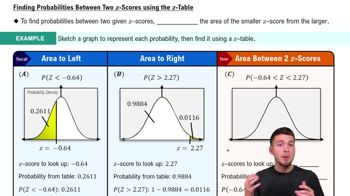
Probabilities Between Two Values

Outliers

Outliers are data points that differ significantly from other observations in a dataset. They can skew results and affect statistical analyses, such as ANOVA, by influencing the mean and variance. Identifying and understanding the impact of outliers is crucial, as they can lead to misleading conclusions if not properly addressed.
Recommended video:
Guided course
04:48
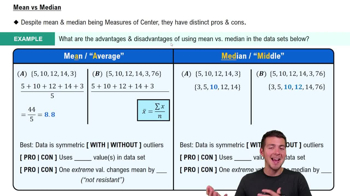
Comparing Mean vs. Median

Effect on ANOVA Results

The presence of an outlier can significantly affect the results of an ANOVA test by increasing the variability within groups, which may lead to a Type I error (false positive) or Type II error (false negative). This alteration can change the F-statistic and p-values, potentially leading to incorrect interpretations of the data. Understanding how outliers influence ANOVA is essential for accurate data analysis.
Recommended video:
Guided course
07:19
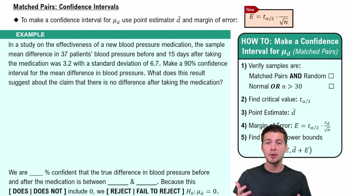
Matched Pairs: Confidence Intervals