
Birth Weights The table below lists some of the same data used in the preceding exercise, but the seven days of the week are combined into weekday (Monday, Tuesday, Wednesday, Thursday, Friday) and weekend days (Saturday, Sunday). Also, the birth weights are converted to kilograms. What do you conclude?
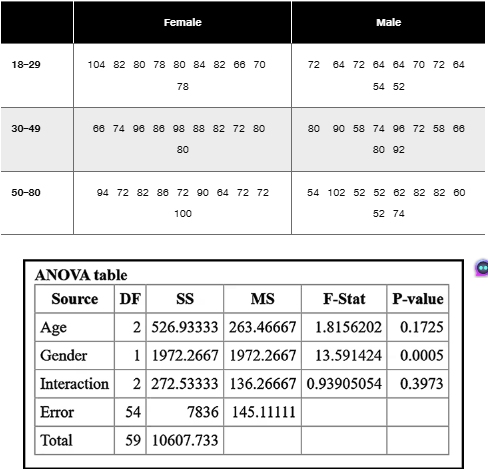
Pulse Rates Shown below are pulse rates from Data Set 1 “Body Data” in Appendix B, and the StatCrunch display from two-way analysis of variance of these data. In analyzing these data, what important feature is addressed with two-way analysis of variance that is not addressed with two separate tests of (1) difference between mean pulse rates based on gender, or (2) differences among the mean pulse rates in the different age brackets?

Verified step by step guidance
Verified video answer for a similar problem:
Key Concepts
Two-Way Analysis of Variance (ANOVA)
Interaction Effect
Main Effects vs. Interaction
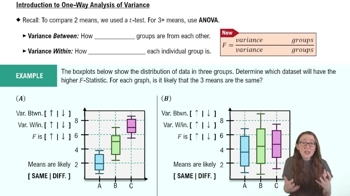
One vs. Two What is the fundamental difference between one-way analysis of variance and two-way analysis of variance?
In Exercises 1–4, use the following listed measured amounts of chest compression (mm) from car crash tests (from Data Set 35 “Car Data” in Appendix B). Also shown are the SPSS results from analysis of variance. Assume that we plan to use a 0.05 significance level to test the claim that the different car sizes have the same mean amount of chest compression.
Anova
a. What characteristic of the data above indicates that we should use one-way analysis of variance?
Interaction
b. If there does appear to be an interaction between gender and age bracket, how should we continue with the procedure for two-way analysis of variance?
Birth Weights Data Set 6 “Births” includes birth weights (g), hospitals, and the day of the week that mothers were admitted to the hospital. Using rows to represent the four hospitals (Albany Medical Center, Bellevue Hospital Center, Olean General Hospital, Strong Memorial Hospital), and using columns to represent the seven different days of the week, a two-way table has 28 individual cells. Using five birth weights for each of those 28 cells and using StatCrunch for two-way analysis of variance, we get the results displayed below. What do you conclude?
Gender and Age Bracket Based on the display included with Exercise 8, what are the final conclusions?
