Ch. 10 - Correlation and Regression
Triola - Elementary Statistics 14th Edition
Triola14th EditionElementary StatisticsISBN: 9780137366446Not the one you use?Change textbook
Chapter 10, Problem 10.1.6

Interpreting r
In Exercises 5–8, use a significance level of α = 0.05 and refer to the accompanying displays.
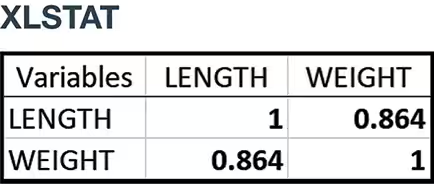
Bear Length and Weight The lengths (inches) and weights (pounds) of 54 bears are obtained from Data Set 18 “Bear Measurements” in Appendix B, and results are shown in the accompanying XLSTAT display. Is there sufficient evidence to support the claim that there is a linear correlation between length and weight?

Verified step by step guidance
1
Step 1: Identify the correlation coefficient (r) from the provided XLSTAT display. The correlation coefficient between LENGTH and WEIGHT is given as 0.864.
Step 2: State the null hypothesis (H₀) and the alternative hypothesis (H₁). H₀: There is no linear correlation between LENGTH and WEIGHT (r = 0). H₁: There is a linear correlation between LENGTH and WEIGHT (r ≠ 0).
Step 3: Determine the significance level (α). The problem specifies α = 0.05, which is the threshold for deciding whether to reject the null hypothesis.
Step 4: Use the sample size (n = 54) and the correlation coefficient (r = 0.864) to calculate the test statistic. The formula for the test statistic is t = r * sqrt((n - 2) / (1 - r²)). Substitute the values into the formula to compute t.
Step 5: Compare the calculated t-value to the critical t-value from the t-distribution table with degrees of freedom (df = n - 2 = 54 - 2 = 52) at α = 0.05. If the calculated t-value exceeds the critical t-value, reject the null hypothesis and conclude that there is sufficient evidence to support the claim of a linear correlation between LENGTH and WEIGHT.

Verified video answer for a similar problem:

This video solution was recommended by our tutors as helpful for the problem above.
Video duration:
6m
Was this helpful?

Key Concepts

Here are the essential concepts you must grasp in order to answer the question correctly.

Correlation Coefficient (r)

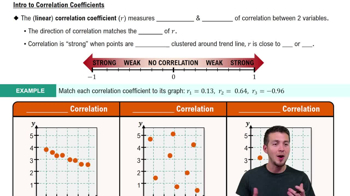
The correlation coefficient, denoted as 'r', quantifies the strength and direction of a linear relationship between two variables. It ranges from -1 to 1, where values close to 1 indicate a strong positive correlation, values close to -1 indicate a strong negative correlation, and values around 0 suggest no linear correlation. In this case, an r value of 0.864 suggests a strong positive correlation between bear length and weight.
Recommended video:
Guided course
05:43
Correlation Coefficient

Significance Level (α)

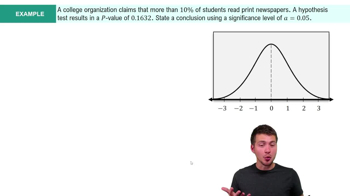
The significance level, often denoted as α, is a threshold used in hypothesis testing to determine whether to reject the null hypothesis. A common significance level is 0.05, which implies that there is a 5% risk of concluding that a correlation exists when there is none. In this context, it will help assess whether the observed correlation between length and weight is statistically significant.
Recommended video:
Guided course
04:46
Step 4: State Conclusion Example 4

Hypothesis Testing

Hypothesis testing is a statistical method used to make inferences about a population based on sample data. It involves formulating a null hypothesis (no correlation) and an alternative hypothesis (there is a correlation), then using statistical tests to determine if the data provides sufficient evidence to reject the null hypothesis. In this scenario, the goal is to evaluate if the correlation between bear length and weight is statistically significant at the α = 0.05 level.
Recommended video:
Guided course
06:21
Step 1: Write Hypotheses